Published
Aug 23, 2026 8:01 AM EDT
Get the Popular Science daily newsletter💡
Breakthroughs, discoveries, and DIY tips sent six days a week.
In Ecuador’s Chocó Andino de Pichincha Biosphere Reserve, a 709,192-acre biodiversity hotspot northwest of Quito, hummingbirds thrive. The country is home to roughly 132 of the world’s 320-plus hummingbird species. On a single afternoon in the reserve’s Mashpi Cloud Forest, you might see a couple dozen of these species, from tiny green thorntails to velvet-purple coronets.
The brilliant-colored avians dart and whizz between feeders, flying forwards, backwards, and in some cases, upside down. They’re dazzling to watch, but also incredible to hear. Their soft hums sound like little motors that, together, create a sort of natural symphony. But where does this distinct “buzz” come from? Or, to put it more bluntly, why do hummingbirds hum?
To find out more about hummingbirds and their iconic sound effects, Popular Science turned to Tatiana Santander, a senior project coordinator for Aves y Conservación (Birds and Conservation), which conducts research and environmental education projects in Ecuador’s Mashpi Reserve.
Hummingbirds are small, colorful avians native to the Americas. They’re incredibly unique. These tiny, fast-flying birds feature specialized anatomy, an ultra-quick metabolism, and one-of-a-kind flight mechanics that all result from coevolution: a reciprocal process when two or more species continuously adapt to each other. In this case, hummingbirds and flowers.
“For example,” says Santander, “hummingbirds have evolved with long bills and a long tongue that is bifurcate,” or split in two. These features make it easier for hummingbirds to feed on nectar from flowers that specifically fit their elongated beak and specialized tongue. At the same time, the flowers’ tubular shapes keep most insects from getting to the nectar first.
Hummingbirds have also developed a distinct flight pattern to feed on brightly colored, nectar-rich blooms like salvia and tiny blue vervain. It’s another example of coevolution.
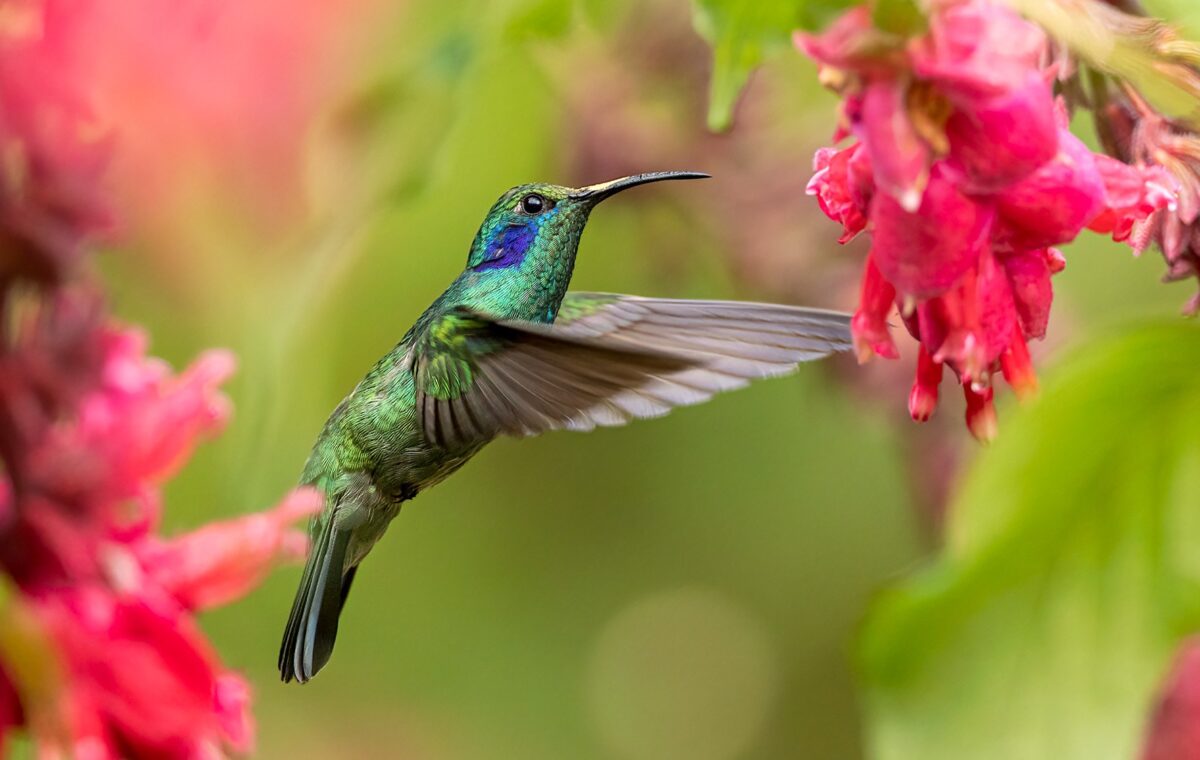
“Hummingbirds are the only birds that can fly in all directions, even backwards,” says Santander. They also hover to eat. “Many hummingbirds can flap their wings over 80 times per second. It’s crazy!” In contrast, an average bird—like a gull or a sparrow—flaps its wings much slower: typically between three to 15 times per second, depending on the bird’s size.
“This kind of life, the constant hovering,” says Santander, is very demanding on hummingbirds’ metabolisms. “Their muscles need a lot of oxygen,” she says, “so they have to keep eating all day.”
The sugar-rich nectar they consume delivers food directly to their flight muscles, where cell parts known as mitochondria use oxygen to break down the sugar and generate energy. In fact, hummingbirds consume half to multiple times their body weight daily. Along with nectar, this includes tree sap and small insects. “This is like if we [would] eat about 300 hamburgers a day!”
Rather than flapping their wings up and down like most birds, hummingbirds rotate their wings in a constant figure-eight motion. They also have flexible shoulders that allow them to turn their wings nearly 180 degrees. Think of them like little biological helicopters.
By continuously changing the angle of their wings, hummingbirds create pressure differences akin to miniature tornado-like vortices of air. These generate the lift (a.k.a. the upward force) and thrust—the ability to move forward—they need to hover, fly, or even stay stationary. In contrast, most birds only get lift by pushing their wings down.
It’s this rapid shifting of air pressure that creates a hummingbird’s distinct “hum.” This signature buzzing sound differs from the “woosh” that you’ll hear from larger birds, like swans or geese. Instead, hummingbirds’ buzzing creates one, continuous acoustic tone that varies according to the specific species.