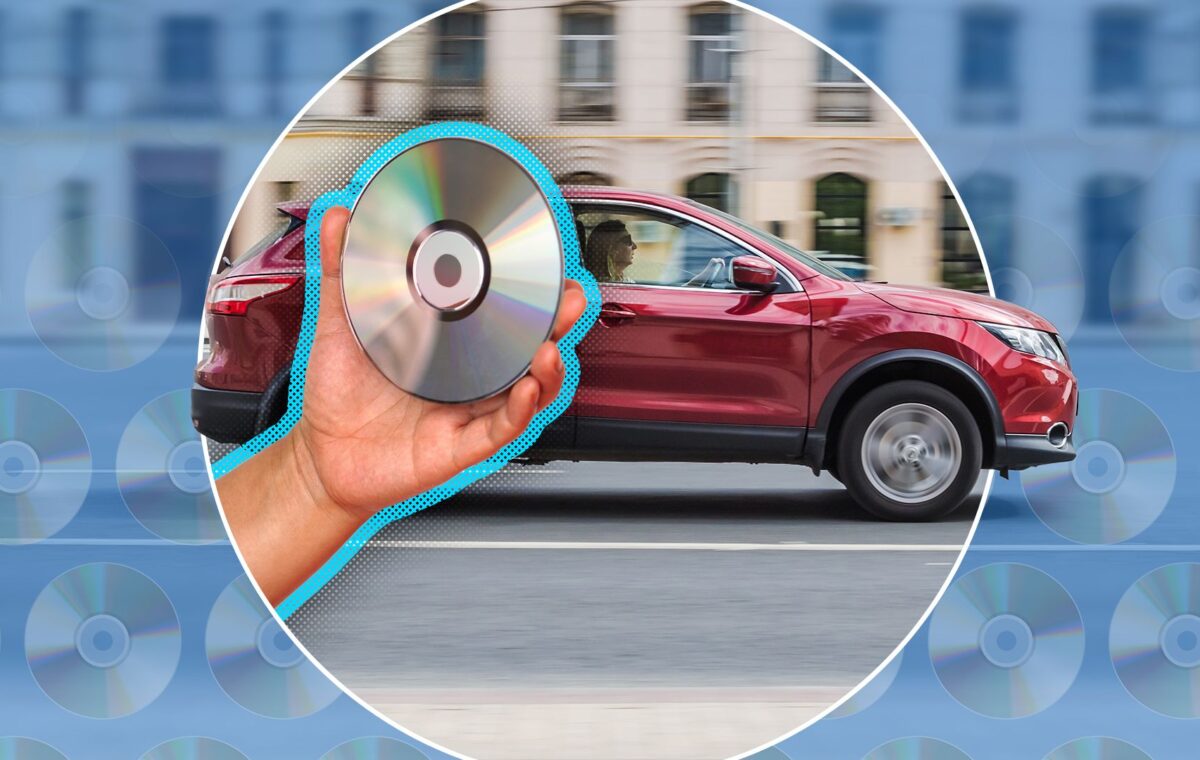
If you own even a moderately modern car, you may not have a CD player in your vehicle at all, but that doesn't mean you can't find some way to enjoy your high quality audio collection on the road.
Modern cars may not have built-in CD players, but they do support Bluetooth! So if you get a portable CD player with Bluetooth, you can still listen to your records in your car.
The main drawback of this is that you lose the CD quality audio, which for many people will be the point, but if you just want access to your music in your car, this is a simple solution.
This also depends on the specific Bluetooth codec in use. If your player and stereo support LDAC or aptX HD, you probably won't notice. But both the stereo and player need to support these high-quality Bluetooth codecs for it to work.
Using a regular portable player can work well, but there are portable CD players with Bluetooth designed specifically for car use, and these can often be mounted inside your glove box or in a center console compartment, under the armrest, for example.
I don't see auxiliary audio ports in modern cars as much anymore, probably because phones have done away with their headphone jacks, so people don't really have anything to plug into them. However, if your car's head unit has a 3.5mm stereo input, then you can use pretty much any portable CD player to play your CDs in your car.
The main downsides are twofold—first, you can't control the disc's playback while driving, so a passenger will have to do it. Second, you now have a cable trailing out of your car stereo. The upside is that you'll get that full, glorious CD-quality audio.
If you want to use the auxiliary audio port as a more permanent CD player solution, then one of those aforementioned portable car CD players with some good cable management might do the trick. Some cars (like my old Yaris) don't have the jack on the front plate of the head unit, but down low on the center console. This makes it much easier to have a neat cable arrangement.
Hyundai is challenging one of Toyota’s biggest advantages—and the numbers back it up.
While using Bluetooth or a 3.5mm stereo cable can work with any type of portable CD player that supports these options, those dedicated car CD players have another trick up their sleeve.
The player connects to the USB port for your stereo, where you would usually insert something like a flash drive containing music. The player makes a copy of the CD in its internal memory, and your stereo sees it as a USB storage device containing audio data.
So you're not listening to the live audio from the disc, but a lossless buffered version held by the player. This gives you the best of all worlds, though it might not be as instantaneous as a regular CD player. As a bonus, you can, of course, control playback as usual, because to the stereo each track simply looks like a file.
Of course, this will only work on head units that can play audio files from a USB drive, and the player and the head unit need to support the same format. So, if the player creates WAV files, your player must support them. Some players may create other formats, but in any event your stereo needs to pick up what the CD player is putting down.
If you don't mind doing a little prep work, you can actually play your CD collection at full quality in your car without even taking your CDs with you. Instead, you can use software on your computer, combined with an optical drive, of course, to make lossless digital copies of your music.
A typical CD uses about 650-700MB of data, and if you digitize it without compressing it, that might sound like a lot. However, that means you can fit around 180 lossless CD rips on a 128GB flash drive. It's common for modern car stereos to support media playback through a USB port, so in many ways this is the best of all worlds. Other than the hassle and that you can't just decide to listen to a CD in your car without some prep.