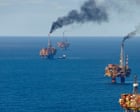
North Sea oil, once the driving force of the UK economy, may be dwindling but it remains a symbol of prestige and a rich resource for political debate
When oil was first discovered off the north-east coast of Scotland in September 1969, industry folklore has it that the duty superintendent on the rig carefully poured it into a pickle jar commandeered from the canteen and took it back to Amoco’s Great Yarmouth office in Norfolk. There, it was emptied into an ash tray, sniffed and then set alight.
From that modest start, North Sea oil – as the huge basin of oil and gas reserves quickly became known – emerged as a driving force of the British economy and a symbol of national power and renewal as the UK emerged from the Opec oil crisis.
By 1977, the then Labour prime minister, Jim Callaghan, declared: “God has given Britain her best opportunity for 100 years in the shape of North Sea oil.” A subsequent white paper said it offered “a unique opportunity for Britain to improve her economic performance, raise her living standards, move forward to full employment, and develop a socially just society”.
A decade later, the basin became a central part of Margaret Thatcher’s political project , with its revenues approaching 10% of the UK’s total tax take at times, supporting a programme of tax cuts and privatisation.
Output peaked at the turn of the century, when the basin produced a staggering 4.4m barrels of oil equivalent a day. Aberdeen, chosen over Dundee by the fossil fuel corporations for their onshore headquarters because it had fewer links to bothersome trade unions, was booming, with offshore jobs plentiful and well paid.
Ewan Gibbs, a specialist in the history of energy in the UK at the University of Glasgow, said that as the oil began to flow, it was seized upon by politicians and the public as a symbol of British imperial might.
“At its peak, oil was associated not only with immense wealth but also with power and international prestige,” said Gibbs. “It came to embody a sense of national renewal.”
Now, those boom years are firmly in the past. The amount of economically viable oil and gas has declined rapidly in the past two decades and by 2030 the basin will produce just 15% of its peak output.
Many of the biggest oil and gas corporations have left as stocks dwindle – BP was the latest, announcing this summer an end to six decades in the basin. And the jobs are going too. During the boom years, North Sea oil directly employed about 120,000 people and supported hundreds of thousands more jobs indirectly. Data from the Office for National Statistics suggests that figure has now dropped to about 27,000 direct employees.
However, although its economic significance has waned, the idea of North Sea oil has retained a disproportionate grip on the national psyche, and – as culture wars over the climate crisis continue to be stoked by politicians and media on the right – it remains a useful symbol of sovereignty and power for some.
“Even as it declines, there is still a strong sense for many people that this is Britain’s oil, that it is bountiful and belongs to the country, and that if we don’t exploit it we are turning our back on something important,” said Gibbs.
“It is this emotional attachment, this idea that this is our oil that means, even as the area becomes less economically significant, it retains an outsized importance in the country’s imagination.”
In the run-up to the 2024 general election, the Labour party announced there would be no new exploratory licences for oil and gas in the North Sea.
It was a significant moment in the fight against climate breakdown. In 2021, the International Energy Agency had said there could be “no new investments in oil, gas and coal” if the world was to avoid the worst impacts of the climate crisis. Now, the government of one of the richest countries in the world was making it clear it was moving away from fossil fuels to focus on renewable energy.