You have reached your maximum number of saved items.
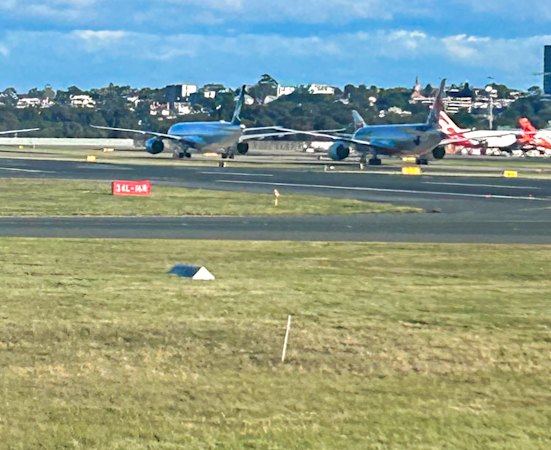
Pilots say a capacity crunch at Sydney Airport’s arrival bays is forcing planes to sit idle on the tarmac after landing, delaying passengers from disembarking at Australia’s busiest airport.
The pilots say the bottleneck is slowing international flights from getting to gates during peak morning hours, 7.30am to 9.30am, resulting in extensive waits on the taxiway and potentially compounding air traffic control issues.
There have been several periods in recent weeks where air traffic control at Sydney Airport has been so short-staffed it has had to delay flights so it can safely manage the airspace around the runways.
But the airport has rejected the pilots’ allegations that as many as a quarter of arrival bays can be out of action at some times, saying it has invested heavily in its facilities. “These claims are false,” a spokesman said.
The pilots interviewed for this story, who work for Australian airlines, asked that their names not be published because they were not authorised to speak on the topic.
“Every morning during peak times multiple aircraft wait for as long as 90 minutes for a bay or parking position,” said one commercial pilot, who frequently flies in and out of Sydney. He blamed the waits on “the lack of capacity at Sydney” and the “parlous state of [its] infrastructure”.
A second commercial pilot claimed that waits of half an hour were common. “The real busy time is 8am,” he said. “That’s when we start seeing aircraft sitting out waiting for bays.”
Sydney Airport typically manages up to about 500 arrivals and departures daily, largely in the hours outside its 11pm-to-6am curfew.
Throughout the day, arrivals, departures, towing operations and gate availability are continuously managed by airlines, air traffic services, ground handlers and the airport operators, the airport said.
When parked at a bay, planes can usually switch their power to a supply provided on the ground, avoiding burning fuel to run their auxiliary power units (APUs), which are needed when stuck on taxiways. At the bays they can also switch to air-conditioning ducted from a ground source, called pre-conditioned air.
Pilots say the planes’ extensive waits on the taxiway can also lead to higher carbon emissions.
The first pilot, who has flown extensively nationally and internationally, said he believed that nearly a quarter of Sydney’s international gates didn’t have consistently functioning ground power units (GPUs) or ground-supplied air-conditioning. “Many of [Sydney’s] bays … have no ground power or air available, and those that do are often unserviceable,” he said.
“We can’t shut down the APU unless the ground power works and conditioned ground air is available.”
This results in planes burning jet fuel to keep the cabin lights and air-conditioning on.