Guardian journalism is independent. We earn a commission if you buy something through an affiliate link. Learn more.
If you want to maintain the integrity of your camembert, specialty products work – but you may already have a solution at home
The Anyday glass food containers transformed how I store leftovers
Sign up for the Filter US newsletter, your weekly guide to buying fewer, better things
Fine cheeses can easily cost more per pound than steak, so unwrapping a long-anticipated treat to discover a science experiment gone wrong can be horrifying. A perfectly ripe cheese can be a transcendent eating experience, but what is the best way to manage that aging window? Storing cheese improperly can negatively affect taste and texture, and can hasten the growth of bad mold. Proper storage can preserve the product for weeks and even go so far as to encourage the good, naturally occurring mold to grow back.
By keeping factors such as moisture retention, breathability and flavor impact in mind, you can store cheese to keep it tasting as good as possible, for as long as possible. So is cheese storage really necessary? In short, yes, depending on your habits. If you’re looking to give your Humboldt Fog double the shelf life, then forget what you know about cheese storage and take a look at some of the products below.
To gain some insight into how the world of cheese professionals store their cheese, we talked with Emilia D’Albero, ACS CCP, a member of Guilde Internationale des Fromagers and Meilleure Fromagère du Monde 2025. (Full disclosure: among her other titles, D’Albero is the sales and marketing manager at Formaticum, which is one of the brands in our roundup.) When asked about what makes a cheese storage method effective, she said: “The two key elements are breathability and humidity … It allows the cheese to breathe because, remember, cheese is a living product. It needs oxygen … so [proper storage] allows the cheese to breathe but also maintains the right amount of humidity in the package.”
We decided to dive deeper into the mechanics of cheese and spoke with Michael Tunick, PhD, an adjunct professor of food science at Drexel University, and the author of The Science of Cheese. “Cheese is a living object,” says Tunick. If it’s just stored in plastic, he explains, “eventually microbes will die out so you are not getting more flavor development. If you are going to keep it for a while … then it ages better when there is some sort of ventilation.” As cheese ages, the microbes change over time. “I just saw an article about an English cheese [that] had over a thousand species in there,” Tunick says.
Not all microbes are a benefit, however. While there are many cheeses where molds are purposely introduced, for example to add flavor in blue cheese, Tunick says that if you see green or pink mold growing on the outside of your cheese, you should be wary. If it’s on a hard cheese, you can just cut off the mold and continue to eat it. With soft cheeses, the mold can grow deep inside – if you see green or pink mold growing on a wedge of camembert, for instance, play it safe and throw it away.
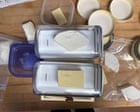
Over the course of two months, we tested brie and cheddar in nine different storage methods. We wanted to look at how well they worked for different types of cheeses while simulating normal storage and use conditions. To minimize variables, we used samples of brie and cheddar from the same wheel and block, respectively. We stored them in a consumer-grade KitchenAid refrigerator in our Dietz & Watson Food Technology Lab in the Drexel Food Lab and regularly opened the refrigerator to simulate normal household use, and to inspect and photograph them.
Throughout the testing, we completed water activity, pH and taste testing, which showed little measurable difference between storage methods. Where we did see significant differences were in appearance, texture and time to spoilage.
According to D’Albero, the go-to storage method in professional environments is cheese paper. Formaticum’s cheese paper is a multi-layered wrap that’s made of polyethylene to create the perfect humid but oxygenated environment that cheese thrives in.
The best performance of any storage method was with Formaticum’s flagship cheese storage paper. The cheese stayed fresh without drying out. The brie saw regrowth of its natural rind on the cut faces, and cheddar didn’t see any unwanted growth for almost two months of storage.
Having to fold the product over the cheese felt slightly awkward at first, but after just a couple of tries, we were able to unwrap and wrap the cheese in just a couple of seconds.
We also tested Zero by Formaticum cheese storage paper, the plastic-free reusable alternative. For anyone prioritizing environmental impact, this Formaticum paper might make more sense than the brand’s flagship product. However, if you are looking just for the best possible performance, the Zero did fall short during our testing. While the cheese didn’t form mold at the eight-week mark, it did dry out more than most other options over a longer storage period. If cheese typically goes fast in your house, the reduction in environmental impact may outweigh this minor concern.