New Delhi: Amara Raja Energy & Mobility is building in-house expertise in nickel manganese cobalt (NMC) battery chemistry after its technology partnership with China-based Gotion fell through, as Beijing’s restrictions on technology transfers made it difficult for the Indian battery maker to secure the technology it needed for lithium-ion cell manufacturing, a top company executive said.
The company had announced a partnership with Gotion in June 2024 to license lithium iron phosphate (LFP) battery technology. LFP and NMC are two cathode chemistries for lithium-ion batteries used in electric vehicles (EVs) and storage systems.
With the Gotion deal unable to provide the required cell manufacturing technology, Amara Raja accelerated investments in its own research and development capabilities and began hiring battery researchers and executives from the US and Europe, executive director Vikramadithya Gourineni said in an interview.
“When we look at NMC, there’s a lot of non-Chinese talent that’s readily available,” Gourineni said. The company looked at the US and at companies such as Tesla and Panasonic, which have large-scale battery manufacturing operations outside China, he said.
“We were able to pick up a couple of people of Indian origin from those kinds of companies,” Gourineni said. Amara Raja also hired talent from smaller, well-funded companies developing NMC technologies.
While Gourineni did not elaborate on the individual talent hired from various geographies, publicly available records show that the company hired Uday Kasavajjula, who was appointed head of cell technologies after working at US-based electric vehicle battery maker Solid Power. Aditya Palthi, head of giga factory and lithium-ion cell manufacturing, joined Amara Raja in September 2024 from Tesla.
“If you look at our R&D team, there’s not a whole lot of traditional Amara Raja talent. Everybody’s from a hardcore lithium background,” Gourineni said. “We keep looking out, trying to find any good talent that’s looking for a change as companies are wrapping up. So, built a pretty good team here in India.”
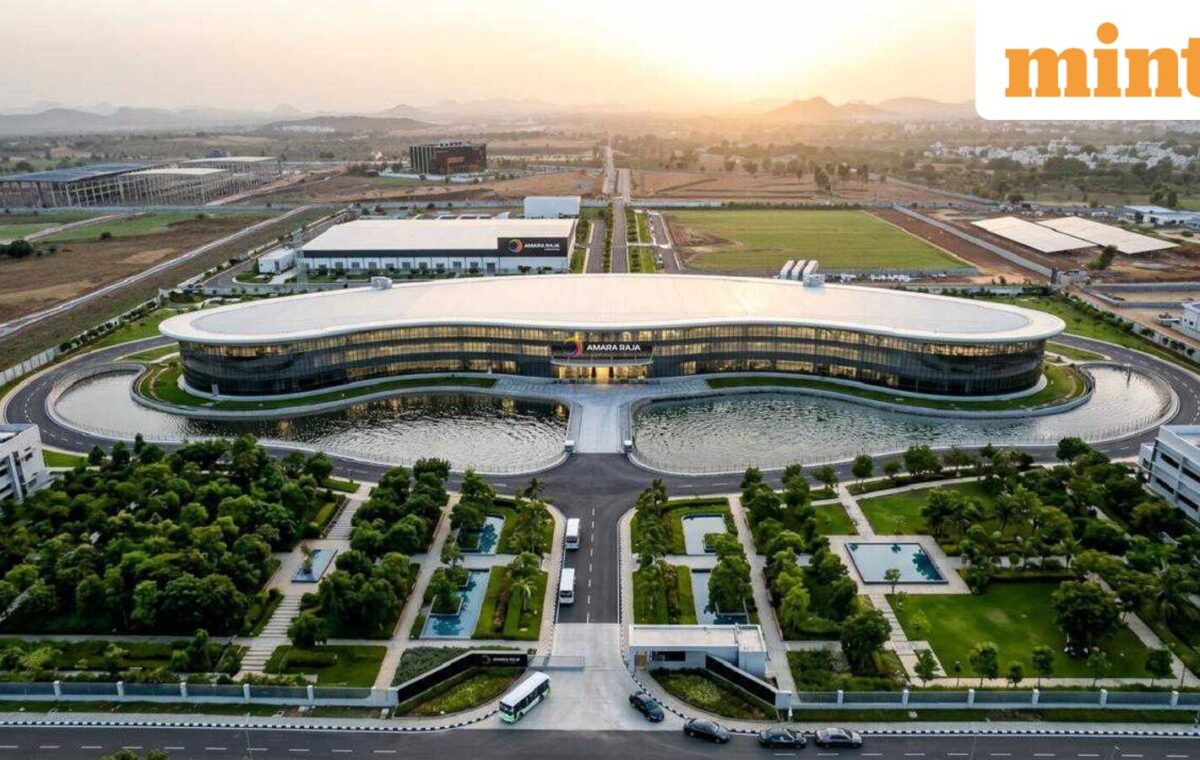
Amara Raja is building a 16 gigawatt-hour (GWh) lithium-ion cell manufacturing plant at Divitipally in Telangana. It plans to begin commercial production with 2 GWh of NMC cell capacity between April and June next year, according to its latest investor presentation dated 10 August.
The company plans to initially target battery energy-storage systems (BESS) before expanding into passenger vehicles, he said.
In an 11 August note, analysts at Nuvama Institutional Equities wrote: “Amara Raja is doubling down on lithium business, with focus on battery packs, cells and BESS segments. These efforts improve long-term growth visibility.”
“BESS can be a notable opportunity considering the boom in renewables and strategic lever for cell capacity,” analysts at Anand Rathi wrote on its bet on stationary cells on 13 August.
Amara Raja had adopted a two-pronged strategy for its cell business since announcing plans for the plant in December 2022: building an in-house technology and R&D team while simultaneously seeking partnerships with technology providers, including Chinese companies.
The difficulty in securing technology through the Gotion partnership ultimately forced the company to accelerate the first part of that strategy.
“I think what we've done between our R&D centre and the CQP is to front-load all of the R&D infrastructure. So, there’s nothing that’s waiting,” Gourineni said, referring to the company’s customer qualification plant, which bridges laboratory development and commercial-scale production.
The shift also comes as India prepares for the emergence of multiple domestic lithium-ion cell manufacturers. Ola Electric has commissioned 1.4 GWh of cell manufacturing capacity and plans to increase this to 6 GWh by September. Reliance Industries, Tata Group’s Agratas and Exide Industries are also preparing to begin commercial production from their respective plants by the end of the current financial year.