By STACY LIBERATORE, US SCIENCE & TECHNOLOGY EDITOR
Published: 16:53 BST, 21 August 2026 | Updated: 16:53 BST, 21 August 2026
A mysterious boat-shaped geological formation in the mountains of eastern Turkey has long been dismissed as nothing more than a solid mass of natural rock.
But an international team investigating the Durupınar Formation near Mount Ararat believes it could contain the remains of Noah’s Ark.
According to the Bible, the massive vessel saved Noah, his family and every kind of animal from annihilation during a catastrophic flood that some biblical chronologies place more than 4,300 years ago.
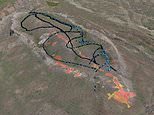
Now, a new radar survey has detected strong subsurface anomalies and distinct layers inside the 515-foot-long formation, challenging the idea that it is one homogeneous block of rock.
Led by Dr Khosrow Bakhtar, the survey used BakhtarRadar, a specialized imaging system developed through US Air Force research, to probe deeper beneath the site than earlier scans.
Noah’s Ark Scans founder Andrew Jones, who is part of the research team, said the deeper readings processed so far had yet to reveal a clear boundary between the formation and the underlying bedrock.
The team is still analyzing the data and will use the results to select locations for core drilling that could establish what lies beneath the formation.
‘We believe the Durupınar Formation is the remains of Noah’s Ark, and that is exactly why we want to put it through the strongest scientific testing we can,’ Jones said.
However, the researchers acknowledged that the results are preliminary and that radar anomalies alone do not prove the formation has an archaeological origin.
A new radar survey has detected strong subsurface anomalies and distinct layers inside the 515-foot-long formation, challenging the idea that it is one homogeneous block of rock
Bakhtar shared: 'My team and I are carefully evaluating the collected subsurface data, which aids in planning the core drilling pattern to be performed at the site.
'We will use BakhtarRadar's unique capability to directly distinguish any still preserved petrified, man-worked timbers from the natural host formation and its varying mineralogy.'
The team expects to release a preliminary technical report in the coming weeks identifying the strongest anomalies, providing a clearer view of the underlying geology and determining the best locations for targeted core drilling.