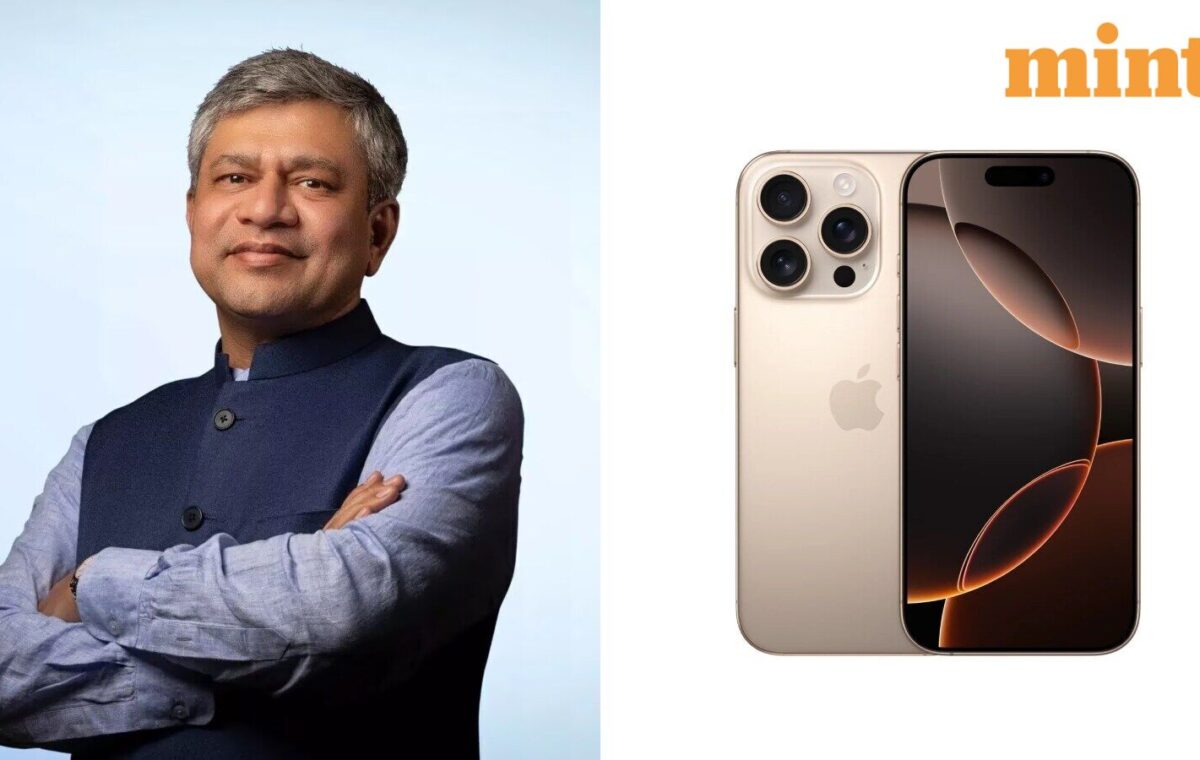
Apple may expand its manufacturing operations in India beyond iPhones, according to Union Minister Ashwini Vaishnaw, as the government steps up efforts to build a stronger domestic smartphone ecosystem through original designs, Indian intellectual property and greater local sourcing.
The development comes alongside the government’s new Mobile Phone Manufacturing Scheme, or MPMS, which aims to support large-scale production while also encouraging the emergence of Indian smartphone brands. Here are five key things to know about the latest push.
A central requirement for companies seeking support under the government’s push for Indian smartphone brands is that their products must be based on original designs rather than copied from existing devices.
“In this target segment of developing Indian brands, we are very particular that the design has to be your own design. It cannot just be a copycat.”
The emphasis reflects the government’s attempt to move beyond assembling phones and towards developing products with home-grown design capabilities and technology.
The original design alone will not be enough. Companies will also need to demonstrate that the intellectual property behind their products belongs to them.
“They have to come up with the design and prove that the IP is their own.”
The MPMS, approved by the Union Cabinet in July with an outlay of ₹62,500 crore, specifically aims to encourage Indian brands to build technological capabilities, patents, design, and research expertise. The scheme is set to run from FY 2026-27 to FY 2030-31.
Vaishnaw said the government sees the possibility of three new Indian smartphone players emerging over the next 10 to 14 months.
“We see three players who have the potential of coming up in a time frame of, let us say, about 10-14 months from now”
The government is seeking to identify companies capable of competing across different smartphone segments, with a focus on developing brands that can eventually establish a wider market presence.
Among existing domestic companies, Lava International and Ai have said they design their smartphones locally.
Their role could become increasingly important as the government looks to support Indian brands that can demonstrate genuine design and intellectual property capabilities. The broader policy objective is to help domestic companies capture more value from the smartphone supply chain instead of limiting their role to assembly and manufacturing.
The new manufacturing push also seeks to increase the use of domestically produced components. Mobile phone companies that use Indian-made electronic components, including display modules, camera modules, enclosures, batteries, and USB cables with connectors, will be eligible for additional incentives ranging from 0.2% to 0.5%.
The MPMS more broadly provides incentives ranging from 2.25% to 5% on eligible sales, with additional support linked to domestic sourcing of key components and sub-assemblies.