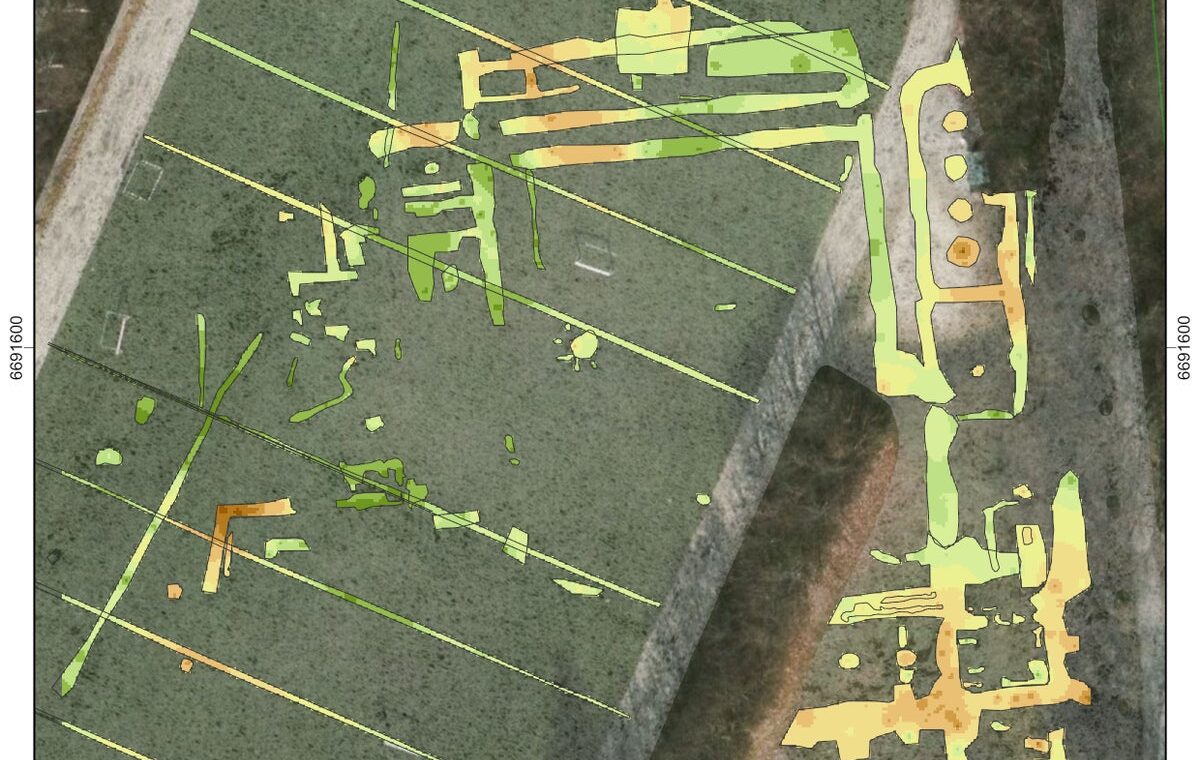
Advanced radar has exposed an extensive complex just three feet below the surface
I would like to be emailed about offers, events and updates from The Independent. Read our Privacy notice
The remarkably well-preserved remains of a 13th-century convent have been uncovered beneath a Danish sports field.
Archaeologists were left astonished to locate the site of St Clare’s Monastery in Roskilde.
First established in 1256, the convent was later demolished and long presumed to have been lost to history.
However, advanced ground-penetrating radar has now exposed an extensive complex lying roughly one metre (3.3 feet) below the surface.
The scans reveal individual rooms, cloisters and columns, alongside a church positioned in the monastery's southern wing.
Experts say that the images are among the clearest ever produced by radar at any monastic site across Scandinavia.
The discovery occurred during initial investigations by Roskilde Municipality ahead of plans to construct an underground car park beneath the sports field at Byparken.
Aware that a medieval nunnery had once stood in the area, museum organisation ROMU scanned the ground prior to any construction work taking place.
“We knew that St. Clara Monastery was there, but not how much of the monastery from 1256 had been preserved,” archaeologist Jesper Langkilde, of ROMU, said.
“But the ground scans showed very clearly that the monastery is still there – and that it lies right under our feet.”
Roskilde was an important centre of royal and religious power during the Middle Ages, and St Clare’s was the last of five monasteries known to have existed in the city.
The other four are protected ancient monuments, but St Clare’s was not because it was assumed to have been lost.
The survey, carried out with the National Museum of Denmark and Norwegian experts, used electromagnetic waves to detect buried structures without digging.