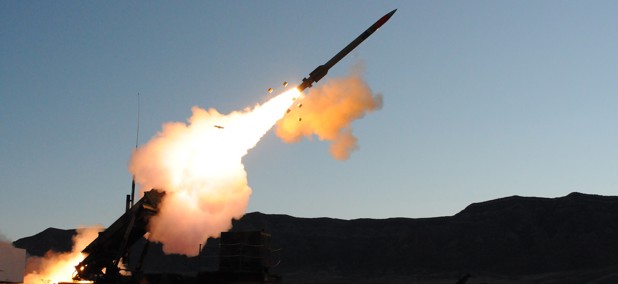
The PAC-3 MSE.
U.S. Army / Darrell Ames
HUNTSVILLE, Ala. — As the U.S. military’s critical munitions are overused in the Iran war and underproduced at home, companies are eagerly pitching new low-cost solutions, and the Pentagon is keen to make big deals. But defense experts say those new, cheaper missile options—and the push to rapidly produce existing weapons—aren’t the short-term fix needed to overcome the long-existing problem exacerbated by the Iran war. However, they will provide the military much-needed options in the future.
At the Space and Missile Defense Symposium last week, Boeing unveiled a low-cost seeker missile, with crucial hit-to-kill guidance technology used on the PAC-3 missile, made of commercial, off-the-shelf components. At the same conference, Northrop Grumman released its “cost-effective” 50 millimeter gun-based drone defense system to “address a critical short-range air defense gap.”
And last month at the Farnborough International Air Show, Lockheed Martin announced a more affordable, proximity-detonation version of its Patriot missile. But those solutions will likely only have a significant impact on the Pentagon’s stockpiles if the Iran war drags on and if officials quickly award contracts.
“The push for low-cost munitions is unlikely to have a material effect on the Iran War—at least not anytime soon,” said Becca Wasser, Bloomberg Economics’s defense lead.
And, she said, making enough new weapons, at the right cost, is only part of the problem.
“Getting to a lower cost for exquisite munitions will take time. It requires developing new weapons or adapting old ones, which means going through new testing and evaluation processes,” she said. “If the Iran war drags on for years, that’s when the drive for lower cost interceptors and munitions could have an impact,” because “wars of attrition require enormous amounts of material—and the lower price tag helps.”
Right now, the Pentagon is blowing through its prized Patriot and Terminal High-Altitude Area Defense missiles, and they won’t get replaced anytime soon, defense analysts say—even with novel framework deals.
In the last year, top officials have been pushing those deals with major defense primes and are continuing the administration’s rallying cry for the firms to build and innovate faster. Some of those are starting to bear fruit.
This week, RTX netted a seven-year, $22.9 billion Tomahawk missile contract with the U.S. Navy under a new deal, showing that the military is making big bets on legacy systems as it pursues newer options.
But those legacy munitions still take time to manufacture. In a recent report, the American Enterprise Institute think tank found that it would take 27 years for defense contractors to produce THAADs at the current maximum annual rate of 96 interceptors a year to reach quantities the Pentagon wants.
There “will be a window of vulnerability for several years until inventories return to their previous levels, and another several years before they get to the levels that war planners desire,” according to a May report from the Center for Strategic and International Studies.
“These newer, lower-cost munitions absolutely should be part of the way we fix this. But we shouldn't be kidding ourselves that they're going to be ready quickly en masse, are operational, and our forces are trained and understand how to use them,” said Todd Harrison, AEI’s defense budget expert. “It will take years, some sooner than others. And I think it remains to be seen if they're going to be available in large quantities sooner than the reorders of the more exquisite existing weapons.”
The Pentagon has already inked framework agreements for low-cost and traditional munitions. Overall, experts say they are a step in the right direction.
“It's not a contract, but it helps give the companies a demand signal they can take to their boards and their shareholders, and…it reduces their risks, so they can make increased capital expenditures, or capex, investments,” said Jerry McGinn, a CSIS senior fellow and the director of the Center for the Industrial Base.