Get the Popular Science daily newsletter💡
Breakthroughs, discoveries, and DIY tips sent six days a week.
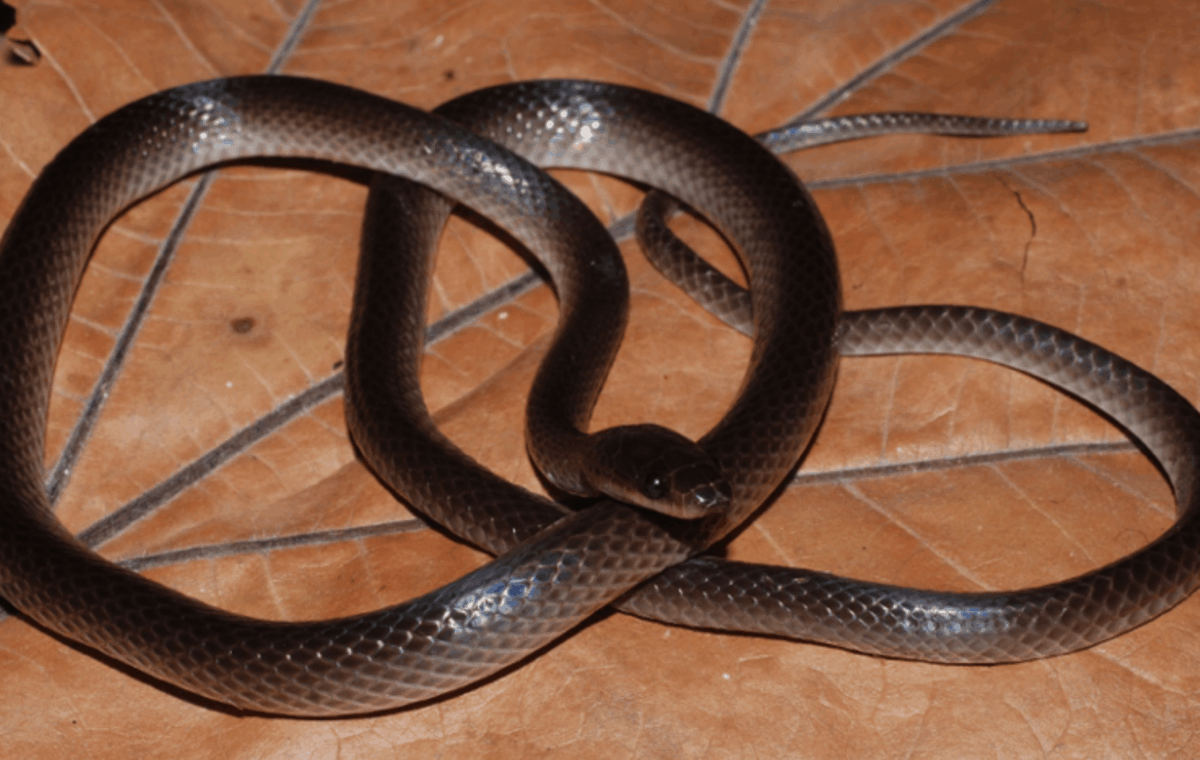
Welcome to the jungle, Lielaphis slashi. The newly discovered snake is named after Saul Hudson aka Slash, Guns N’ Roses’ lead guitarist. The snake’s named translates to “Slash’s groundsnake” in English, and honors his lifelong love of reptiles and support for museums and zoos.
“As a long time herpephile, I am extremely honored and humbled to have Lielaphis slashi from New Guinea named after me. It is really exciting, I never would have imagined this moment would arrive,” Slash said in an email to Popular Science.
The discovery is particular exciting for Sara Ruane, the Associate Curator of Herpetology at the Field Museum in Chicago and senior author of a paper describing the species published the journal Zootaxa.
“Guns N’ Roses has been one of my favorite bands since I was in first grade, and by fifth grade, I had already told my teacher that I wanted to be a herpetologist—a scientist who studies reptiles—when I grew up,” said Ruane. “So when I was twelve years old and got my copy of Reptiles Magazine in the mail and it had a picture of Slash holding his pet reticulated python on the cover, I thought, ‘This guy is so cool.’”
The 28-inch-long, reddish-brown snake was discovered in the forests of New Guinea. The landmass just north of Australia is the second-largest island in the world, after Greenland. It’s divided between the countries of Indonesia and Papua New Guinea, and the dense tropical forests that cover the island are a bevy of biodiversity that have not been well-studied.
While conducting field work one night in 2006, Chris Austin, a study co-author and herpetologist at Louisiana State University (LSU), spotted an unfamiliar snake.
“These New Guinea groundsnakes are nocturnal, so the best way to find them is at night. They are typically found just after sunset at the base of large trees where they are looking for something to eat,” said Austin, who is also the curator of herpetology at the Louisiana State University Museum of Natural Science. “When working at night in New Guinea you need to be very careful as there are several highly venomous species that look very similar to the non-venomous groundsnakes.”
After completing her doctorate In 2016, Ruane worked with Austin at LSU. The pair teamed up to research the poorly known snakes of New Guinea and have been collaborating ever since.
Based on the snake’s appearance alone, it was not clear that the team was looking at a new species. A laboratory analysis made it clear that something was different about this particular reptile.
“Using multiple cutting-edge genetic analyses, we found that L. slashi is genetically distinct from other similar snakes in the same genus,” says Tianqi Huang, a study co-author and post-doctoral researcher at the Field Museum. “The combination of physical characteristics, like differences in numbers of scales when compared with other species, and the genetic evidence is what led us to realize that it is an entirely new species. We also used ecological modeling to show that L. slashi’s preferred habitat is different from similar snakes.”
The team still has a lot to learn about Slash’s groundsnake, since they are difficult to observe in the wild and can slither away undetected. However, there are some clues based on its anatomy.
“Snakes in this genus often have large teeth in the back of their mouths, which New Guinea groundsnakes may use to grab on to and eat small, slippery-scaled lizards and the eggs of other reptiles; this snake isn’t grasping and squeezing its prey like a boa constrictor,” said Ruane.
Importantly, it does not produce any venom that could seriously harm a person. And as for the snake’s famous name, Ruane thought back to that magazine article.