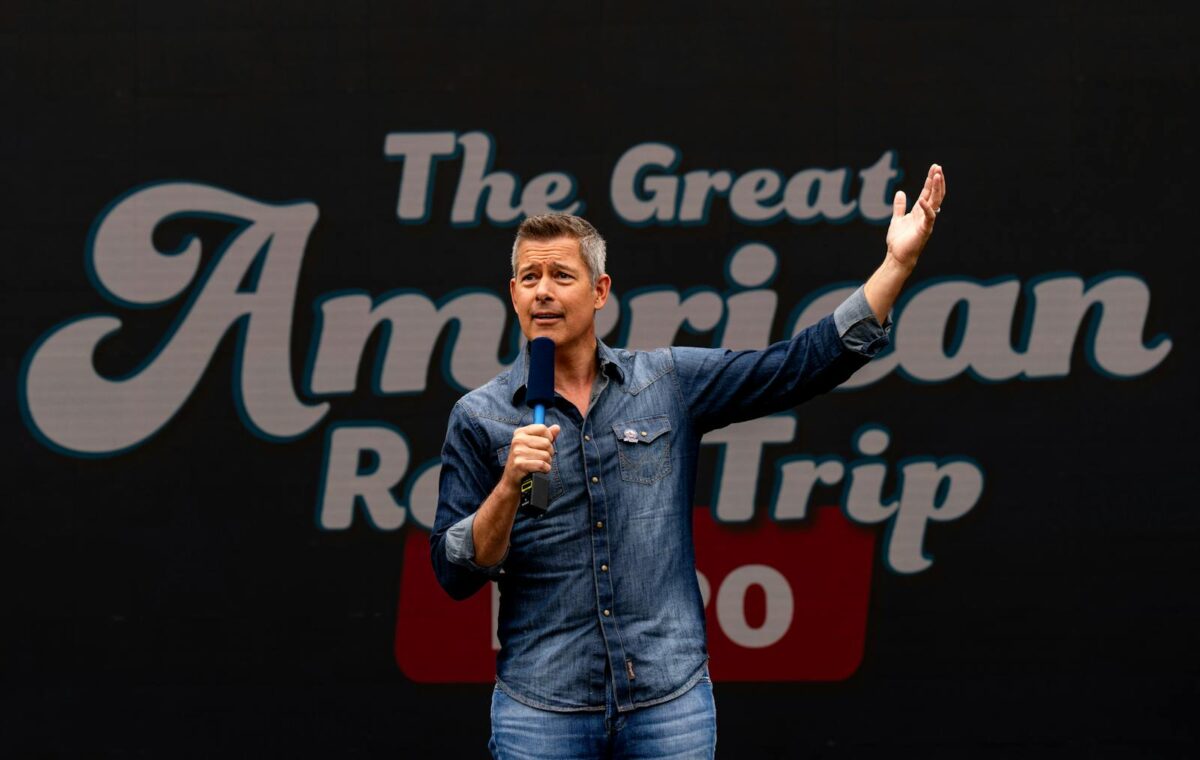
The second episode of The Great American Road Trip, Transportation Secretary Sean Duffy’s recently released vanity project travel show, starts in the massive suburban home Duffy shares with his wife Rachel Campos-Duffy and their nine more or less interchangeable children.
Four of those children will accompany their parents on the upcoming leg of their road trip to Boston, and before they leave Duffy has to have a heart-to-heart with Paloma, his 17-year-old daughter. The family will soon be visiting colleges and the Transportation Secretary is worried. “Let’s say you got into Harvard, would you be pushing us to actually have you go?” Duffy asks.
Paloma, sitting across a massive kitchen island from her father, answers yes as the first notes of foreboding music begin to play in the background. This conversation is not just about where Paloma will go to college. After years of raising their children as devout Catholics, the Duffys are worried about what a single semester at a liberal college could do to their daughter’s faith. This tension is stretched into a full-fledged storyline over the course of the six-part series, a twist on a coming-of-age tale. Paloma wants to grow and change; her parents have other plans.
The camera then cuts to Rachel Campos-Duffy in a jarring nod to the aggressive editing style that characterizes most reality TV. “We spent a lot of time nurturing and providing formation for our kids, giving them an environment where they’re steeped in faith and values,” a strangely barefoot Campos-Duffy says while curled up on the couch beside her husband. “And so the idea of dropping her off at a place that would undermine that, or try to undo all those things makes me worried.”
Speaking to Paloma, Duffy is less diplomatic about what he’s really worried about. “They have professionalized figuring out how they can take good young girls like you, and, I think, corrupt their minds,” he says. It’s a sinister, if vague, allegation that a Cabinet secretary may want to look into. But Duffy is speaking to his daughter as her father, not as the man who currently sits fourteenth in the line of succession.
Poor Paloma pushes back. “I went to an extremely conservative school in high school, and I’m part of an extremely conservative family. If I go to a liberal setting, that’s a way more rounded education than if I go to a conservative high school and then a conservative college,” she says.
A knowing look spreads across Duffy’s face—his daughter is still learning the ways of the world. She only sees Harvard as the nation’s preeminent private college, not as the sex and communism factory it really is. “They’re so good at it, you’ll see,” Duffy says. “Young people go to a conservative school with a conservative family, and they get perverted and contorted” when they stray too far afield—like, say, by attending a prestigious “liberal” university. Paloma is clearly smart, but Duffy seems not to think she’s smart enough to evade the perverts and contortionists at Harvard.
Unless you’re clamoring for a window into Paloma Campos-Duffy’s college plans for some reason, it’s not exactly compelling television. Still, it’s a conversation that gets at a tension that runs throughout the Great American Road Trip. Duffy and his family are ostensibly on a journey to “[explore] destinations, transportation, and all the people and places that make America unique.” There’s just one problem: Duffy isn’t actually interested in most of the country he spent months traveling across. In fact, he wants to protect himself and his family from much of it, just like he wants to keep Paloma away from Harvard.
The six-part show is part unscripted series and part illegal advertisement. For something so boring, it has always been controversial. Its announcement was greeted by an immediate and severe backlash—which should have been expected given that The Great American Road Trip was paid for by corporate sponsors like Boeing, Toyota, and Shell—companies the Secretary of Transportation is ostensibly supposed to oversee and regulate. Initially scheduled to drop as part of President Trump’s sketchy Freedom 250 celebration, it faded from view and was quietly dumped on the DOT’s official YouTube channel earlier this week. Millions of dollars were spent for a couple thousand views. The show is dreadfully boring. And the ethical problems that have dogged it from its inception haven’t gone away.
Federal employees are bound by a code of ethical standards that strictly prohibit them from using their public office for private gain and from endorsing any product, service, or enterprise while they serve. Of course, that rule has become more of a suggestion during the second Trump administration—which is how we got The Great American Road Trip.
Before each episode, a disclaimer clarifies that no taxpayer dollars were spent on the Duffys’ family vacations. But it does not clarify whether the family received compensation for their participation from The Great American Road Trip Inc., a nonprofit 501(c)(4). Duffy and Campos-Duffy have publicly insisted that they were not compensated for their appearances on the show, but the nonprofit has yet to disclose its beneficiaries. If they got paid, that would not only be a violation of ethical standards, but also could potentially amount to bribery.
In multiple episodes Duffy announces that he has to go to “work” for DOT, before visiting one of the medley of industry giants funding his family’s Road Trip.
In Charleston, South Carolina, the family visited a Boeing plant to gawk at the new Dreamliner. Boeing, one of the project’s main sponsors that has multiple contracts with the DOT. In Fort Worth, Texas, the secretary broke off to visit Cement Roadstone Holding, the country’s largest asphalt producer, which stands to earn big from the secretary’s slate of proposed highway expansions. In Scottsdale, Arizona, members of the Duffy family were treated to rides in Waymo’s autonomous vehicles that Dad calls “the future of transportation.”
Still, the disclaimers and quiet release of the series displays a level of self-consciousness that is uncharacteristic of the shameless Trump administration. Is it really possible that they got all the way through production before realizing how badly they’d broken the rules?
The numerous ethical violations aren’t the only reason the show should never have aired: The series’s central college storyline is a humiliating blow to the Trump administration’s war on American colleges and universities.