Published: 10:23 BST, 20 August 2026 | Updated: 19:13 BST, 20 August 2026
NASA has revealed its first official images of an enormous crater made when a SpaceX rocket smashed into the moon.
Earlier this month, an out–of–control SpaceX Falcon 9 second stage careened into the lunar surface at 5,400 miles per hour (8,690km/h).
Scientists believe that the 9,920lbs (4,500kg), 39ft–long (12m) rocket would have hit with a force equivalent to 15,000 sticks of dynamite, or three tonnes of TNT.
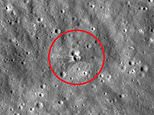
Now a NASA satellite has captured pictures showing the result of the impact – revealing a 60–foot–wide (18m) crater surrounded by streaks of lunar rock thrown up by the rocket's impact.
'NASA's Lunar Reconnaissance Orbiter (LRO) has captured images of a new crater on the moon.
'The crater formed on August 5, 2026, when a SpaceX Falcon 9 upper stage impacted the lunar surface.'
In the remarkable image, the new crater is clearly visible with a darkened rim and dark streaks emanating from its centre.
This image shows the moon's surface before the rocket crashed into it (left). Here, the new 60–foot–wide crater can be seen, surrounded by streaks of lunar rock (right)
One of Elon Musk's discarded SpaceX rockets crashed into the moon. Pictured: The rocket launching in January 2025, from Kennedy Space Centre in Florida
NASA used its Lunar Reconnaissance Orbiter to capture images of the impact as it passed over the site during orbit earlier this month.
Engineers tilted the spacecraft so its cameras would point toward the crater as the satellite passed 60 miles above the moon, travelling one mile per second.
As well as measuring its width, scientists were able to work out that the crater is less than 10ft (3m) deep.
They were also able to confirm the crater's coordinates – 19.4759°N, 266.7138°E at 511 metres (1,676ft) elevation.
'The images show bright and dark rays stretching out from the crater,' NASA said in a statement.