Published
Aug 20, 2026 11:00 AM EDT
Get the Popular Science daily newsletter💡
Breakthroughs, discoveries, and DIY tips sent six days a week.
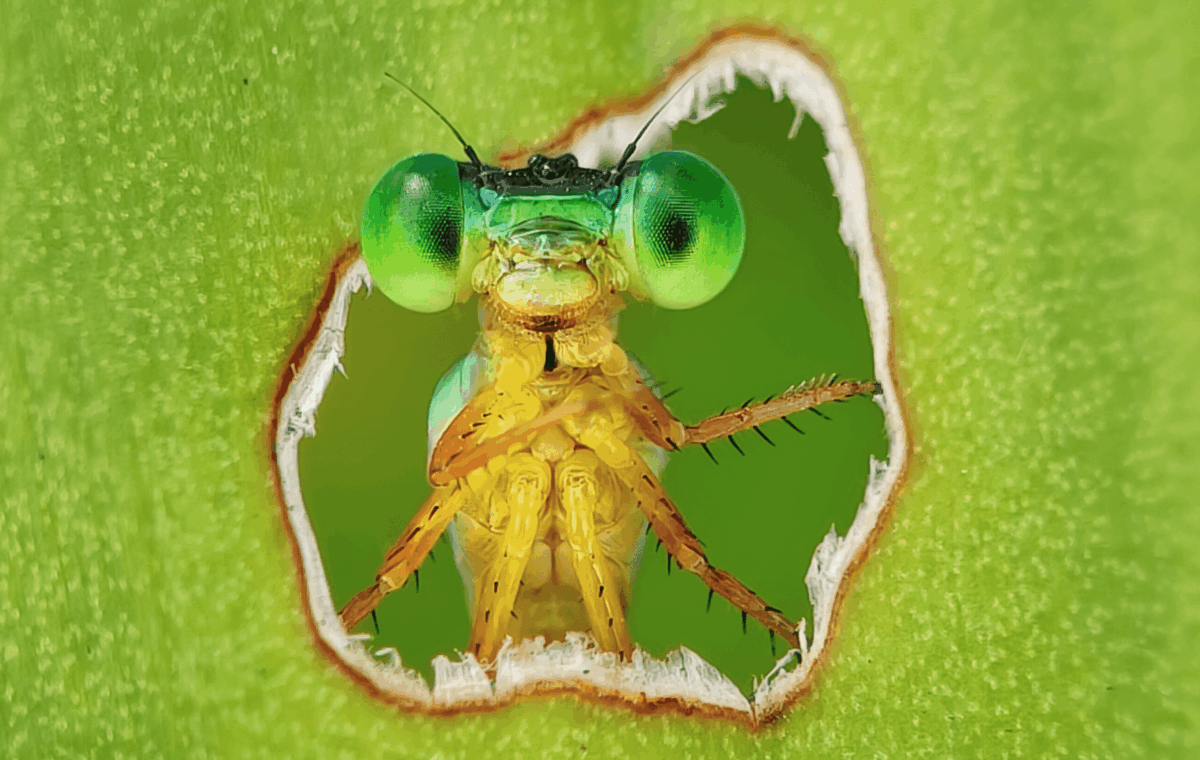
An expressive little orange-tailed marsh dart damselfly (Ceriagrion cerinorubellum) peering through a hole in a leaf is the winner of the 2026 BMC Ecology and Evolution and BMC Zoology image competition.
Since 2023, the annual competition highlights the beauty and diversity of life on Earth, while celebrating the researchers working to understand and protect the natural world. The judges selected an overall winning image and a runner-up, in addition to winners and runners-up in three categories: Relationships in Nature, Protecting Our Planet, and Research in Action.
Browse through all of the winners in the gallery below. (Click to expand images to full screen.)
An orange-tailed marsh dart damselfly (Ceriagrion cerinorubellum) is framed by a hole in a leaf in a freshwater wetland in the state of Odisha, India. Berhampur University, Odisha student Sritam Kumar Sethy took the photo and says it “offers a glimpse into the often-overlooked world of freshwater biodiversity.”
Damselflies are critical predators in wetland ecosystems, and are an indicator of ecosystem health. Since they rely on both aquatic and terrestrial habitats, they can be particularly sensitive to the effects of pollution, habitat loss, and climate change.
“It is hard not to smile at this beautifully composed and vivid image, in which the damselfly seems to display a remarkable sense of character and presence,” BMC Ecology and Evolution Senior Editorial Board Member David Ferrier said in a statement
Jennifer Harman, Editor of BMC Ecology and Evolution and BMC Zoology, added that the photo “highlights the importance of wetlands, which support a remarkable diversity of species yet are among the world’s most threatened and rapidly disappearing habitats.”
Two students working in the field on a dark, rainy night near Portland, Oregon are attaching a radio transmitter to a northern red-legged frog (Rana aurora). Ryan Wagner of Washington State University took the photograph, which demonstrates how technology is helping scientists better understand animal movement and habitat use, which could lead to safer environments for at-risk species. Northern red-legged frogs are a medium sized frog that are considered a species of concern.
Two male giant Australian cuttlefish (Ascarosepion apama) compete for a female’s attention during their annual spawning aggregation in the Upper Spencer Gulf in South Australia. The aggregation occurs every year from May to August. The photo taken by Victor Huertas from Australia’s James Cook University shows how tens of thousands of cuttlefish use their skin’s natural pigmentation to vie for mating rights.
David Ferrier describes the image as showing “both the intimacy and intensity of a complex and highly competitive mating display.”
Alwin Hardenbol of the Natural Resources Institute Finland showed noisy friarbirds (Philemon corniculatus) mobbing a brown goshawk (Tachyspiza fasciata) in Australia.
BMC Ecology and Evolution Senior Editorial Board Member Christy Hipsley says that the image of this common anti-predator behavior in birds is “like charcoal smudges on white paper.”