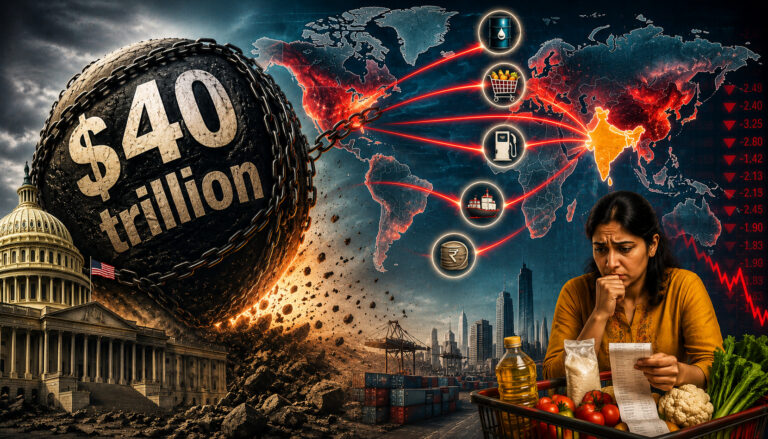
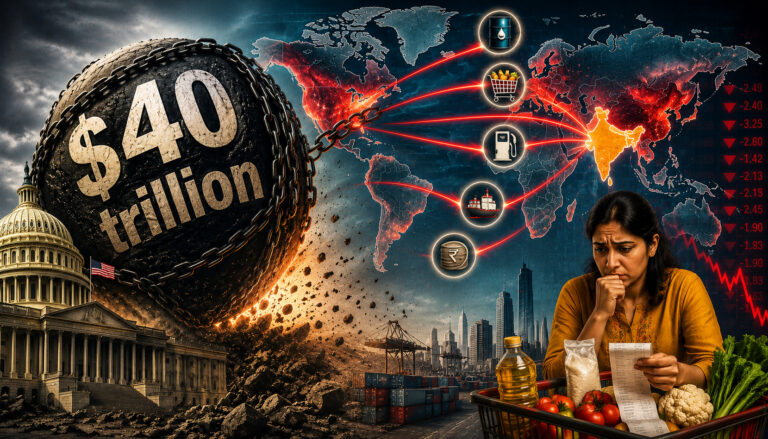
Neha starts most mornings with the same small habit. She opens her mutual fund app before the day gets busy. She is 34, works at a mid sized firm in Gurugram, and has been putting ₹15,000 into SIPs every month since she got her first job. For the third month in a row, the screen is red. It is not a crash, and she knows that. Still, it is enough to make her look up from her coffee and wonder whether she has made a bad call. She has not.
Part of the answer sits thousands of kilometres away in Washington DC, where the US government’s debt is now $40 trillion. That figure can sound remote and meaningless, the sort of number discussed by economists on television. But it has a way of travelling. It can affect Neha’s SIP returns, the cost of cooking oil in a Lucknow household, and the order book of a Tirupur garment exporter whose American clients have begun buying less. The connection is not new, what is different now is the scale. When investors start worrying about the US government’s finances, they do not limit their anxiety to America. They become more cautious across markets. Indian equities, from the perspective of a global fund manager in London or Singapore, are an investment that can be sold when uncertainty rises. Once that money starts leaving India, the rupee comes under pressure.
US public debt crossed $40 trillion for the first time. Reuters correspondent David Lawder says this is an 'unsustainable' trajectory as annual interest costs surpass military spending https://t.co/fBvDYU9OYB pic.twitter.com/pOzd1uR6Wy
— Reuters (@Reuters) August 20, 2026
A weaker rupee makes dollar priced imports more expensive. That means higher costs for crude oil and fertiliser, which then feed into diesel prices, transport bills, vegetables in the market, and the urea needed for the rabi crop. If the US economy itself slows, the impact comes through another channel. Fewer orders for Indian IT firms, garment makers, and engineering exporters. You may not see it as breaking news. You may see it as delayed recruitment, cautious companies, or a familiar red number on an investment app.
America’s debt may be recorded in Washington, but its effects do not stay there. They surface in Indian homes, farms, businesses, and portfolios, often after the US news cycle has already shifted elsewhere.
To see why, we need to begin with a number most Indians rarely encounter, even though it quietly influences what they pay every day.
The number that isn’t supposed to scare you
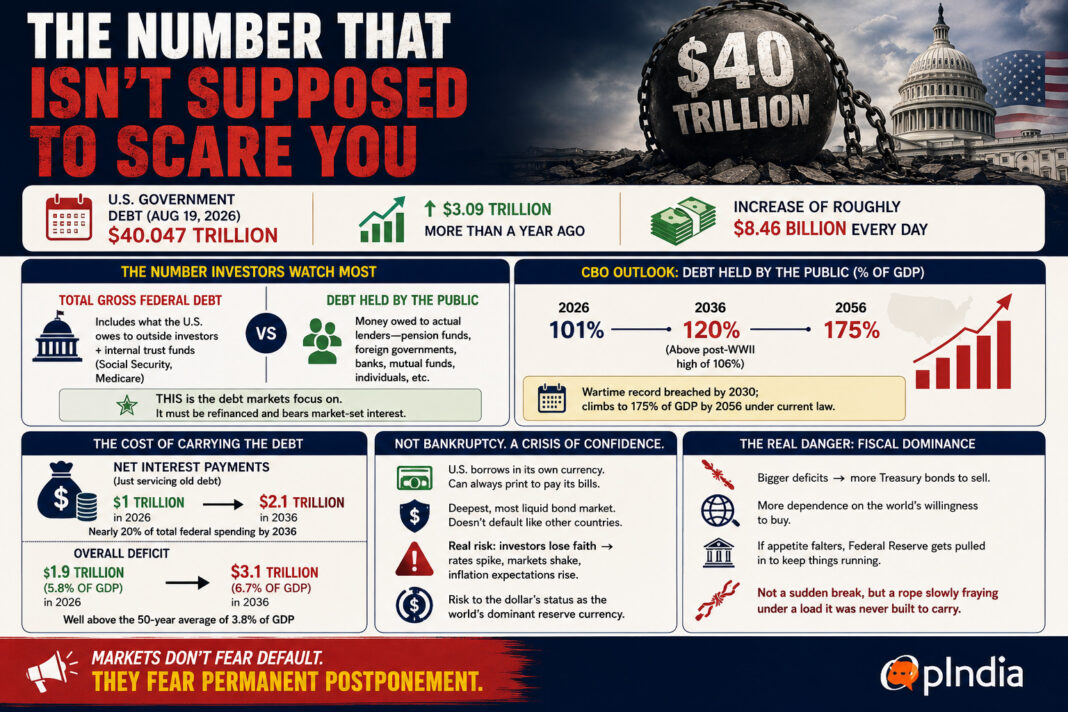
By the third week of August 2026, the US government’s debt was just $40 trillion. On August 19th, total gross federal debt stood at $40.047 trillion, around $3.09 trillion more than it was a year earlier. That works out to an increase of roughly $8.46 billion every day.
Numbers this large can quickly become meaningless, so one distinction is worth making. Total debt includes money the US government owes outside investors, but it also includes money it owes to its own trust funds, particularly Social Security and Medicare.
The more important number for markets is debt held by the public. This is the money Washington owes to actual lenders, pension funds, foreign governments, insurance companies, banks, mutual funds, and individuals who own US government bonds. These are obligations the government must keep refinancing as old bonds mature, and it must pay interest at rates set by the market. That is why this part of the debt, not merely the headline total, is what investors watch most closely.
And on this number, the US government’s own referee has been unusually blunt. The Congressional Budget Office, that non-partisan outfit both Republicans and Democrats have to take seriously, even when they’d rather ignore it, put out its latest ten year outlook in February 2026. Debt held by the public is set to climb from 101 percent of GDP in 2026 to 120 percent by 2036, blowing past the previous high of 106 percent that was hit right after World War II.
Looking further ahead, it gets even more striking. Under current law, that debt would top the wartime record by 2030 and hit 175 percent of GDP by 2056.
What really jumps out, though, is the cost of just carrying all this debt. Net interest payments, pure money spent servicing old borrowing, with nothing new to show for it, are projected to rise from about $1 trillion in 2026 to $2.1 trillion by 2036. At that point, interest alone would swallow nearly a fifth of everything the federal government spends. For context, the overall deficit is expected to widen from $1.9 trillion (5.8 percent of GDP) in 2026 to $3.1 trillion (6.7 percent of GDP) in 2036, well above the 3.8 percent average of the past fifty years.
No, America is not going bankrupt
Now let’s kill a common myth right away, this is not America going bankrupt. A country that borrows in its own currency, whose dollar the rest of the world still treats as the reserve of first resort, and whose bond market remains the deepest and most liquid on the planet doesn’t default the way Argentina or Sri Lanka can. In the most literal sense, Washington can always print the money to pay its bills. That’s exactly why the CBO’s report never uses the word ‘default.’ Instead it talks about something more realistic and useful, a crisis of confidence.
The real risk it flags is that investors could simply lose faith in the value of U.S. government debt, sending interest rates spiking and shaking markets more broadly, and that expectations of higher inflation could, over time, slowly chip away at the dollar’s status as the world’s dominant reserve currency.
That is the real risk worth understanding, and it isn’t classic bankruptcy, it’s something closer to a rope that’s slowly fraying under a load it was never quite built to carry. America has not run out of money. It has run out of slack. The credit rope still holds, but it’s stretched tight across a much wider canyon than it used to be, and every fresh gust of bad news, a weak bond auction, a credit-rating scare, another messy debt-ceiling fight, makes the fraying a little more obvious.
Bigger deficits mean more Treasury bonds have to be sold every year. More bonds mean more dependence on the rest of the world’s willingness to buy them. And if that appetite ever falters, even for a short while, the Federal Reserve gets pulled in to keep the machinery from seizing up. Economists have a name for what happens when a central bank’s independence quietly bends under the weight of government borrowing needs: fiscal dominance. It’s the slow drift toward that condition, not some Hollywood-style default, that should worry anyone watching from outside America’s borders.
Numbers alone don’t move markets. Stories do. And the story markets have begun telling about American fiscal politics is one of permanent postponement.
Four roads from Washington to your wallet
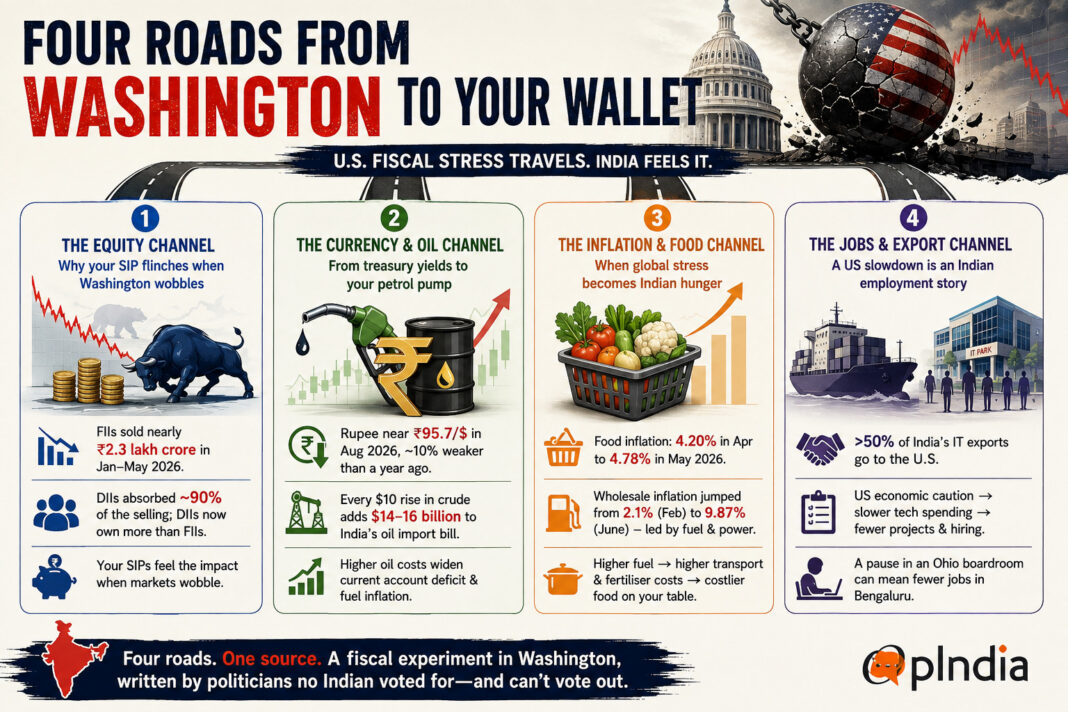
Every time that story flares up, a bad auction, a shutdown scare or a ratings warning- it doesn’t stay at Wall Street. It travels down four distinct roads into the Indian economy, and each one has been visibly, measurably active through 2026.
The equity channel: Why your SIP flinches when Washington wobbles
When global investors get nervous, India is rarely the reason. But it is often one of the first places they pull money from. Indian stocks are relatively easy to buy and sell, widely tracked, and highly liquid. For a foreign fund manager who needs to cut risk in a hurry, that makes India an easy exit door.
That is roughly what happened in the first five months of 2026. Foreign institutional investors sold nearly ₹2.3 lakh crore worth of Indian equities, more than the total that left the market through all of 2025. March alone saw outflows of close to ₹1.2 lakh crore, one of the biggest single months of foreign selling India has seen. India-focused offshore funds and ETFs watched roughly $5 billion walk out the door in the quarter ending March 2026, their worst quarterly outflow in six years.
The reason this did not turn into a full-blown market collapse was not that foreign investors suddenly regained their faith. It was because domestic money stepped in. Ordinary Indians investing steadily through SIPs, together with domestic institutions, helped absorb the selling. Domestic institutional investors put in $17.2 billion in the first quarter, taking in nearly 90 percent of the equity that foreign investors sold. Domestic institutional ownership has now moved ahead of foreign ownership, while foreign ownership of Indian equities has dropped to around 16 percent.
That is a genuine sign of strength, and one worth coming back to later. But it should not make us careless about the larger risk. For India’s middle class, the stock market is no longer a playground reserved for wealthy speculators watching a television ticker. Mutual funds and SIPs have quietly become part of how families plan their future. When Neha sees her fund fall, she is not watching some abstract market movement. She may be watching the money set aside for a child’s education, a home, or retirement become a little less secure.
The currency and oil channel: from treasury yields to your petrol pump
The second road runs through the rupee. It sounds counterintuitive at first. If investors are worried about America’s bonds, why would they rush into the dollar? But that is exactly what tends to happen in a panic. The dollar remains the world’s default safe haven, largely because investors are used to treating it that way. As money moves toward the dollar, it strengthens, and currencies such as the rupee come under pressure.
In August 2026, the rupee was trading near ₹95.7 to a dollar, nearly 10 percent weaker than a year earlier, while the RBI was repeatedly intervening to slow the fall. That weakening hits an old Indian weakness, India imports most of the crude oil it uses. Earlier this year, disruption to Gulf shipping and supply during the US-Israel-Iran conflict sent Brent crude above $100 a barrel before it eased back into the mid $80s by August. Even after prices came down, the impact of that spike did not simply vanish.
ICRA estimates that every $10 rise in the average crude-oil price adds about $14-16 billion to India’s yearly oil import bill. It can widen the current account deficit by 30-40 basis points and add around 80-100 basis points to wholesale inflation. In simple terms, the current account tracks the difference between what India earns from the world and what it pays the world, a larger deficit means India is sending out more money than it is bringing in.
In a more severe case, with oil staying near $120 a barrel, analysts estimated that India’s oil trade deficit could rise to $220 billion and the current-account deficit could move beyond 3 percent of GDP. The Finance Ministry made a similar point in its July 2026 economic review, if high oil prices driven by the Gulf conflict persist, they can once again put pressure on both India’s fiscal deficit and its external balance.
The rupee is the thin skin between the Indian consumer and the world’s storms. When the dollar flexes its muscle three oceans away, it is that skin, first, that burns.
The inflation and food channel: When global stress becomes Indian hunger
India’s headline inflation remained reasonably contained through this period. At first glance, that seems reassuring. Retail inflation was 3.48 percent in April 2026, comfortably within the RBI’s preferred range. But the overall number hid a more uncomfortable detail. Food inflation was already at 4.20 percent. Tomato prices were up 35 percent from a year earlier, while cauliflower had become more than 25 percent costlier. By May, the headline inflation rate had risen to 3.93 percent and food inflation to 4.78 percent. That difference matters much more to a lower income household than it does to the average consumer. Families with tighter budgets spend a much larger share of their income on food, so even a modest rise in prices is felt immediately at the kitchen table.
The bigger warning was further back in the chain, at the wholesale level. Wholesale price inflation tracks what producers, transporters, and traders pay before goods reach the retail market. These higher costs often take a few months to reach consumers. Wholesale price inflation was only 2.1% in February 2026. By April, it had jumped to 8.36%. It rose again to 9.68% in May and reached 9.87% in June, the highest reading in the current series.
Fuel and power were doing most of the damage. Their prices were 27.41% higher than a year earlier in June. Wholesale inflation eased only slightly to 9.78% in July, with fuel inflation cooling to 20.05%. This is how an oil shock slowly enters daily life: it raises diesel costs, makes fertiliser costlier, increases transport bills, and eventually shows up in the price of dal, milk, and cooking gas in kitchens across the nation.
The jobs and export channel: A US slowdown is an Indian employment story
The fourth road works more slowly, but that does not make it any less important. More than half of India’s software services exports go to the United States. That leaves the IT sector closely tied to the confidence of American companies and, more specifically, to how willing they are to spend on technology.
That dependence was visible during the tariff uncertainty of the past year. For much of 2025, Washington had imposed tariffs of up to 50% on several Indian goods. A bilateral deal signed on February 2, 2026 brought that rate down to 18%. But for Indian businesses, the damage was not only about where the final tariff settled. It was about spending months unable to make plans because policy in Washington kept shifting. Garment exporters in Tirupur and Ludhiana, steel producers, and engineering-goods manufacturers were all left trying to plan for a market whose rules were being decided in a capital where they have no voice.
A fiscal scare in Washington works differently. It does not necessarily arrive through a tariff announcement. It arrives through caution inside American companies. When firms begin worrying about the economy, technology spending is often among the first budgets they put on hold. Those are the same budgets that keep IT offices in Bengaluru and Gurugram busy.
A decision to pause hiring in an Ohio boardroom may not look connected to India at all. But a few quarters later, it can mean fewer projects, slower recruitment, or an unfilled desk at a Bengaluru tech park. The connection is real, even if neither side sees it immediately.
These four roads are not really four separate stories. They are four faces of the same fact, a meaningful share of India’s day-to-day prosperity is wired into a fiscal experiment being run in Washington DC, by politicians no Indian voted for and no Indian can vote out.
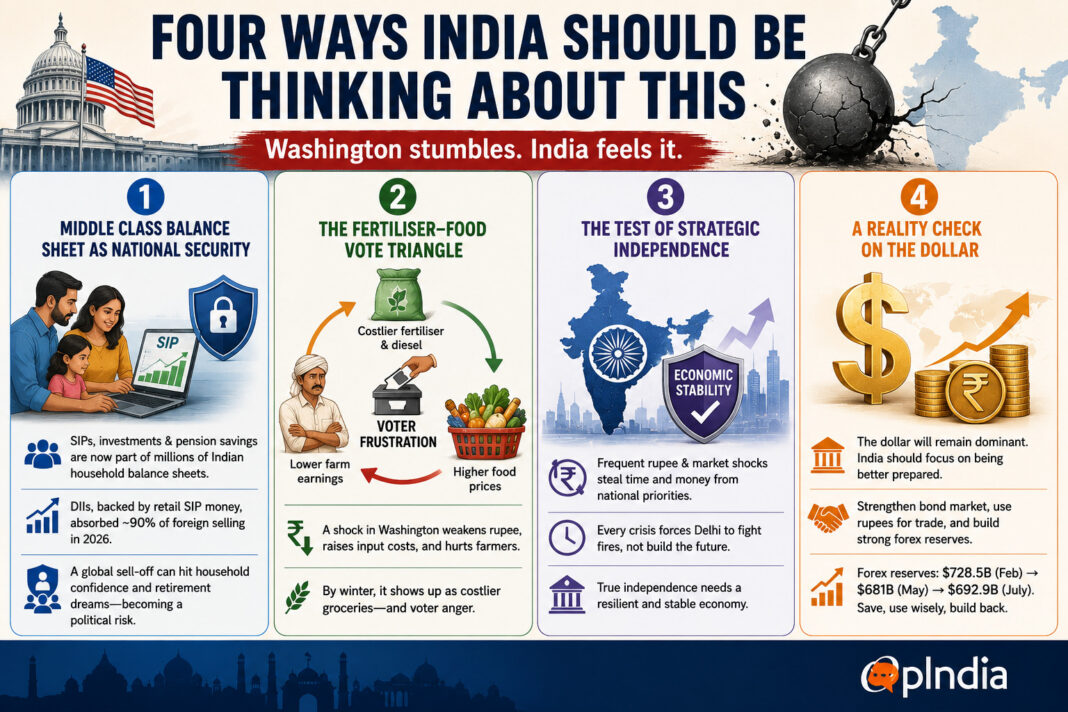
Four ways India should be thinking about this
None of what follows requires America to collapse. It only requires Washington to stumble often enough, and loudly enough, for the tremors to keep reaching Delhi, Mumbai and Bangalore on roughly the schedule we’ve just seen.
The middle class balance sheet as national security: People often say that the stock market is not the real economy. There is truth in that. But for millions of Indian middle class families, the market is no longer some distant game played by wealthy traders. It has become part of the household balance sheet, SIPs, insurance linked investments, pension savings, and the money set aside for retirement or a child’s education.
This year, domestic institutional investors, driven in large part by regular retail SIP money, absorbed nearly 90% of the foreign selling in Indian equities. That is an impressive sign of patience and discipline. But it also creates a new vulnerability. If a prolonged global sell-off hits Indian markets, it will not remain a story confined to business channels. It will affect household confidence and retirement plans for a large enough section of the population to matter politically.
The fertiliser food vote triangle: The second connection is less obvious, but equally real. A shock that begins in Washington can strengthen the dollar and weaken the rupee. A weaker rupee raises the cost of imported fertiliser and diesel. Higher input costs then cut into a farmer’s earnings, often precisely when money has to be spent on sowing and cultivation.
A few months later, those costs travel further down the chain. They can show up in a mandi as higher prices for vegetables and grain, and then in a household kitchen as a costlier monthly grocery bill. Something as technical as stress in the US Treasury market in April can become a voter’s frustration over food prices by winter. Policymakers rarely explain this full chain in public, and voters are rarely shown how closely these events can be connected.
The test of strategic independence: India wants to be seen as a country that can take its own calls in a world where many big powers are competing. But that goal depends on more than foreign policy and defence. It also depends on keeping the economy steady. If India has to deal with a falling rupee or worried bond markets every year or two, the government has less time and money for bigger national goals. Each time there is a fear that India may struggle to pay for imports or attract enough dollars, Delhi has to focus on putting out that fire first.
A reality check on the dollar: In India, it has become common to hear that the world is about to move away from the dollar. That is unlikely anytime soon. The dollar is still used for much of the world’s trade, savings, and financial deals. For India, the sensible aim is not to fight the dollar but to be better prepared when it becomes stronger.
That means making India’s bond market stronger, so Indian companies do not need to borrow as much in dollars. It means using rupees for trade with other countries when both sides find it useful. And it means keeping enough foreign currency reserves for difficult times.
India has done this last part fairly well in 2026. Its foreign exchange reserves reached a record $728.49 billion in February. They fell to around $681 billion by May because the RBI sold dollars to slow the rupee’s fall. By late July, they had climbed back to $692.9 billion. Put simply, India had savings for a difficult moment, used some when pressure came, and then began building them back up. That is more useful than simply talking about ‘ending dollar dominance.’
Conclusion
It would be wrong to tell Indian readers that America has suddenly lost all its strengths. It has not. In a crisis, the world still runs to the dollar, even when the crisis begins in America itself. The US still has the world’s biggest and most active financial markets. It still leads in technology and innovation. Its universities, military power, and global alliances have been built over decades and will not disappear because of a few bad years in its budget.
India, too, has shown that it can handle difficult global conditions. The RBI had estimated that the Indian economy would grow by 7.6% in the financial year 26, despite the Iran conflict and wider uncertainty in the world economy. That is a reminder that the right response is not panic. It is to stay prepared and steady.
But having strengths does not mean America is safe from every problem. The CBO’s projections make that clear. US debt is rising on a path that cannot continue forever. The money America spends only to pay interest on old borrowing is expected to double over the next decade. Its yearly deficit is also much higher than the average of the last 50 years, even at a time when unemployment is low. Normally, a country borrows less when more people are working and the economy is doing well.
This does not mean the US is about to collapse. It means America is slowly losing room to deal with a bad surprise. And when America has less room to handle its own problems, the effects do not remain inside its borders. They can reach countries like India, which had no part in creating those problems in the first place.
India should not want the USA to decline. A stable US is still good for India and for the world. But India cannot treat the dollar-based global system as something distant that has no effect on us. It does. As we have seen, trouble in Washington can affect Indian shares, the rupee, oil prices, jobs, and even family savings. For India, the main question is not whether America will stop paying its debt. It is whether Delhi will understand that every serious US debt problem can become an Indian issue. It may not arrive with a warning or a dramatic headline. It may first show up as higher prices at the petrol pump or another red number on a mutual fund app.
So the answer is not fear, but it is not carelessness either. India needs to stay alert and prepared. The dollar will likely remain strong for years, but America’s growing debt is making the system around it less stable with every passing year.
Big powers do not always fall suddenly. Sometimes the damage builds slowly, like a small leak that no one fixes. And often, the countries around that power feel the problem before the power itself does. This is the first of a two-article series. The next one will look at the part of this story most people never see: how the US government bond market works, the hedge funds that borrow heavily to trade in it, and how an asset considered among the safest in the world could, in the wrong situation, trigger another global shock.