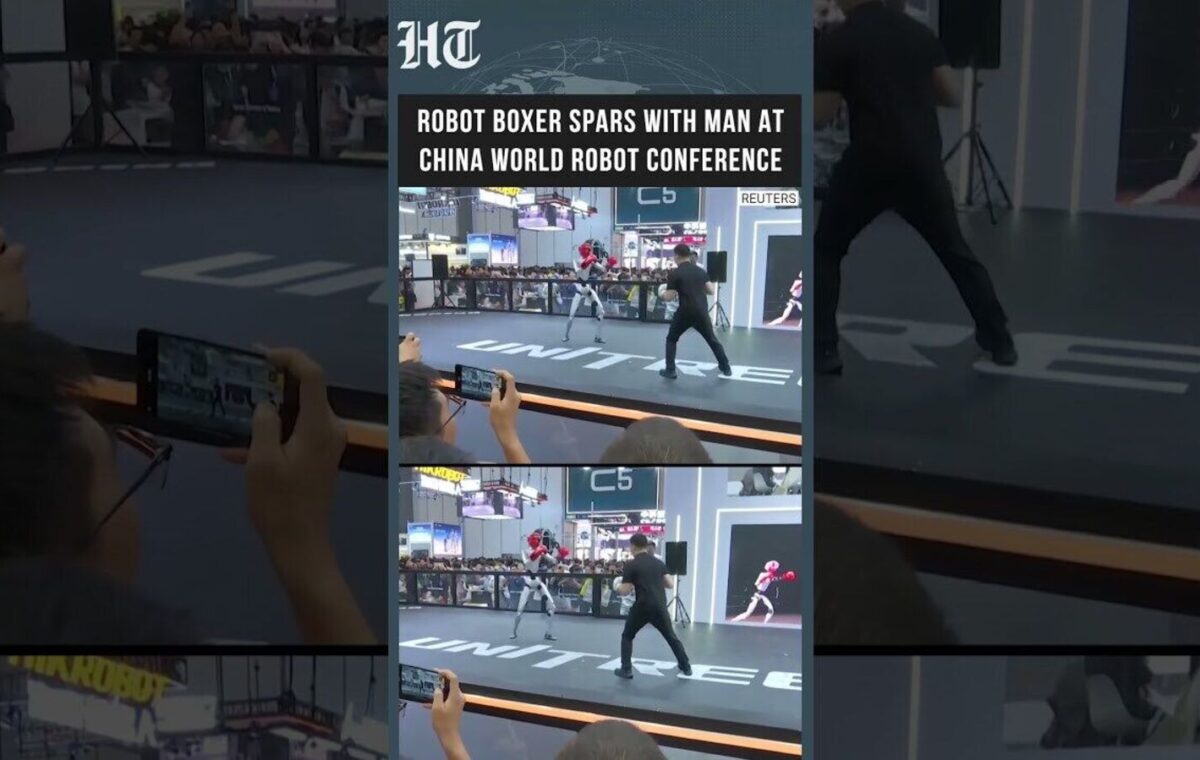
Following Unitree’s massive Shanghai stock market debut, which solidified China's drive to dominate AI-driven robotics, the company's CEO noted that robot intelligence is approaching a “ChatGPT moment”.
While the company's shares dropped 11% on Thursday, this followed a nearly 600% surge on opening day, underscoring massive investor appetite and Beijing's strong support for the emerging industry.
According to a Thursday report from a Chinese industry association, China dominates the global market, accounting for 97% of worldwide shipments, with over 40,000 humanoid robots delivered in the first half of this year alone.
However, this sector has ignited a new tech battleground between the US and China.
In a significant setback for Chinese manufacturers, the US Federal Communications Commission recently prohibited future imports of foreign quadruped and humanoid robots due to national security concerns.
In response, various firms at the Beijing World Robot Conference informed Reuters they are now seeking new avenues for international expansion.
Speaking at a robotics conference in Beijing, Unitree's founder and CEO Wang Xingxing said, “We are marching towards a 'ChatGPT moment' in embodied intelligence.”
He anticipated a looming breakthrough in which machines would be able to navigate completely new environments and execute most tasks given in basic text or voice prompts.
“We hope that in the future, we can see a robot be introduced into an unfamiliar household, and it can achieve approximately 80% of tasks successfully through voice or text commands,” Wang said, adding, “It is an important tipping point for the robot industry to usher in explosive growth.”
However, Wang tempered expectations by estimating that this massive software evolution could take anywhere from two to three years at best, or up to a decade at worst.
Meanwhile, Galbot founder Wang He projected a specific timeline for this milestone, defined as the point at which robots can handle 70% to 80% of daily chores without targeted training.
“With continued accumulation of data and further technological breakthroughs, we expect to reach the 'ChatGPT moment' for embodied intelligence by 2028,” he said.
Regardless of the exact timeline, Wang predicts a forthcoming decade of rapid, self-driven progress for humanoid robots as AI language models continue to refine themselves.
This aligns with Beijing's strategic gamble: deploying robots to perform low-level, repetitive, and hazardous tasks to offset the country's shrinking labour force and demographic decline.
According to Reuters, the robotics industry has not yet experienced a true paradigm shift in "world models"—the physical AI simulations required for robots to comprehend and safely navigate real-world spaces.