The Fuse Games CEO on reinventing racing games, young talent beating veterans, and an overdue move away from the "bullshit" idea of a "single creative visionary"
Matt Webster looked set to be a lifer at Electronic Arts. He joined the firm way back in 1990, and spent nearly two decades working at Burnout and Need for Speed maker Criterion, which EA bought in 2004.
But in early 2023, along with Criterion alumni Steve Uphill, Pete Lake, Andrei Shires, and Alan McDairmant, he broke away to form the independent UK studio Fuse Games. Now, three and a bit years later, the studio is on the cusp of releasing its first game, Star Wars: Galactic Racer, published by the newly independent Secret Mode.
Galactic Racer is launching some 24 years after the last Star Wars racing game – 2002's Racer Revenge – and the intervening years have seen racing titles fall out of favour more generally. Amazon recently pulled out of a publishing deal with UK studio Maverick Games for its upcoming driving title Clutch, with Amazon games head Jeff Gattis saying "we didn't see a real fit in the market for that game." Criterion, meanwhile, has switched from producing racing games to working on Battlefield.
But Webster is convinced there's a market out there. "Clearly we think there's an audience for a Star Wars racing game," he tells GamesIndustry.biz. "We don't think we're the only ones. And I would attest from people watching our videos and reading articles that we might not be alone in that.
"Look, genres are cyclical in many cases. And of course, we went through a phase of shooters eating the world, but that's clearly not the only genre. And as more and more people play video games, even the tiniest of niches find a bigger audience."
He thinks that players are looking for "fun, interesting, compelling new experiences that they haven't seen yet," and he reckons Galactic Racer fits the bill. "We've got a vision to do something fresh and new."
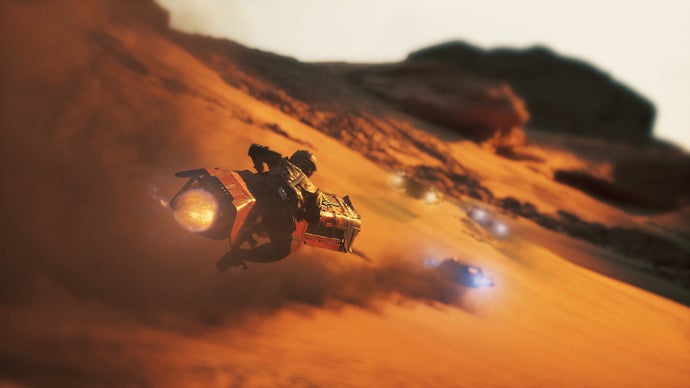
Webster says that Fuse wanted to embrace the instant gratification of an arcade racing experience, as well as to explore "what things are possible once we are decoupled from tyres and tarmac."
"For instance, we've got tracks that reach up the side of an active volcano," he says. "It's a roller-coaster sometimes."
But beyond those arcade thrills, he says Galactic Racer is challenging genre conventions. "The structure in most racing games is car collection – I mean, that hasn't changed for probably 20 years. So let's rip that up, let's steal from other genres."
He says Galactic Racer is built around consequential decision making, giving the example of crashing. "In racing games, it's hard to have consequences when you've got a rewind button. So let's bring that consequence back, and make it mean something." He says the structure of the game is inspired by roguelikes such as Hades, Returnal, and Slay the Spire: "games that are built and designed for infinite replayability. And I think that plus racing is a match made in heaven, because racing thrives on replayability."
Crashing too many times sends the player back to the start, says Webster, although you "carry some meta progression back with you, and you start from a more powerful position. But that crash has a consequence, and when you're on your last crash and you're in systems critical, you lean forward and you're starting to think about the risk that you're taking."
It's a bold step away from the handholding we've become accustomed to in AAA games, but Webster is aware of the need to stand out in a crowded marketplace, and particularly in a year in which GTA6 is set to arrive. Galactic Racer is launching on October 6, a generous distance from GTA6's due date of November 19, although not too far after some of the year's biggest releases, like Control Resonant and Silent Hill: Townfall on September 24.
But Webster says we've seen even more crowded pre-Christmas release schedules in the past. "Someone was saying, 'Oh, September looks busy', but I remember making games years ago and people talking about 'murderers' row' – and October was full of stuff." He acknowledges that the market is competitive, but says Fuse Games has "a healthy sense of confidence," tempered by a "realistic view on how things may turn out."
"I was always told good games will find a way," he says. "So we're hoping."