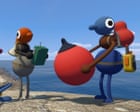
After their hit Untitled Goose Game, Australian studio House House is back with a new game where your only goal is to go exploring with friends – so we took them on a big walk inside Big Walk
When I arrive to meet with the tiny team at Melbourne game developer House House, they’re sitting in a circle under a eucalyptus tree. After introductions, the five of us set off into the scrub. Over the course of our hike we take a train to the beach, huddle on deck chairs in the sand dunes and climb a mountain as the sun rises. All without ever leaving our desks.
Welcome to the world of Big Walk: House House’s new game after the runaway global success Untitled Goose Game, which saw millions fall in love with being a naughty goose rampaging through a bucolic village. After Untitled Goose Game’s overwhelming success, House House wanted their next game to be very different and “unusual”. Despite this, Big Walk has been an immediate success, with more than 1m downloads in the first week of release.
In Big Walk, your only goal is to go on a walk through sprawling bushland, solving puzzles with friends. At the centre of the game’s design is a proximity voice chat, which means you can talk clearly to someone who is right beside you but can’t hear each other when you’re separated.
As we board the puttering train that winds across the game’s map, the House House team tells me how Big Walk began: during Covid lockdowns, when they started playing games online with international friends. This group was the first to test a very early version of Big Walk.
“One of the first things we did was just go on a walk, from one side of this map to the other,” says Nico Disseldorp, who describes his niche within the team as “capital G game design”. “And it had this really interesting feeling of wanting to pay attention to each other, to look out for each other, make sure no one got left behind.”
A turning point for House House came when sound designer Em Halberstadt suggested they bring on audio programmer Nicholas Zhang. The two had a “level of ambition” that became integral to the game; while telling me about this, the train we’re on goes through a tunnel and our voices change, echoing in the confined space.
Beyond the chunky stick figure characters, the world of Big Walk is remarkably realistic. Although they initially considered the Faroe Islands in the North Atlantic as a setting, they were drawn closer to home – specifically Wilsons Promontory, a few hours south of Melbourne. “Because of its geography, it has that kind of isolated video game level feeling that we needed,” says Jake Strasser, who worked alongside Kalonica Quigley to design the game’s intricate landscape. “And it’s just so beautiful and has all this magical, rich source material to it.”
The team spent time on Wilsons Promontory during development, staying in a cabin at Tidal River. They would brainstorm in the mornings and go on walks in the afternoon. Strasser and Quigley took reference photos of plants and the sound team flew out to do field recordings.
Jumping off the train, we head to a secluded spot by a beach. We collect deckchairs from the surrounding bush and arrange them in a circle. The sun has set but we have a glowing orb to light the way – when the sun sets in Big Walk it is properly dark.
“It seems like a tough ask for a video game audience,” animator Stuart Gillespie-Cook says of the darkness, “That sometimes it’s going to be a bit slow and sad.”
The team realised they needed something “to guide you through and give you a reason to go on these walks”: these are puzzles, the kind “you might play if you go camping when you don’t have much equipment, that are just about communicating with each other”, Disseldorp says.
The puzzles, dotted in neon buildings across the map, force you to think about communication. Often the ability to talk is removed, so you have to find another way through. Your reward for finishing each one is a red bulbous object. I’ve seen these referred to as peanuts or gourds. My friend group calls them babies.
When I ask the team what their official name is, they won’t answer.
“This interview is over!” Strasser jokes, running off.