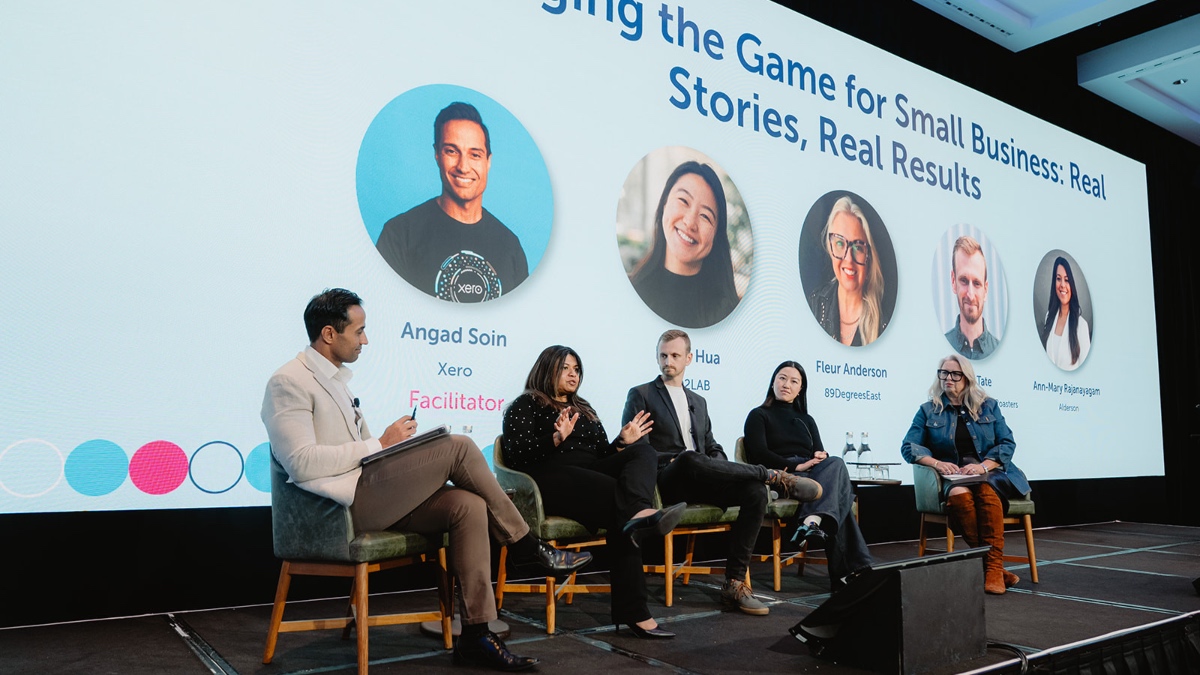
Four small business leaders shared how AI is solving real problems, not just generating headlines, at COSBOA’s National Summit.
Most conversations about AI and small business tend to stay abstract: productivity gains, competitive necessity, the risk of falling behind. At the COSBOA National Small Business Summit in Sydney, one session skipped the theory and went straight to what’s actually happening on the ground.
Led by Angad Soin, Managing Director ANZ and Global Chief Strategy Officer at Xero, the panel brought together four small business leaders to describe how AI is showing up in their day-to-day operations. The consistent thread: start with a real problem, keep people involved in the decisions, and don’t expect AI to run the business on its own.
Lindy Hua, of sustainability consultancy CO2LAB, described AI as something closer to infrastructure than a tool.
“AI has become the company’s second brain,” Hua said, explaining that it helps her lean team automate routine tasks, capture organisational knowledge and support decision-making. She encouraged other business owners to build a basic understanding of AI while being clear that subject matter expertise and human judgement remain essential.
For Fleur Anderson of 89 Degrees East, the technology serves a more specific purpose: reaching people who might otherwise be left out of business support. Her organisation uses AI to provide personalised guidance to female entrepreneurs, particularly those in regional and remote communities. Anderson said building trust matters as much as the technology itself, pointing to the importance of strong guardrails and making sure the support AI provides is genuinely practical rather than generic.
Chris Tate, of Pablo & Rusty’s Coffee Roasters, offered one of the more concrete examples from the session. He described using AI to address specific operational challenges, including food costing and staff rostering, tasks that are unglamorous but constant in a hospitality business.
Tate’s advice to other owners was to resist trying to overhaul everything at once. He encouraged businesses to start with a single practical use case, stay curious about what the technology can and can’t do, and apply human insight before acting on whatever AI recommends.
Ann-Mary Rajanayagam, of Alderon, focused on governance rather than use cases. She encouraged businesses to experiment with AI while putting clear rules in place from the outset, including defining where the technology should and shouldn’t be used, keeping accountability for AI-generated work with a person, and seeking trusted advice as the technology continues to change.
None of the four speakers presented AI adoption as simple or risk-free. Each returned to the same point in different words: the technology is useful when it’s aimed at a specific, well-understood problem, and it still requires a person checking its work.
That caution echoed a broader theme from elsewhere at the Summit. Productivity Commission Chair Danielle Wood told delegates that AI and robotics could lift Australia’s labour productivity by around 4% over the next decade, but only if businesses actually adopt the technology. She noted that while individual use of AI is high among Australians, businesses in the country continue to lag behind many international counterparts, and pointed to greater access to workplace training as a key factor in closing that gap.
Keep up to date with our stories on LinkedIn, Twitter, Facebook and Instagram.
Yajush writes for Dynamic Business and previously covered business news at Reuters.
Learn why choosing an MAS-licensed cryptocurrency exchange ensures maximum security and transparency.
How telematics and fleet technology help businesses cut costs, reduce downtime, improve productivity, and make smarter operational decisions.