Published: 14:06 BST, 19 August 2026 | Updated: 15:41 BST, 19 August 2026
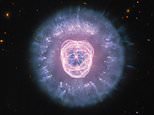
NASA's James Webb Space Telescope has snapped stunning new images of the 'Lion Nebula'.
Officially known as NGC 2392, the nebula gets its nickname thanks to its resemblance to a lion.
Around the edge of the nebula, hazy structures form a 'mane', while the stellar core, located at the centre, looks just like a button nose.
The Lion Nebula was first photographed in visible light by the Hubble Space Telescope back in 2000.
Now, James Webb has provided an even sharper look at the cosmic object in infrared.
'Webb's imagery "freezes" this planetary nebula in time, though the star's death, and its tumultuous effects, go on,' NASA explained.
'NGC 2392 will continue to undergo changes as its gas and dust migrate away from the stellar core.
'Astronomers estimate the lion will eventually disperse in approximately 10,000 years – a relatively short period in astronomical terms.'
NASA's James Webb Space Telescope has snapped stunning new images of the 'Lion Nebula'. Pictured: the NIRCam and MIRI image
James Webb has provided an even sharper look at the cosmic object in infrared. Pictured: the photo taken by the MIRI camera
The Lion Nebula is located around 5,000 light–years from Earth, in the constellation Gemini.
It formed when the star at its centre died, shedding its outer layers into space, and leaving behind a stellar core called a white dwarf.
'In the Lion Nebula, the oxygen–rich central star has died and left behind a white dwarf that is effectively "cooking" the nebula from within,' NASA explained.
'Its intense radiation is creating a bubble of ionized gas that makes up the lion's recognizable face.