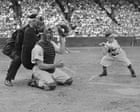
Baseball showman Bill Veeck’s most audacious stunt sent Eddie Gaedel to bat for the lowly St Louis Browns in 1951 – and created an unforgettable diamond spectacle
Bill Veeck had a track record for designing some of the most elaborate marketing promotions during his four stints as a Major League Baseball owner, including an exploding scoreboard in 1960. But his most outlandish publicity stunt was sending 3ft 7in inch pinch-hitter Eddie Gaedel to the plate at a game 75 years ago Wednesday.
Sporting uniform number 1/8, Gaedel was greeted with a standing ovation at Sportsman’s Park in St Louis as he came to bat in the second game of a doubleheader on 19 August 1951 for the St Louis Browns. A famous Associated Press photo shows Detroit Tigers catcher Bob Swift sitting on his knees with a ball in his glove, towering over Gaedel and his tiny strike zone. Not surprisingly, he walked on four pitches, and was immediately lifted for a pinch-runner.
“Detroit Tiger pitcher Bob Cain walked the first St Louis Brownie to face him today – he didn’t know what else to do with him. He was a midget,” the AP reported in a story that ran in newspapers across the country.
Many baseball traditionalists clutched their pearls about the stunt – more about undermining the seriousness of the national pastime, than out of any concern about exploitation, which would surely derail such a promotion today.
Years later, Veeck (rhymes with wreck) stood by the stunt, in words that would cause people with modern sensibilities to cringe.
“Were it in my power to turn back the clock, I’d never send a midget to bat,” he said. “No, I’d use nine of the little fellows, including the designated hitter.”
In Veeck’s defense, he used similarly politically incorrect language to describe himself. The owner, who got around on a wooden leg after a second world war injury that cost him his right leg below the knee, insisted on calling himself a “cripple”.
At the time of the Gaedel stunt, Veeck was a new owner of the sad-sack Browns, looking to inject some life into a franchise that always played second-fiddle to the city’s more popular baseball team, the Cardinals. In fact, after winning their lone American League pennant, in 1944, the Browns lost the World Series to their crosstown rivals.
Veeck had a much better run in his first stint as an MLB owner, when he ran the Cleveland Indians (now Guardians) in the late 1940s. In 1947, he became the first AL owner to sign a Black player, Larry Doby, just three months after Jackie Robinson had broken the color barrier with the National League’s Brooklyn Dodgers. In 1948, Cleveland won the World Series – still the most recent one in franchise history.
But the Browns were another story. By 1951, when Veeck bought the team, they were coming off back-to-back seventh-place finishes in the eight-team AL. At the time of the Gaedel promo, they were in dead last.
To goose attendance, Veeck had earlier announced a celebration would take place at the team’s 19 August doubleheader to commemorate the 50th anniversary of the league. More than 18,000 fans came out – a huge crowd for a team who averaged less than 4,000 fans a game, also last in the league.
But nobody knew about the unorthodox headliner.
Between games of the doubleheader, the Browns featured a procession of vintage 1901 cars and a one-man show by Max Patkin, known as the “Clown Prince of Baseball”. There were other promotions that afternoon, including free beer to every adult at the ballpark, acrobats and a band featuring legendary pitcher Satchel Paige on drums. The icing on the cake, so to speak, was Gaedel emerging from a giant papier-mache cake. Still, his place on the roster was a well-kept secret.
Veeck paid Gaedel, who was identified in news coverage as a 26-year-old stunt man from Chicago, $100 for the baseball gig. That was serious money back then: nearly $1,300 in today’s dollars.