Hello! This piece is a part of Optimism Week on Eurogamer – a week of features either about optimism itself or those which hope to inspire it. For more articles like this, you can visit our Optimism Week hub. Thank you as ever for reading!
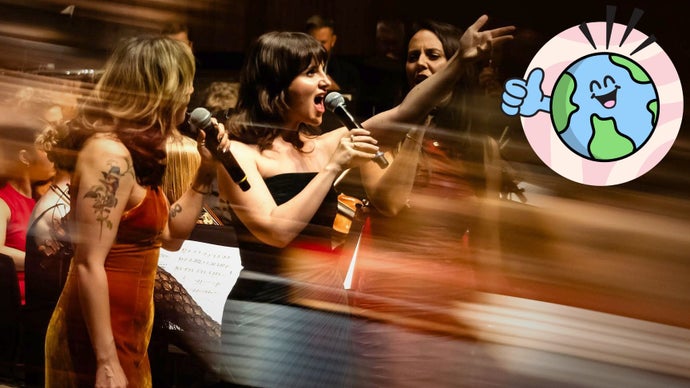
Orchestral performances of video game music are no longer the novelty they once were – and that's a good thing. Organisations such as the Game Music Festival have had such success with them they're doing multiple performances for multiple game franchises each year, selling out locations like the prestigious Royal Festival Hall on London's South Bank – sometimes in hours. That's where I watched a packed auditorium literally scream in excitement as Baldur's Gate 3 composer Borislav Slavov joined actor Andrew Wincott and singer Mariya Anastasova to perform Raphael's Final Act as an encore. These audiences: they aren't what the Royal Festival Hall is used to, they're probably not what orchestras are used to, and I love that.
Between Dom and I, we were at three orchestral game-music performances this summer. We were both at the Hades concert, then I watched the Diablo concert and Dom watched the Shoji Meguro 'Persona Grooves' concert. We come together here to talk about what we thought of these concerts and, more importantly, what makes them so vital and celebratory.
Bertie: Can I just say 'thank god for air conditioning' before we begin? It was an agonisingly hot week in London when the Hades performance was on, and as the doors flew open on that central room in the Royal Festival Hall, and an arctic breeze rushed out, it was heavenly. It was like climbing inside the half-time ice-cream cart. I've never seen an audience take their seats quicker.
Speaking of the audience: what always strikes me about these performances is who's there, who's attending them, because it doesn't seem to be a typical orchestral performance crowd. These people – us people – are costumed, casual, eclectic, perhaps younger. I'd guess that some haven't been to an orchestral concert before. But they're here because of a passion for a game or game series, and it makes for a refreshingly chaotic yet endearing experience. There's a vitality recharging what orchestral performances can be. Have you noticed this?
Dom: I have! And it's not an observation unique to us, either – many years ago in 2013, I attended a concert called Final Symphony at the Barbican. It was a suite of specially-orchestrated Final Fantasy tracks, performed by the London Symphony Orchestra. I was working for GamesTM magazine at the time, and managed to get an interview with conductor Eckehard Stier. He told me that orchestras (he'd been working with the London Symphony and the London Philharmonic that season) absolutely adored doing video game concerts.
I'm paraphrasing a bit here, but he noted that when the orchestras did Mozart or Bach or something, the audience is always very dignified and chaste. Maybe you'd get a polite clap at the end of a suite. When the Final Fantasy fans descend, however, you've got people coming dressed as Moogles or – for the show I attended – some lad in a full suit of armour reminiscent of Final Fantasy 5's big bad, Exdeath.
The audience sings along to the most memorable melodies. There's a standing ovation after every movement. I remember seeing the musicians grin from ear to ear, clearly taken aback by the passion. I am not ashamed to admit I cried at that show myself; the music from Final Fantasy 8 just does something to me. More recently, at the Persona show, I left with my face hurting because I was smiling so much – everyone on stage just seemed to be having so much fun. I think, in an industry where everything is often taken very seriously, we forget that there is good, silly fun to be had along the way.
Bertie: I love that, and I hope that through video games and pop culture more widely – I saw an orchestral performance of The Lord of the Rings: The Two Towers at the Royal Albert Hall which was wonderful – orchestras discover rich new veins of opportunity and employment, and new audiences. That they are reinvigorated by it. My even bigger hope is that live performance thrives in a world where artistic work is threatened by generative AI – because this stuff, you can't replicate. As far as I'm concerned, this is a quintessential celebration of human creativity and skill.
Dom: Ah! I have facts about this! Back in 2024, TV and film music accounted for roughly 30 percent of a touring orchestra's seasonal output – two years later and with games folded into the mix, I imagine that is a lot more now. Performing this music is an essential revenue stream that allows orchestras, composers, and conductors to continue doing what they do. And, in the theme of this week, I find that so encouraging: things may be grim elsewhere, but here games are helping sustain another industry that could otherwise face ruin. Solidarity through art. It's very special.
And I think a part of this uptick in games music as a staple in the yearly events calendar now is because it no longer lives explicitly within the game. Stephen Barton and Gordy Haab – the composers behind the Jedi Survivor games – gave me some really cool insight into this before they performed at London's Soundtrack Festival in 2025.
"We're seeing millions of streams of game soundtracks, daily," Barton told me. "There's a huge amount of social media content on Instagram and TikTok that ties into it, not to mention the world of Twitch where a streamer's playlist is a huge part of their identity. The record industry is just about catching on to this." Haab then added: "In broader entertainment circles – award shows, industry mixers – video game scores are part of the conversation now. They're treated with the same respect as film music, standing on their own as a legitimate art form. And if the surging demand for soundtrack releases tells us anything, it’s that people aren't just listening: they’re seeking it out."
Bertie: You touched upon something else I wanted to zero in on too: community. Something these performances provide is a dedicated place to celebrate a particular game or series. Fan-run events fill in some of these blanks but I don't know of another event entirely dedicated to Hades, say, or Baldur's Gate 3. There's a slight exception in Diablo, in that BlizzCon includes it, but not exclusively, and the series' music is not at the forefront there. Here, it feels like a fandom horn has been sounded, like the horn of Gondor, by which to bring people who love these things together – and that seems like a really important part of it.
Dom: I'm not trying to show off, but I've done a few of these concerts now – including one dedicated to Elden Ring and Final Fantasy 7 Rebirth, specifically, back in 2024 – and, like you say, I feel like it creates a nexus for fans. I was chatting to people that travelled from Germany and Poland at the Elden Ring concert (at the Royal Albert Hall, no less: very grand and very fitting). Here, people make new friends in new communities and – in some cases – even get introduced to new games via interacting with other fans in this way.
Bertie: It's giving game-music a way to come forward into the fore, and not just in relation to films – shout out to Baldur's Gate 3 composer Borislav Slavov who campaigns for game-music to be recognised alongside films, by the way – but also within the world of games. Music is fundamental to these experiences, but how often is it talked about in reviews? It's mentioned but usually as a side point. These concerts make game-music the star, and give it the time and space and adulation it deserves.