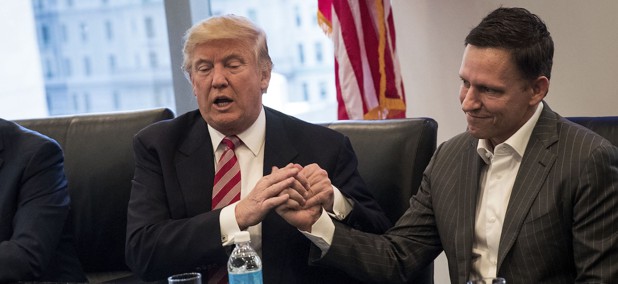
Donald Trump shakes Peter Thiel's hand during a meeting with technology executives, December 14, 2016.
Drew Angerer / Getty Images
The newest White House tech strategy pushes faster development of emerging technologies for the military, gives defense innovators more room to experiment, and will broaden the federal market for young defense tech startups. But it also doubles down on a particular approach to developing AI—one that favors a handful of well-connected U.S. tech companies at the expense of other innovative approaches. That could benefit China and slow the U.S. military from getting the tools commanders actually want.
Here’s a breakdown of the winners and losers.
Winners: swarms, deployed AI, faster military technology
The strategy puts a big emphasis on new, tech-driven approaches to warfare, particularly the use of drones and even drone swarms alongside manned and legacy assets. Specifically, it calls for “optimal combinations of lower-cost (and sometimes lower-tech or attritable) platforms that can be deployed in larger numbers and complement more limited numbers of sophisticated platforms.”
Over the last decade, efforts to field autonomous aircraft alongside fighter jets or ships, for instance, have been uneven at best—even when the Pentagon changed its talking points on the necessity for large numbers of low-cost drones—constrained by programs' internal buying policies and previous commitments to other programs' investments. The Replicator program provides a vivid example, hailed as an essential pathfinder but receiving only $1 billion in funding.
The new strategy sets specific “priority areas” for new military research and spending: undersea, space, and AI and autonomy. These priorities are the most relevant to “deterrence in the Indo-Pacific”—as in, preventing China from launching a major conflict. Within those priority areas, it lists “multi-agent systems and swarm intelligence” and various uses of autonomy, from robotics to command and control, as “critical.”
The strategy also takes square aim at policies and practices that slow down military buying of new technologies. Building off other executive orders, it pushes Pentagon buyers to bypass traditional acquisitions in favor of a “mix” of contract types, such as performance-based contracts and other transaction authorities, or OTAs. It also resets the tone for military purchasing toward “faster non-traditional approaches that may involve higher risk but offer high potential reward,” something that commanders, younger defense tech leaders, and even lawmakers have long pushed for.
Perhaps most importantly, it also takes steps to actually grow the market for younger defense tech players beyond just the military. It takes aim at foreign military sales rules and export controls that hobble the sale of much defense tech to allies. That will be especially important for newer defense companies trying to secure early-stage investment to survive. And it calls for other federal agencies to build “streamlined pathways” for smaller companies to at least get their foot in the door, even via partnerships that don’t offer young companies much more than access to federal infrastructure, such as “Cooperative Research and Development Agreements (CRADAs) and Agreements for Commercializing Technology (ACTs).”
While the strategy champions smaller, more innovative players in defense, it also weighs in on the debate about what the future of AI should look like and comes down on the side of Big Tech companies that are pushing a specific, energy-intensive, and deeply unpopular future of AI over emerging strategies favored increasingly by researchers. China will benefit from the oversight, Michael Schiffer, a partner at Scalare Advisors and former Deputy Assistant Secretary of Defense for East Asia, wrote on Tuesday for Just Security.
In its section on critical technologies for support, the strategy lists “Foundation models, including large language, multimodal, and world systems.” The section also includes niche tech areas like brain-computer interfaces but omits entirely open-weight models and open-source software development.
Foundation models, such as today’s large language models from companies like OpenAI and Anthropic, represent just one potential method for building AI tools—one that relies heavily on pushing as much data through as much computational infrastructure as possible to achieve something that looks like “reasoning,” but that’s really just plain old probability calculation.
Anthropic co-founder Dario Amodei helped to transform that concept from a research effort into a massive endeavor to acquire computational resources and data as quickly as possible. Amodei explained it simply in a 2023 discussion with Dwarkesh Patel. “It turns out that raw scale—more compute and more data—drives capabilities far more powerfully than complex algorithmic inventions or hand-crafted architectural changes.”
A small handful of frontier AI labs, and their big cloud computer backers, are in a literal race for company survival because there’s only so much power, so many chips to continue to pursue “raw scale.” If, as Amodei says, just having more “more compute” and “more data” means having the best performing models, then whoever has the most of those resources can push out any competitor.
It’s no wonder the AI race has become a concentration of wealth and power, in just a handful of labs with their large cloud compute backers. No wonder, also, that public perception of AI has plummeted: just 18 percent of Americans believe it will be a positive force for the United States, one new poll found. But the foundation model approach does have its fans: large-scale U.S. cloud providers who have invested billions in foundation model labs.