Victor Cha says Trump’s frustration with trade and investment delays, his desire to reengage Kim Jong Un and his view that wealthy South Korea should shoulder more defense costs all factored into the decision.
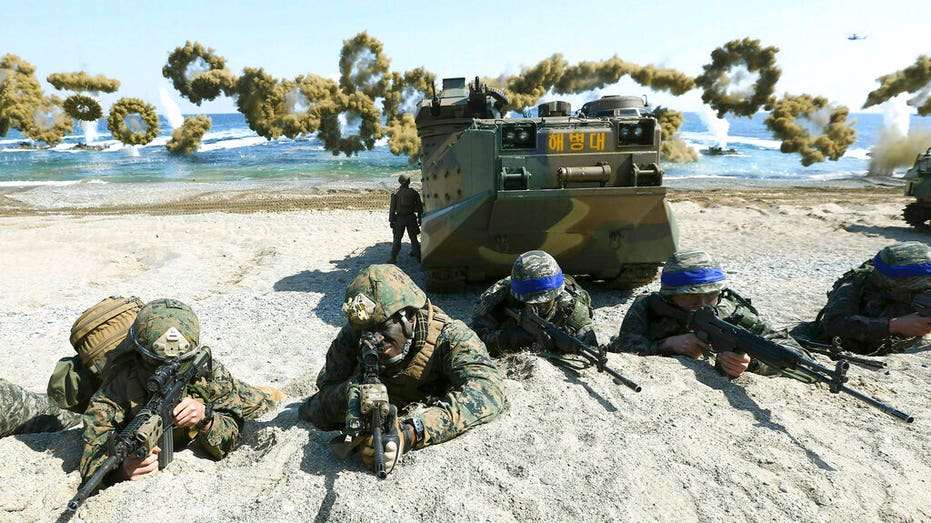
President Donald Trump is scaling back major joint military exercises with South Korea after Seoul declined to support U.S. operations against Iran, a sharp U-turn with an ally his administration publicly praised just days prior.
The move came just three days after Secretary of State Marco Rubio called South Korea an "indispensable partner" and said the allies had entered a "historic new era" of cooperation following Trump’s state visit to Seoul last fall.
Victor Cha, the Korea Chair at the Center for Strategic and International Studies, told Fox News Digital that Trump appears to see the drill reduction as a win-win for the U.S. — pressure Seoul to move faster on investment and burden-sharing while offer Kim incentives to reopen diplomacy.
"He sees this as a two for one," Cha said. "A combination of things led to Trump's frustration, that South Korea is not moving the trade and investment framework agreement on investments faster and his desire to meet the North Korean leader."
A handout photo provided by Dong-A Ilbo of North Korean leader Kim Jong Un and U.S. President Donald Trump inside the demilitarized zone (DMZ) separating the South and North Korea on June 30, 2019 in Panmunjom, South Korea. U.S. President Donald Trump and North Korean leader Kim Jong-un briefly met at the Korean demilitarized zone (DMZ) on Sunday, with an intention to revitalize stalled nuclear talks and demonstrate the friendship between both countries. The encounter was the third time Trump and Kim have gotten together in person as both leaders have said they are committed to the "complete denuclearization" of the Korean peninsula. ((Handout photo by Dong-A Ilbo via Getty Images/Getty Images))
TRUMP ORDERS MAJOR CUT TO US-SOUTH KOREA DRILLS AS NORTH KOREA RAMPS UP MISSILE TESTS
Behind the administration’s recent praise of Seoul, strains had been building, potentially leading to the mixed-messaging.
Trump has grown frustrated with the slow rollout of a $350 billion trade and investment framework, commercial disputes involving American companies and what he sees as South Korea’s unwillingness to do more for U.S. priorities, Cha detailed.
"That combination of things led Trump to make a decision where he said, 'Hey, yeah, I'm gonna scale down these exercises maybe it'll get a response from Kim Jong-un. At the same time, the South Koreans are rich, they should be doing their own exercises and like we should not be paying for them.'"
The deal would bring substantial South Korean investment to the United States while offering Seoul expanded cooperation on shipbuilding and nuclear-powered submarines.
But the first investments have moved slowly, despite Trump’s earlier threat to raise tariffs on South Korean goods by 25%, while parallel agreements with Japan are advancing faster.
The pressure on Seoul comes as Trump returns to another unfinished project from his first term: diplomacy with Kim.
Trump’s tumultuous relationship with the North Korean leader swung between threats of "fire and fury" and historic summits. The first was in Singapore in 2018 and the second in Hanoi in 2019, which was followed by a third meeting at the Korean demilitarized zone later that year.
NORTH KOREA EXPERT WARNS US CAN 'NEVER TAKE THEIR EYE OFF' KIM JONG UN FOLLOWING MISSILE TEST DURING IRAN WAR