Texas Gov. Greg Abbott joins 'The Sunday Briefing' to respond to President Donald Trump's critique of his data center halt. He also addresses a controversial surrogacy case and DFW Airport's decision to scrap plans for Islamic foot-washing stations.
Silicon Valley has spent decades winning consumer loyalty. In unprecedented numbers, people have Apple iPhones in their pockets and Amazon Alexas on their counters while they browse on Google and write in Microsoft Word. Americans have shown themselves eager to try every new technology, from health tracking rings to doorbell cameras to robot vacuums.
Yet Silicon Valley has seemingly been caught flat-footed facing something it has never faced before: the near-united opposition of the American people. When it comes to artificial intelligence (AI) and data centers, the tech industry has never been more unpopular. The industry that has created the tools of modern life is losing the fight for public opinion because, ironically, it is using the wrong tools, at least in the arena of political advocacy.
The tech industry certainly funds a formidable political machine. But it’s a machine focused on fighting over what happens on screens — content moderation, privacy, antitrust, intellectual property. Its political teams are not built for what AI actually requires: power plants, transmission lines, water rights, land use permits and the approval of hundreds of local communities across America.
TRUMP’S REINDUSTRIALIZATION AGENDA FACES ITS BIGGEST HURDLE — AMERICANS
That mismatch is why the industry is losing — badly.
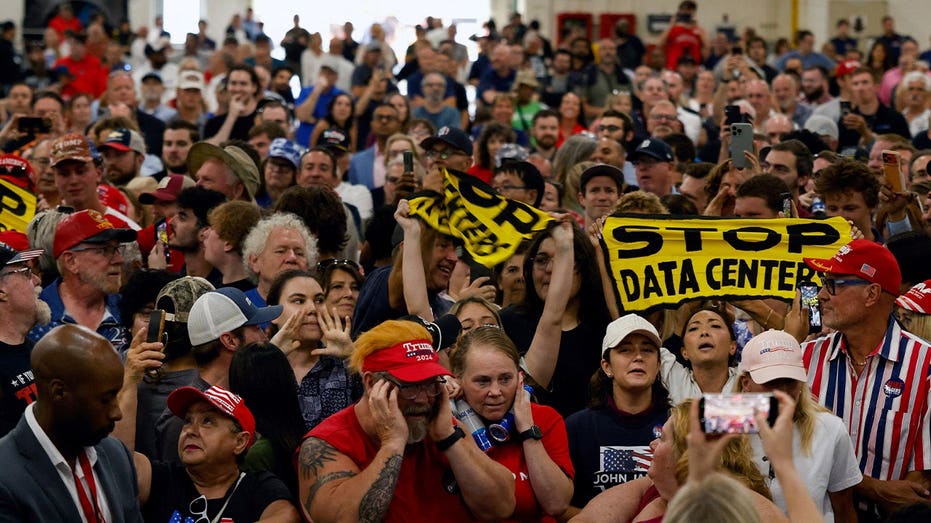
Protestors hold up 'Stop data centers' signs, on the day of President Donald Trump's speech at the General Motors Proving Ground, in Milford, Mich., July 27, 2026. (Carlos Osorio/Reuters)
Local opposition has already blocked or delayed $64 billion in data center projects between May 2024 and March 2025. A Gallup poll found that 71% of Americans oppose data centers being built in their communities — opposition now exceeding that of nuclear power plants. And just recently, New York became the first state to ban data centers.
Companies with enormous influence in Washington are losing at county commission meetings, utility hearings and state legislatures. The problem is not a communications gap. It is a structural one. Before, tech had to win big policy fights just in Washington. Now, it must win countless small fights across the country, not against local communities, but against an organized opposition with years of experience using state and local networks to block development.
Note the activist groups heading the charge against data centers. More than 230 organizations — led by Food & Water Watch and including Greenpeace and Friends of the Earth — have formally demanded a national data center moratorium.
TOP ENERGY GROUP WARNS WEALTHY FOREIGNERS ARE POTENTIALLY BANKROLLING ANTI-DATA CENTER CAMPAIGNS ACROSS US
Setting aside for the moment the irony that these so-called environmental groups are trying to thwart the biggest private-sector renewable buildout in history, these are not grassroots organizations. They are well-funded political machines that have lawyers, full-time activists, local chapters and decades of experience stopping energy projects. And some of these organizations have drawn congressional scrutiny over foreign funding: The House Energy and Commerce Committee opened an investigation to explore Chinese influence on U.S. energy policy. The logic is simple: When America fails to invest in energy infrastructure that powers AI, China wins.
No matter how they are funded, these political machines know how to take a legitimate concern about electricity rates or water consumption and turn it into a national campaign against technology itself. They have done it before with fracking and nuclear (again, in both cases, ironically driving up emissions by keeping coal plants online longer).
Fracking offers the tech industry a more hopeful template. The shale industry survived not because it out-lobbied environmentalists in Washington, but because it created direct beneficiaries in hundreds of communities. Landowners received royalties, workers earned paychecks, businesses gained customers, towns collected tax revenue and everyone gained affordable energy. Those benefits created armies of local defenders.
Nuclear, on the other hand, shows what losing looks like. Despite nuclear being an incredible, zero-emissions technology, it lost the political fight in the 1970s before its value was fully understood. America then spent 50 years underbuilding nuclear capacity. It was only surging electricity demand from AI that made nuclear energy essential enough to overcome old opposition.