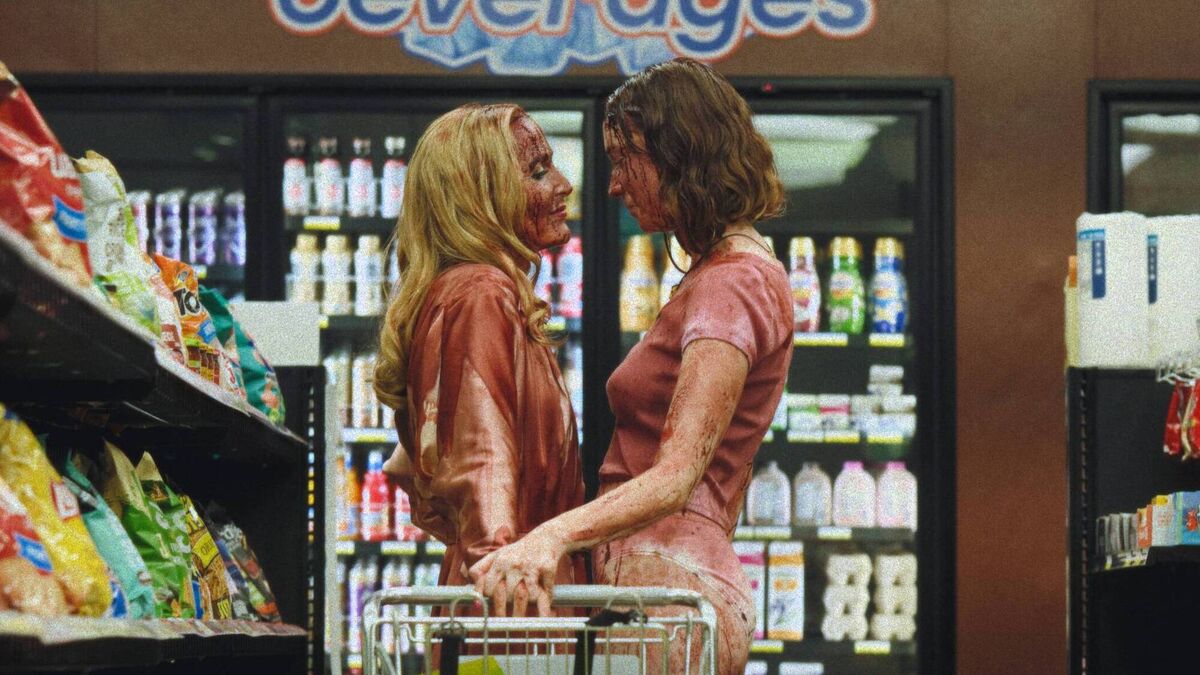
Gillian Anderson as Billy Presley and Hannah Einbinder as Kris Williams in Teenage Sex and Death at Camp Miasma. Picture: Ryan Plummer Photography
Gillian Anderson, who rose to fame as FBI Special Agent Dana Scully in The X-Files in 1993, has enjoyed a four-decade career spanning film, television and theatre.
The 58-year-old British-American actress gained a new generation of fans as sex therapist Dr Jean Milburn in Netflix’s Sex Education. She also won an Emmy and a Golden Globe for her portrayal of Margaret Thatcher in The Crown.
However, Anderson says her latest project, the queer slasher film Teenage Sex and Death at Camp Miasma, has attracted more attention than anything she has done before.
Written and directed by Jane Schoenbrun, the film follows filmmaker Kris Williams, played by Hacks star Hannah Einbinder, who is hired to resurrect the Camp Miasma slasher franchise after years of lacklustre sequels and dwindling fandom.
But when Kris visits the original film’s star, Billy Presley, played by Anderson, she encounters a reclusive actress shrouded in mystery. The two women soon become entangled in a blood-soaked world of desire, fear and delirium.
The film premiered at the 2026 Cannes Film Festival in May, where it received the Queer Palm award and earned rave reviews.
“I’ve been around for a little while, and one can only wish for this kind of response to a film,” says Anderson.
“It’s kind of crazy that a queer slasher film is getting more attention than pretty much anything else I’ve ever done.”
She adds: “It’s fun, though. People are having such a strong reaction to it, but it’s bringing them a lot of joy. They feel like they’re part of the reveal and the story in a way. They’re taking real ownership of it, which is really delightful to watch.”
Schoenbrun, who grew up as a horror fan, says the film is their most personal work to date, exploring themes of sexual trauma and dissociation.
Speaking about the queer themes in the film, Anderson says: “There’s always something about the filmmaking process that ultimately gets distilled into something quite serious because there’s so much focus and, not necessarily technique, but even in sex scenes, for instance, it can get very technical, where the angle of the head is, where your body is placed and all that kind of stuff.
“But part of Jane’s own experience post-transition, which they’re very vocal about, is the degree to which so much joy has become a part of their life in a way that didn’t exist pre-transition. So it felt like there’s almost a celebration built into the film that is specifically about joy and pleasure.”
She adds: “Even with all the snacks, popcorn and gummies, it’s all part of an expansive experience of not just the horror genre, but of the film’s meta experience of it. You’re properly leaning into and jumping into the middle of that kind of gorging. You’re surrounded by all the wrappers, and the experience of a horror film in and of itself is something that is both dangerous and titillating, full of excitement and joy.
“That tension between all of those things is so much a part of what the film is about that you can’t help but feel joyful in the process of watching it. The people on the screen, the people in the audience, and the degree to which Jane has created this homage to the genre, cinephiles and fandom, it’s almost like an, dare I say, orgasm in and of itself, a celebration of exactly what it represents.”