You have reached your maximum number of saved items.
Remove items from your saved list to add more.
“Whatever she did was excellent, you know – she didn’t muck about.” Lady Primrose Potter is telling me about her friend, Dame Joan Sutherland, the famed soprano whose career was so storied, her voice and vocal range so spectacular, that she was popularly known by the name “La Stupenda”.
Born in Sydney in 1926, by the time she retired in 1990, she had cemented herself as a legend of opera, having revived bel canto – literally “beautiful singing” – repertoire in the operatic canon.
Potter is a powerhouse of Australian philanthropy and a long-time champion of the arts, with a resume of directorships, trusteeships and patronage spanning a significant cross-section of the country’s leading arts organisations.
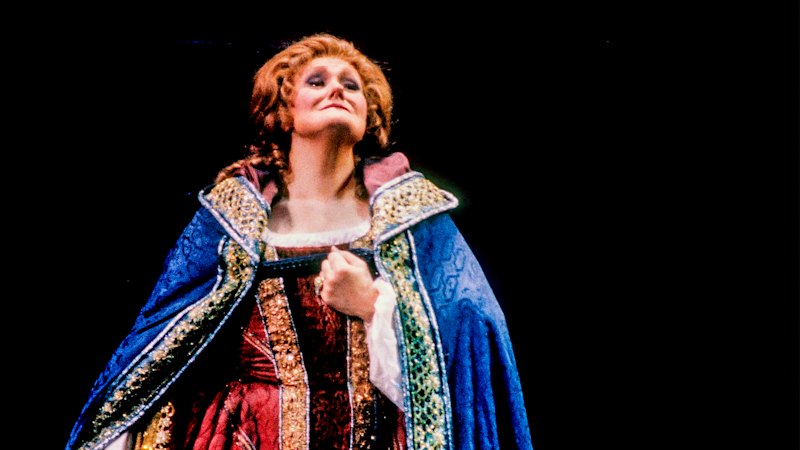
Sutherland and Potter were friends until the former’s death in 2010, at the age of 83. This month, Melbourne Opera will be staging a production of Verdi’s four-act opera Il Trovatore in honour of Sutherland’s centenary. One of the company’s founding patrons, Sutherland performed the role of Leonora numerous times across from the 1950s to the ’80s.
The stories start slowly at first, then they come quick and fast. There’s the one about when Sutherland sang the title role in Donizetti’s Lucia di Lammermoor and fully embraced the gore and tragedy. “I loved it,” says Potter. When Joan walked out [as Lucia] having murdered the husband, with blood all the way down the front of her dress, everyone went [sharp inhalation of breath]. It was lovely”, she says with a laugh. “Others had little bits here and there, but she had the whole works.”
Another story is of when Sutherland and her husband Richard Bonynge were preparing to travel from New York to London she left all her luggage on the street corner. “She said, ‘I washed the floor, I washed Ricky’s shirts, I ironed them, I did this, I did that, scrubbed and cleaned’, and then she said ‘I dragged the four big suitcases down to the street level, and swept into the car.’” It wasn’t until they arrived at the airport that they realised none of their baggage was with them. “Luckily,” says Potter, when Sutherland rushed back to the street corner, “it was still there”.
Then there’s the story about how Sutherland extended her vocal range. “She said, ‘…I was in the bath and I was singing to myself, and Richard shouted from the next door room, “Go a bit higher”,’ and so she did, and he said, ‘Yes, go a bit higher again’, and that’s what got her up to the soprano stuff.”
All of Potter’s stories about her friend paint the same image; of a warm woman at the top of her field, who was both practical and hands on.
“It was just sort of cosy, you know. My friendship with her – I wasn’t particularly interested in all the how-do-you-do’s … opening nights and you know, people all dressing up and carrying on … I always went for her sake.”
Their friendship stretches back so far that Potter, who is now in her mid 90s, can’t remember how they first met, but she remembers how “we’d sit and talk – but very little talk because she looked after her voice so well,” she adds with a smile. “We’d talk quietly about something and then stop and just sit nicely in the sun.
“She was a really nice person. There was no grandeur about her. She got in there and sang. ”
When someone slips into legend status, it’s easy to forget the little things about them that made them an individual – it can be hard to imagine that the person the main stage in the Sydney Opera House is named after used to sit on the edge of the stage doing tapestry during rehearsals while wearing her slippers.
Potter emphasises the fact that Sutherland was also a strong supporter of up-and-coming singers. She didn’t feel threatened, or the need to be competitive? “She didn’t need to be,” Potter replies, matter-of-factly. She was the best.