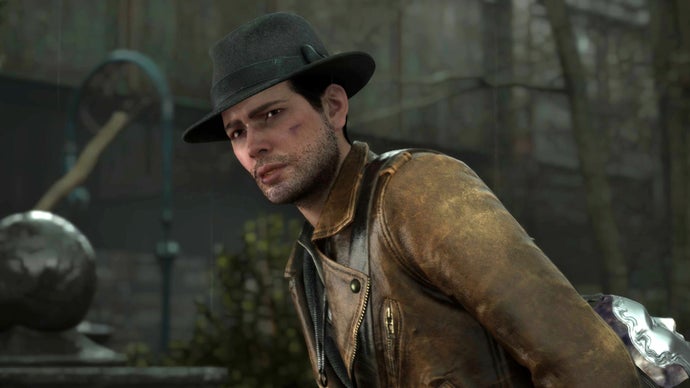
There's a bit, early on in The Sinking City 2, where you enter the waterlogged Miskatonic University. As you teeter around toppled shelves and slalom through sodden tomes, a siren begins to blare. It's the last call for survivors hoping to flee the doomed city of Arkham, after which only a few determined souls remain. It feels like a world in the process of transition as we join it, and that's reflective of the series too.
The original Sinking City, released back in 2019, saw Ukrainian developer Frogwares building on its detective game roots (the studio is perhaps best known for its Sherlock Holmes adventures) to create a Lovecraftian tale of cosmic horror with an investigatory open-world focus. Its sequel retains the evocative 1920s time period and moody sunken metropolis setting, but it's all change from there. We've a new protagonist in paranormal gumshoe Calvin Rafferty, and the action's now shifted from Oakmont, Massachusetts to Arkham. But the changes run deeper; this follow-up massively downplays the original's deductive spirit and massively ups its combat, shifting firmly into the realm of survival horror. It's a risky gamble – especially given Frogwares' previous struggles to deliver satisfying combat – but seven or so hours in, it's definitely winning me over.
Not that The Sinking City 2 doesn't find ways to impress from the off. It is, for one, gorgeous. It's a looker from your first glimpse of Arkham's skyline – a tangle of 1920s billboards, huddled brownstone apartments, raised railway lines, historic monuments, and New England spires – and it's equally striking, albeit in a rather soggier, more dilapidated fashion, as you take to the flooded streets in your dinky little boat, watching the buildings drift by. It's a world full of period flourishes – from vacuum tube radios and grandiose art deco lobbies to hinge-bonnet automobiles and half-submerged tram cars. And because it's a city in the grip of cosmic forces, there's room for stranger sights too.
It's an evocative backdrop to The Sinking City 2's retooled action, beginning with a trip to Miskatonic University and the search for an ancient rite that might wake Rafferty's lover from her endless slumber. And while the sequel's boaty business initially suggests a return of its predecessor's semi-open-world tootling, it's all a bit of a ruse, and it quickly turns into a leaner, more focused kind of adventure. Early on, momentum is halting as Rafferty traverses Arkham's accursed floodwaters; charting a linear path until he reaches the next impasse, at which point the shift to survival horror, with all its familiar trappings, is immediate.
Out of the water, you'll prowl shadowy interiors and rain-drizzled exteriors in an endless search for the usual macguffins – fuses, cogs, keys, and key-like things. You'll hoover up conveniently discarded health and ammo (and gather resources to craft your own, although the crafting system feels a little superfluous here). You'll see faint glimmers of the series' deductive past-life too as you uncover clues to solve puzzles – find the correct sequence of glyphs to activate an arcane contraption, say, or deduce a numerical padlock combination – but it's lightweight stuff, and they're rarely stumpers. And while some clues hint at optional upgrades in previous areas, loosening up the rigid early progression, the balance undoubtedly leans heavily toward action.
The good news is Frogwares seems to have cracked the fundamentals of combat this time. There's nothing revelatory about its gunplay – pull a trigger to focus your shot, pull another to fire, do a stomp attack when an enemy goes down, or a stumble-dodge when things get hairy – but it's responsive. And things will get hairy. Arkham's monsters – corpses reanimated by worm-like hosts, scurrying spidery horrors – are skittish things. They'll lurch graspingly forward, dash away around corners then come bounding back, or simply fling themselves at you, making it tricky to hit their weak points or land a toppling knee shot, without burning through ammo.
And because we're firmly in survival horror mode, tension is built through limitations. Inventory space is small; ammo, health restoratives, and crafting resources are scarce (side note developers: if you're making a game where your health indicator is a massive pulsating red screen border and I'm going to be short on health most of the time, please let me turn the effect off in the settings). And you never quite feel properly equipped for any given situation. It's a familiar survival horror trick, of course, but The Sinking City 2 feels perhaps a little overzealous in its hobbling. Chuck in other quirks – its slightly too confined spaces, its untelegraphed rear ambushes – and there's some early frustration while you figure your way around combat's somewhat counterintuitive rhythms.
Gradually, though, as I learned to adopt a less fleeted-footed, more doggedly stolid approach to combat, it started to click (boons and weapon upgrades also help), and things shift for the better elsewhere. The oddly staccato pacing of those opening hours dissipates as Frogwares begins to play in larger spaces – a crumbling art deco hotel is an early highlight, and a surprise second-act shift away from the city to a labyrinthine hospital brings a more exploratory focus. And as the pace settles, the mood intensifies into a surprisingly effective bit of horror.
But even before Frogwaves properly finds its groove, there's plenty to admire in its craftsmanship. Routes might be relatively constricted early on, but they're wonderfully evocative in their roaring 20s dilapidation, winding through the city in unexpected ways: a bar stop-off spills into a traffic-strewn street and a nearby firestation; a graveyard path snakes its way into an adjacent printing house before tumbling out into a waterlogged back alley, up a fire escape, and into neighbouring buildings. And the gentle worldbuilding – the notes, the environmental tableaus, even bits of item flavour text – brings a melancholy life to Arkham as Frogwares seeds snapshots of those who left and those who stayed behind.
But as doomed as The Sinking City 2's world may be, there's a lovely sense of fun throughout. One early set-piece sees you charging through a burning building, leading you toward a hole in a wall where a blinking bar sign's few remaining letters amusingly flash the word "RUN". A little later, a brief dalliance with an elder god and its hooded worshippers in an abandoned church is an entertaining bit of cosmic silliness (Frogwares very much leans into the mythology's pulpier side here), and I honestly can't get enough of the the Weird Tales-inspired radio broadcasts, read by an actor who appears to be channeling David Lynch from beyond the grave.
I might only have played half of it so far, but already The Sinking City 2 feels all kinds of transitional. It's a world in shift, and a series in flux – eventually finding a more confident rhythm as it shakes off its first-act ties to its waterlogged past and more fully commits to survival horror, even if I do miss some of the original's more pronounced deduction. And it feels like a transition for Frogwares too. A few wobbles aside, it's a boldly assured departure for the studio, and I'm fascinated to see where the journey takes it – and us – as we venture further into unknown places.