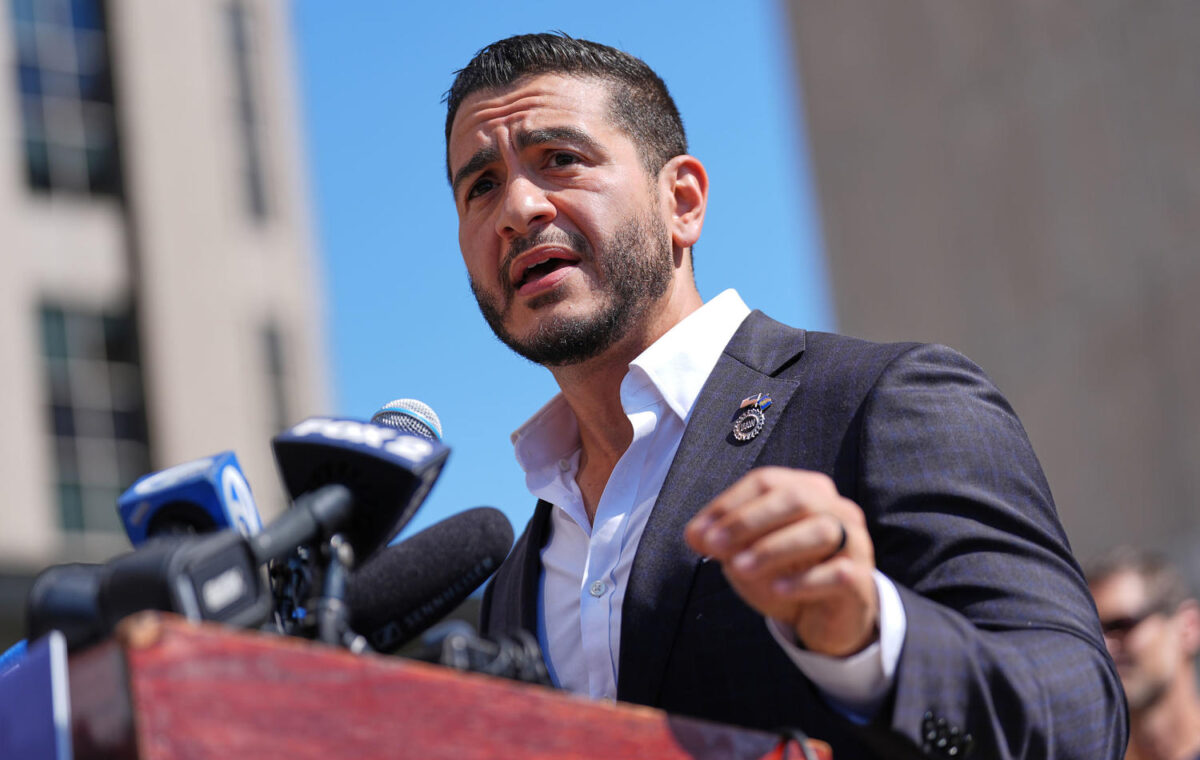
Happy Monday. In today’s edition, our staff digs into President Donald Trump’s latest surprise in the realm of foreign affairs. Plus, senior national politics reporter Sahil Kapur explores a polling gap in Michigan — and what it means for the Democratic Party.
Sign up to receive this newsletter in your inbox every weekday here.
While polls show a political environment favorable enough to Senate Democrats that they’re competitive in several states where President Donald Trump won by double digits, a new survey offers a sobering reality check in must-win Michigan.
Days after progressive Abdul El-Sayed defeated moderate Haley Stevens in a highly competitive Democratic primary this month, a Fox News poll conducted by a bipartisan pair of polling firms found El-Sayed trailing Republican nominee Mike Rogers by 4 percentage points, 51%-47%.
The same poll also looked at the race for governor and found Democrat Jocelyn Benson leading Republican John James by 5 points, 52%-47%. Both spreads are within the poll’s margin of error of plus or minus 3 points.
The most worrying finding for El-Sayed in the poll may be that his weakness compared to his Democratic ticket-mate isn’t limited to any specific demographic. He’s underperforming Benson among just about every group — including men (by 4 points), women (by 8 points), white voters (by 5 points), Black voters (by 11 points), college-educated voters (by 4 points), voters without a college degree (by 7 points) and even voters under 30 (by 7 points).
The starkest deficit is among independents: Benson is winning them by 18 points, or 56%-38%, while El-Sayed is losing them 5 points (48%-43%) in the same poll.
There are caveats. El-Sayed just broke free of a bitterly contested primary that divided the Democratic Party — and while Stevens has fully endorsed him, those wounds will take time to heal. By contrast, Benson coasted to her nomination without much competition, allowing her to pivot to the general election early.
Rogers has also proved to be an adept candidate, serving in Congress as a mainstream conservative from 2001 to 2015 and more recently gaining Trump’s endorsement to help him with the MAGA base. He only narrowly lost a 2024 Senate race, and he’s trying to avoid weighing in on contentious issues and instead keep the focus on Democrats.
El-Sayed ran on a message that a populist progressive like him is better suited than an establishment Democrat to carry the mantle of change and to speak to the needs of struggling middle-class and low-income Americans. Now he has to prove it — and the stakes are high for both the progressive movement and the Democratic Party.
Without holding on to Michigan, the party’s already tough path to netting four seats and winning a Senate majority narrows dramatically.
El-Sayed has 11 weeks to make up the deficit. But the early findings show that he has a lot of work to do.
The United States’ military drills with South Korea have long served as an annual demonstration of American commitment to its key ally’s security. But the exercises were thrown into confusion today after President Donald Trump called for them to be scaled back hours before they were set to begin, adding to a sense of vulnerability in Asia as the U.S. is occupied by the war with Iran.
Trump cited South Korea’s refusal to join the conflict in the Middle East, as well as his “very good” relationship with North Korean leader Kim Jong Un. He said the exercises sent a “totally inappropriate and hostile” signal to North Korea, a nuclear-armed state that has been escalating threats against its neighbor.
But the order to “substantially reduce” the 11-day drills may have sent its own ominous signal to South Korea, which remains heavily dependent on the U.S. for nuclear deterrence against North Korea’s growing nuclear threat.