June had come and gone. It was almost the end of July. But Babul Bora of eastern Assam’s Golaghat district was still waiting for rains to sow paddy.
This was unusual. Monsoon typically arrives in Assam in the first week of June. Between mid-June and mid-July, farmers across the region get busy in sowing and transplanting paddy.
“Khorang asile,” Bora told Scroll. “There was a drought.” The 56-year old cultivator from Balidowa village in Pachim Brahmaputra panchayat saw cracks appear in his fields.
Many other villages in Golaghat recorded such conditions. According to reports by district authorities, three of Golaghat’s six revenue circles faced “drought-like” conditions as of July 14.
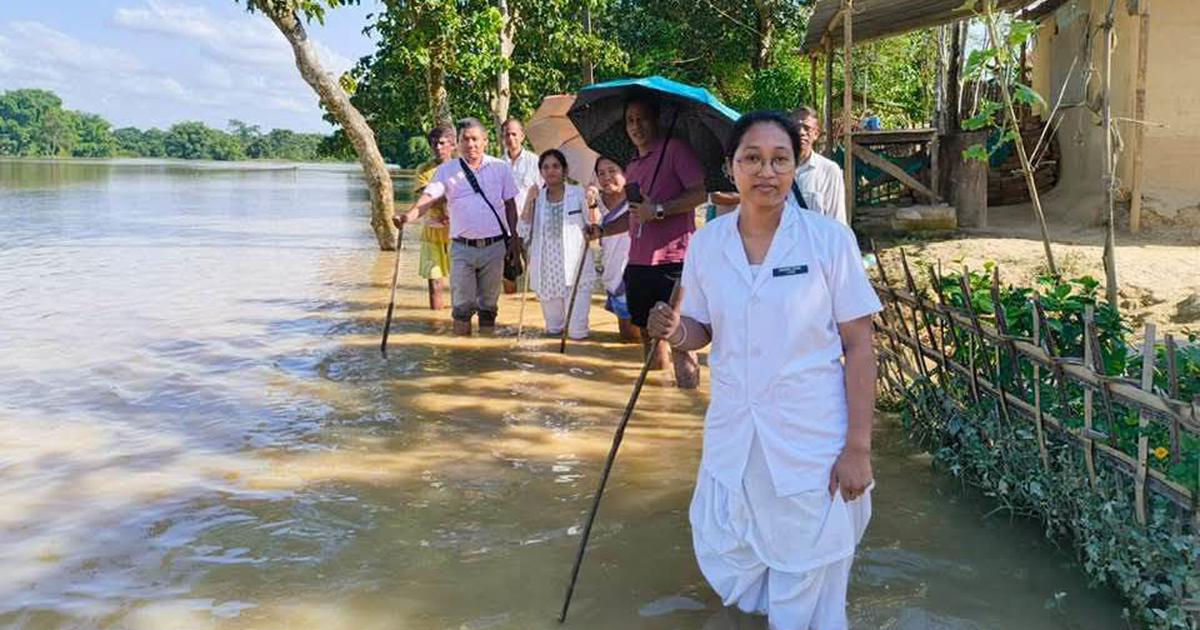
On July 19, heavy rain caused the Gelabil river near Bora’s village to swell up, submerging homes and farmlands.
In the week between July 16 and 22, Golaghat received 147% more rain than usual, data from the India Meteorological Department shows.
Golaghat became one of the four worst-hit flood districts in Assam. Over 100 people have lost their lives and around seven lakh people displaced across the state in devastating floods. The waters have wreaked havoc in Upper Assam, areas which have rarely seen such intense floods in the past.
“The floodwater killed us,” said Bora. The water has not receded from his fields even today.
For the first time since 1998, Bora’s family has not been able to sow paddy. “It is the first time that we have suffered drought and flood at the same time,” he said. “It is a disaster.”
In Sarupatha revenue circle, official documents that Scroll saw indicated that 57 villages were affected by drought-like situation, impacting over 12,000 farmers.
Six of these villages were subsequently flooded, according to the flood report prepared by the district disaster management authority.
Dipok Gogoi, a cultivator of Kenduguri village under Morongi revenue office, faced drought-like conditions followed by floods a few days later. His family managed to sow paddy around August 1 by pumping up groundwater. Six days later, his village was inundated. “Ten bighas of our paddy fields are still under water,” said Gogoi.
But, strikingly, even as fields remain inundated and uncultivable in Golaghat, latest data from the met department shows that between August 6 and August 12, the total rain the district received is still short by 45%.
Golaghat has always been vulnerable to both droughts and floods. But scientists point out that what might be changing is the nature and impact of these extremes.
“Our district-level assessment identifies Golaghat, Dibrugarh, Sivasagar, Charaideo and South Salmara–Mankachar as facing dual risks of both flood and drought,” said Surbhi Vyas, a research fellow with Centre for Disaster Management and Research at Indian Institute of Technology, Guwahati.