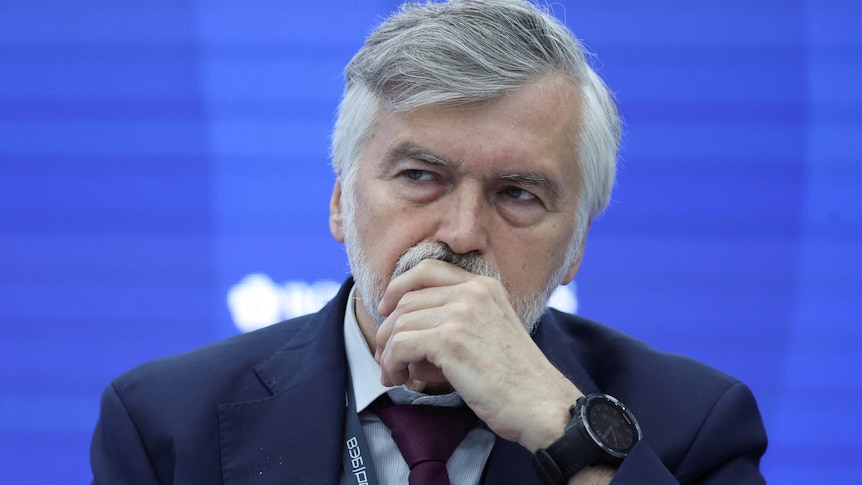
Andrei Klepach is one of Russia's most prominent macroeconomists. (Reuters: Anton Vaganov)
Andrei Klepach, the chief economist of the Russian state development bank VEB, has been fired.
It follows an address at a financial forum in which he predicted a social crisis and warned Russia was losing its "war of attrition" with the West.
The comments mark a rare critique by a senior figure at a state institution of the costs of the war in Ukraine.
Russian state development bank VEB has fired its chief economist over remarks in which he said the country was falling behind the West and China and suffering mounting economic damage from the war in Ukraine, two sources familiar with the matter said.
Andrei Klepach, one of Russia's most prominent macroeconomists, made the remarks to a financial forum in May, but they were reported in Russian media only last week.
"We are falling behind. We are losing both the technological and economic competition in the world. And we are losing it not only to China and the United States, in some ways we are losing it to Ukraine too," he said, adding that this was due to Kyiv receiving financial support from the West.
The speech, published on the website of the Nikitsky Club — a forum of economists, academics and government officials — and in which he predicted a social crisis, marked a rare public critique by a senior figure at a state institution of the costs of continuing the war that Moscow launched in 2022.
Mr Klepach has held several roles at economic institutions and worked at the economy ministry for 10 years before joining VEB.
VEB, which finances state projects, confirmed in a written response that Mr Klepach was no longer its chief economist, but did not say why. Mr Klepach, who was appointed to the role in 2014, also confirmed his dismissal to Reuters.
In the speech in May, Mr Klepach highlighted Russia's resilience to Western sanctions but said pressures were mounting due to Ukrainian strikes on energy and logistics infrastructure.
He pointed to rising income inequality and a slower GDP growth rate than in the US and Ukraine.
In July, the Russian central bank suggested the economy might not grow at all this year. Over the summer, repeated Ukrainian attacks on Russian oil refineries and warehouses of top online retailer Wildberries have created supply shocks, raising inflation risks and public unease.
Ukraine's 40-day campaign to take the war to the heart of Russia increases the strain on Russian businesses, people and air defences, analysts say.
President Vladimir Putin has said the economy was stable despite what he called external attempts to undermine it.