The Guardian’s journalism is independent. We will earn a commission if you buy something through an affiliate link. Learn more.
After trying nearly everything to prevent mosquito bites, I tested Biogents’ traps, used by the CDC and WHO, to find if backyard results are worth $200
This $380 kayak goes from backseat to lake in 10 minutes
Sign up for the Filter US newsletter, your weekly guide to buying fewer, better things
Don’t get me wrong: I’m a peaceful person with compassion for all earthly creatures. Except mosquitoes, which deserve all the swats, cursing and loathing they get.
As someone for whom a single bite brings big, red, itchy lumps that last for days, I’ve done everything imaginable for relief. I’ve removed any standing water I could find, slathered myself with Deet, picaridin and eucalyptus oil until I smelled like a chemical waste dump, and worn hats, long sleeves and shirts soaked in alleged repellants, but none of it works.
So it was time to roll out the big guns. I turned to Biogents, a German company whose patented nontoxic mosquito traps are used by organizations from the Centers for Disease Control and Prevention to the World Health Organization. But the Mercedes of mosquito control also comes with a Mercedes price tag: a single trap costs $200. Could the backyard results possibly justify that kind of expense?
Biogents sent me two of their Mosquitaire traps, designed to trap and kill existing mosquitoes, and two of their GAT devices, designed to prevent further them from reproducing.
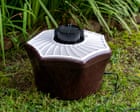
The Mosquitaire is a hexagonal plastic device the size of a plant pot you’d buy a small tree in. I put two in shaded, still corners of my garden and installed a SweetScent attractant pouch in each. Despite the misleading name, this nontoxic pouch gives off some of the rather repulsive smells that we stinky humans emit, luring the mozzies in. Three pouches are included with each trap, enough for a six-month season. Once inside, a fan sucks them into a trap bag, where they are trapped and die, as mosquitoes are surprisingly bad fliers. The 12V power supply plugs into an ordinary outlet and includes 30ft of low-voltage cable, which was enough for my yard, but could be limiting depending on where your home’s outdoor outlets are. (Mosquitaire warns not to use it with an extension cord.)
These Mosquitaire traps also offer an option to make them even more enticing by adding a flow of CO2 (carbon dioxide) that makes the trap look more like a live creature to a mosquito. I wasn’t able to test this, as I couldn’t find a CO2 bottle in driving distance.
The next line of defense is the GAT (Gravid Aedies Trap), a smaller device the size of a flower pot that catches the real villains: the female mosquitoes that lay eggs by the thousand. You fill it with water and dead leaves, then install a net and a plastic sticky card above the water. Egg-laden female mosquitoes smell the stagnant, stanky water and decide that this looks like a good spot to lay their eggs where their evil offspring can thrive. Before they get to the water, the net blocks them and they blunder about until they get stuck on the sticky card. I put these at the side of my house, also in shaded, still spots. The GAT doesn’t require power, but you do want to put it away from pets who might stick their noses in and get stuck.
The theory is that this combination captures not just the mozzies who want to drain my blood, but also the ones that have already bitten me (or someone else), digested my vital fluids and are now looking to spawn the next generation of evil.
After deploying all four traps for two weeks, I emptied them to see the death toll. The results were fascinating.
One of the fan traps caught more than 200 of the common floodwater (Aedes vexans) mosquitoes and about 15 Asian tiger (Aedes albopictus) mosquitoes. The other fan trap on the other side of my yard caught much less: just a handful of the smaller floodwater and two Asian tiger mozzies.
The GAT traps seemed to be less effective. I only found a couple of the larger Asian tiger mosquitoes and a handful of other insects. That is disappointing: the females looking to lay eggs are the ones that you really want to catch, as every female mosquito can lay thousands of eggs, which can lead to hundreds of biting adults. So while I may have caught a couple, I prevented many more.