Published : Aug 17, 2026 22:29 IST – 8 MINS READ
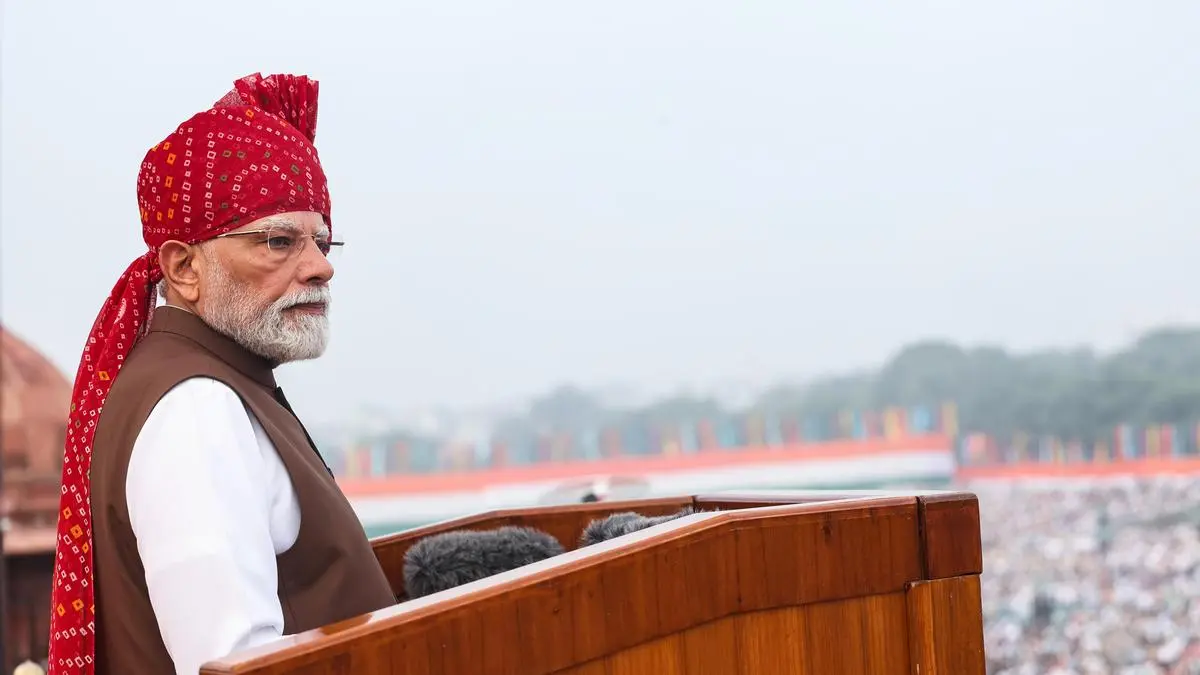
Prime Minister Narendra Modi addresses the nation from the ramparts of Red Fort on 80th Independence Day, in New Delhi, on August 15, 2026.
| Photo Credit: DPR PMO/ANI
From the ramparts of the Red Fort on Independence Day, the Prime Minister said armed naxalism was nearing its end but warned of a “dimagi naxal” mindset. Such people, he said, must be identified and isolated. Read that again slowly. It is now enough to just think the “wrong” way. This is where every political order that has ever tried to manufacture consent eventually arrives. The process begins by punishing what people do, finds that insufficient, and ends by taking an interest in what they even think or may think. India has stood near this spot before—the Emergency did it in the open. What is new is that no official or even unofficial proclamation is required. A phrase from a national podium, on the most public morning of our year, does the work. The ante, it seems, has been raised.
There are moments in the life of a nation when a question must be asked, and remembering what the flag stands for is precisely what compels the asking. The tricolour is more than cloth on a pole; the national anthem, more than a composition to be finished before we resume our ordinary lives; and the national song, more than a cultural inheritance. These symbols carry memory, sacrifice, aspiration and, above all, an idea of India and, hence, we must ask whether reverence for them requires silence about the nation’s anxieties. Most Indians would answer no.
A country does not grow stronger because its citizens have been persuaded to set aside their questions for a few minutes, and patriotism does not deepen because the unemployed are asked to sing louder, the anxious to stand straighter, or those hurt by public policy to accept that national pride comes first. A nation is no abstraction floating above its people; it is experienced through their lives. It is experienced by the young person searching without success for work; by the farmer calculating whether the next crop will survive the season and whether it will cover what he spent to grow it; by the family wondering whether an illness will consume its savings; by the worker whose wages lag behind rising prices; by the student who is worried about her future; and by the citizen who asks whether institutions remain independent, whether public discourse remains humane, and whether disagreement still has a legitimate place in the Republic. These are not anti-national questions. They are national questions.
The greatest danger to patriotism may not be criticism at all, but a political culture that treats criticism as disloyalty. Why should a citizen have to choose between loving India and worrying about India? Why should a question about unemployment be read as a deficit of national pride, a concern for social harmony as a weakening of the country, or an inquiry into whether public institutions are functioning as an attack on the nation? Why should citizens who question the denial of tribal communities’ rights over their land and resources be branded “Urban naxals” or “Dimagi naxals”? A democracy worthy of the name must have room for those who love their country enough to question its government, its institutions, and its injustices. Patriotism that requires silence is no longer patriotism; it is obedience.
The Republic was not founded on the proposition that citizens would surrender their judgment at the sight of a flag or the sound of an anthem. Its founding premise was more demanding: that citizens possess judgment, and that their judgment matters. Our constitutional imagination is more spacious than the narrow patriotism that so often enters public life today. The Constitution does not ask citizens to feel proud; it establishes the conditions under which pride can become a democratic responsibility—a framework within which people may speak, question, disagree, associate, protest, vote, and demand accountability. Dissent, in that framework, is not an interruption of patriotism but one of the ways citizens take part in the life of the Republic.
This is no technical distinction; it goes to the heart of democracy. A government is not the nation. No party and no leader holds the sole copyright to speak on the nation’s behalf. The nation is larger than all of them, which is why disagreement with a government cannot be equated with hostility towards the country. Governments are temporary occupants of constitutional offices; citizens are the enduring sovereigns. Sovereign citizens may grasp the values inherent in national symbols and still object to their political exhibition, particularly when emblems of unity are invoked to deflect attention from governance failures or to shame critics into silence. The flag moves people; the anthem evokes memories politics cannot manufacture; a song from the freedom struggle connects generations as no slogan can. At their best, these symbols create a shared emotional vocabulary among people who agree about almost nothing else. Their power lies in belonging to everyone, and it dissolves the moment those who govern claim them as their own.
The question, then, is not whether to respect these symbols; it is what we do once we have. There is no contradiction when the anthem ends, and the difficult questions begin, when the flag rises, and citizens demand accountability, or when a national song recalls the sacrifices of earlier generations and moves us to ask whether the India being built today honours their hopes.
This may in fact be the most meaningful form of patriotism, and the form governments find least comfortable. Strip away the theatre and return patriotism to its moral core: would it not include concern for the dignity of fellow citizens, a demand that every child receive a decent education, an insistence that public institutions treat citizens fairly and without discrimination, an objection when hatred becomes politically profitable, and a question about whether development is reaching those who need it most?
A flag should never become a curtain behind which a nation’s problems disappear, nor an anthem a lullaby sung whenever uncomfortable questions arise. In the picture, school students wave national flags during a rehearsal ahead of the Independence Day parade at Guru Nanak Stadium, in Amritsar, Punjab, on August 10, 2026.
| Photo Credit:
SHIVA SHARMA/PTI
A flag should never become a curtain behind which a nation’s problems disappear, nor an anthem a lullaby sung whenever uncomfortable questions arise. The deepest respect we can show these symbols is to live by the democratic and constitutional values they represent rather than to turn them into tests of conformity. There is a further danger in such tests: once patriotism is defined as agreement, the political community begins to shrink. The critic is called unpatriotic, then the dissenter, the protester, the inconvenient journalist, the questioning student. Eventually, ordinary citizens learn to censor their own concerns. A democracy should fear that silence more than any noise.
We should be wary, then, whenever national symbolism is used to sort citizens into categories—patriots on one side, suspects on the other—rather than to bring them together. India is too large, too diverse, and too old a civilisation for so narrow an idea of patriotism. Our plurality is not an inconvenience to be managed but an inheritance to be protected. The person who speaks one language and the person who speaks another, the believer and the non-believer, the government’s supporter and its critic, the urban professional and the rural worker all inhabit the same Republic. They may profoundly disagree about politics, faith, economics, or the country’s direction, and not one of them has a lesser claim to India. The Republic grows stronger not when these differences vanish but when it makes room for them to coexist with dignity.
The flag belongs to all of them, and so does the anthem—and with that belonging comes the right to ask whether the promises attached to these symbols are being kept. The real question is not whether our symbols should make us forget our concerns, but whether they should remind us of our obligations. Let the flag remind us that the country belongs equally to those whose voices carry and those barely heard. Let the anthem remind us that unity is not uniformity. Let the national song remind us that freedom was won so that later generations would inherit the right to shape their own destiny, and not merely a set of ceremonies.
Within a day after the PM’s speech, the dimagi naxal phrase was already being worn as a badge, which is what happens to a label meant to shrink the political community when it turns out to include most of it. So let it stand. If thinking about this country’s unemployment, its farmers, its institutions, and its democratic future makes a person a dimagi naxal, then the ramparts have not identified a threat to India. They have only described a citizen.