While the Sicilian city of Messina celebrated its most important religious summer holiday, thieves carried out a heist at the regional museum, making off with several works by Renaissance painter Antonello da Messina.
The thieves stole four of Antonello’s works from the Regional Museum of Messina (MuMe), local officials said on Sunday. The 15th century artist is credited with revolutionizing Renaissance portraiture by popularizing elements of Flemish realism and oil-painting techniques in Italy.
“We are devastated by what happened. They were among Antonello da Messina’s most important and best-known works. It is a tremendous loss for the museum, the city, the community and the art world,” MuMe director Marisa Mercurio told Italian news agency ANSA on Sunday.
“Messina without Antonello is deprived of the very essence of the greatest artist of the European Renaissance,” Enzo Caruso, Messina culture councillor, told broadcaster Sky Italia.
The theft is the latest high-profile heist in the art world. Days before, Italian police said they recovered three artworks by Renoir, Cézanne, and Matisse that had been stolen from Parma’s Magnani Rocca Foundation in March. Five people were detained in connection with the theft.
MuMe was closed to the public on Sunday amid ongoing investigations.
Here’s what we know so far about the heist.
At least three masked people approached the museum at around 9:50 p.m. on Saturday, Italian media reported, citing museum officials and preliminary investigative materials. The theft took place during the Vara procession marking the Ferragosto holiday, which commemorates the feast of the Assumption of the Virgin Mary.
Italian media outlet TempoStretto reported that part of the perimeter railing near a side gate of the museum appeared bent or cut, and an exterior door had been forced open. The thieves appeared to target the Antonello works, going directly to the rooms after entering the museum, according to newspaper La Sicilia.
The theft took place over a few minutes, local media reported.
Marisa Mercurio, director of the museum, told Italian media that the museum’s alarms and cameras were working. Police are investigating how the thieves managed to bypass the security system. Investigators are reportedly reviewing surveillance footage of the theft.
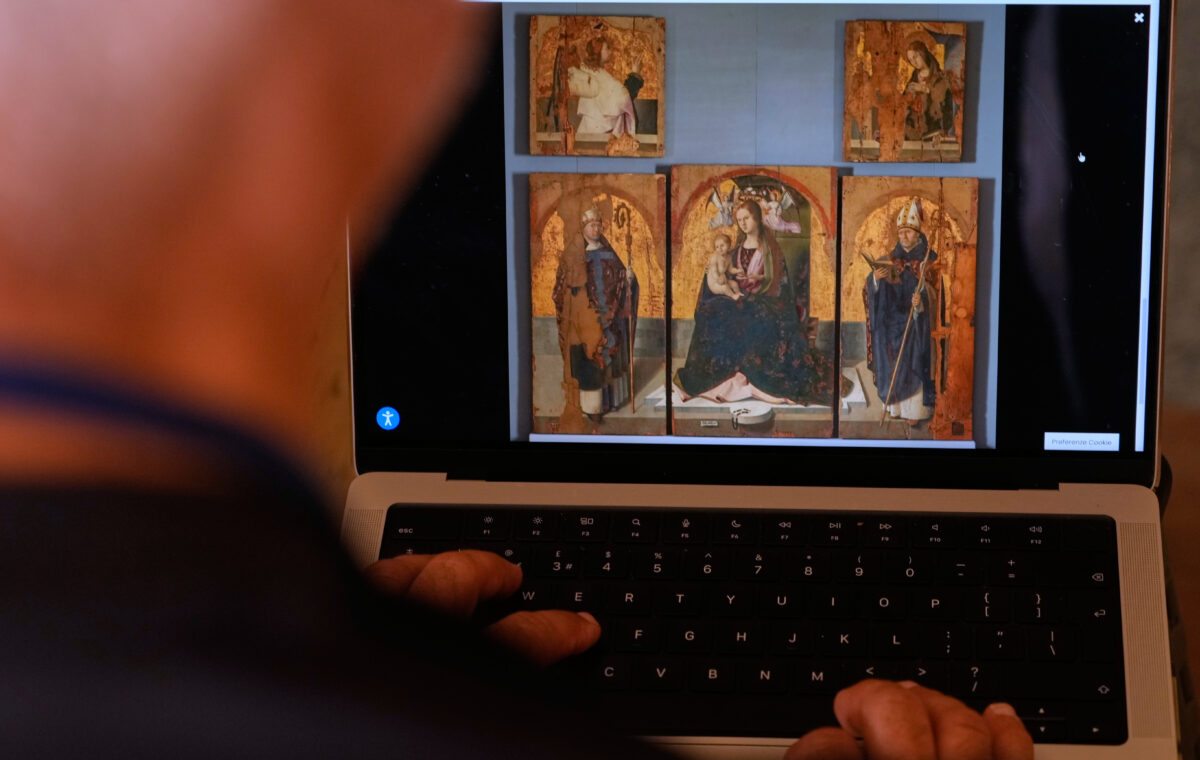
All five surviving wooden panels of the San Gregorio Polyptych, an altarpiece signed and dated to 1473, were removed, while another small double-sided panel was removed from a secure display case. But authorities later recovered two of the polyptych panels that appeared to have been abandoned on a low wall outside the museum. A citizen had noticed the abandoned panels and made the first call to police.
The San Gregorio Polyptych, commissioned for the San Gregorio monastery, originally consisted of six panels but an upper-central panel believed to have portrayed the dead Christ supported by angels disappeared possibly in the 16th century. The surviving polyptych was seriously damaged in an earthquake in 1908 and subsequently underwent restoration, although large portions of lost paint were not reconstructed.
Of the remaining five panels, the two upper panels depicted the “Annunciation of the Virgin.” The middle panel portrayed “Madonna and Child Enthroned,” flanked on either side by depictions of Saints Gregory and Benedict.
The work, considered one of the masterpieces of the Sicilian Renaissance, was the only by the painter to have never left his home city of Messina. Antonello is believed to have been born around 1430 in Messina.