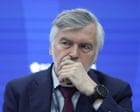
Andrei Klepach of VEB said Russia’s economy was falling behind China, US and ‘in some respects Ukraine’
The chief economist at Russia’s second-largest bank has been fired after a series of critical comments about the state of the economy, including warnings that Moscow would not win a prolonged economic war with Ukraine.
Andrei Klepach, who had served in the role at the state-controlled development bank VEB since 2014, was fired days after Russian media reported on a scathing speech he had delivered to fellow economists in May.
In the remarks, first reported by the Moscow Times, Klepach said Russia was “falling behind” China and the US economically, and “in some respects, Ukraine”.
Klepach said pressures on Russia’s economy due to the war would inevitably lead to a “social crisis” that would erupt “when no one particularly expects it”.
He also said expectations of an imminent Ukrainian economic collapse were misplaced and that a prolonged standoff with Ukraine would not lead to Russia’s victory. “We will not win this competition in a war of attrition with Ukraine,” Klepach said. “We have an illusion that everything will collapse there. It hasn’t collapsed, and it won’t. Our costs are growing.”
The comments were a rare acknowledgment from a senior Russian economist of the country’s mounting economic struggles and directly contradicted Vladimir Putin’s claims that Moscow was successfully weathering the economic pressures of the war and that Ukraine’s economic exhaustion was only a matter of time.
VEB did not offer a reason for Klepach’s firing. An acquaintance of Klepach told the business outlet Vedomosti that his departure from the bank was “connected to his personal, harsh assessments of the country’s economic and political development, which cannot possibly align with the corporation’s position”.
The independent Russian outlet the Bell reported, citing sources, that Klepach was fired on orders from the Kremlin and that his dismissal was directly linked to his May address.
Klepach’s dismissal highlights the Kremlin’s growing insistence on loyalty within Russia’s upper ranks, amid reports that Putin has increasingly surrounded himself with officials reluctant to challenge his views.
Alexandra Prokopenko, a former adviser to the Russian central bank and a fellow at the Carnegie Russia Eurasia Center, described Klepach as a respected economist who was unafraid to voice views that diverged from the official line.
“Klepach’s dismissal – he is one of Russia’s best macroeconomists – is unlikely to delay the looming crisis he has been warning about,” Prokopenko said. She said Klepach’s forecasts were “based on assessments of reality rather than a desire to please anyone” and were often more pessimistic than the official figures.
Russia’s economy is facing its most difficult period since the start of Putin’s full-scale invasion of Ukraine in 2022, strained by massive wartime spending, western sanctions and Ukraine’s growing ability to strike at Moscow’s oil and gas industry.
In the first four months of 2026 alone, Russia’s budget deficit hit 5.87tn roubles ($81bn), well above the government’s 3.79tn-rouble target for the entire year. Some of Putin’s closest advisers have privately warned him that the current level of wartime spending is becoming unsustainable, according to two sources with knowledge of the discussions.
Recently, Ukrainian strikes have hit dozens of warehouses belonging to Wildberries, Russia’s largest e-commerce retailer, destroying billions of dollars’ worth of stock. The attacks have raised questions about the company’s financial stability and dealt a severe blow to thousands of independent sellers who depend on the platform for their livelihoods.