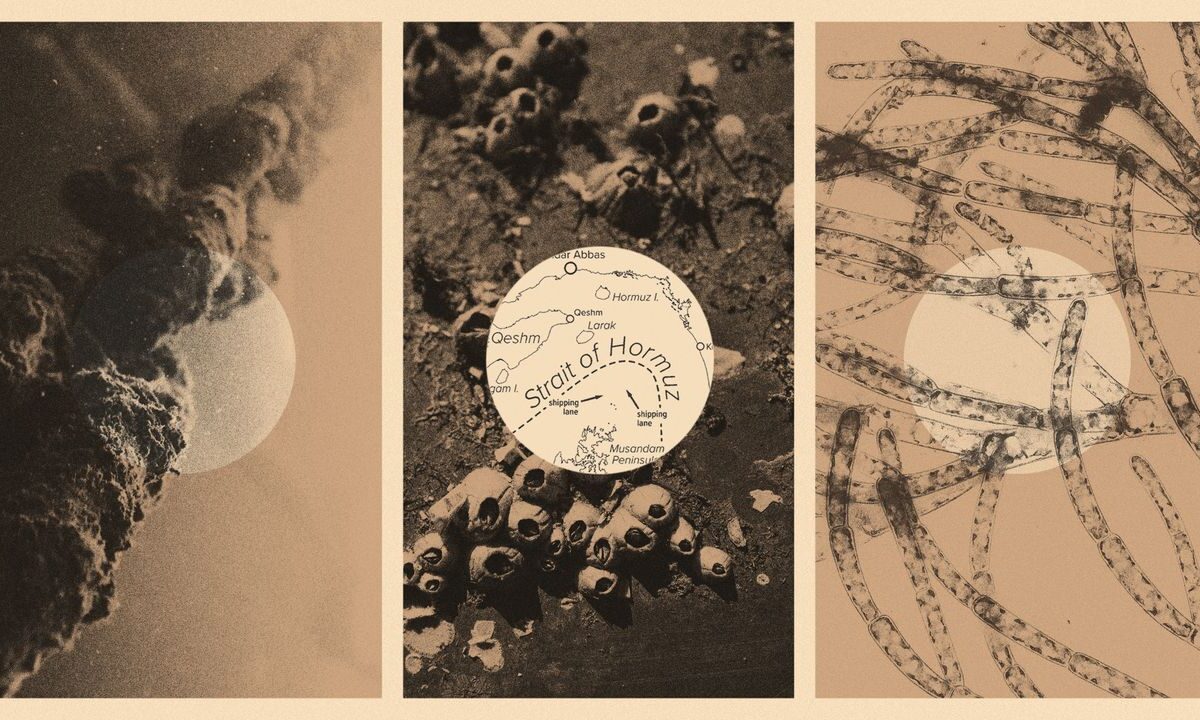
There’s trouble brewing in the water. The ongoing war with Iran has stranded more than 1,500 ships in the Strait of Hormuz, a waterway connecting the Persian Gulf to the Gulf of Oman, since February. While closure of the strait has led to severe economic consequences, there is also a burgeoning ecological crisis. Invasive species growing on the hulls of the trapped ships could soon voyage across the globe.
There is a “high likelihood” that the idle ships in the Strait of Hormuz will “facilitate the extensive spread of economically and ecologically damaging invasive species as they reenter the global shipping network,” said a study published in the journal Biological Invasions. The stagnant ships’ hulls are “becoming encrusted with marine life,” from “microbes and algae to barnacles and other invertebrates,” a phenomenon called biofouling, said The Guardian. These organisms can “hitchhike to ports around the world” when trade resumes.
The “Persian/Arabian Gulf is home to more than 50 marine nonnative species, and many species native to the region have already been introduced across the globe,” said four of the authors of the study in The Conversation. The circumstances, however, are different this time.
Escape your echo chamber. Get the facts behind the news, plus analysis from multiple perspectives.
From our morning news briefing to a weekly Good News Newsletter, get the best of The Week delivered directly to your inbox.
From our morning news briefing to a weekly Good News Newsletter, get the best of The Week delivered directly to your inbox.
Ships “normally only remain at anchor in a harbor for one to three days, limiting the growth of organisms on their submerged surfaces,” said The Guardian. In the case of the current block of the Strait of Hormuz, many vessels have “remained stationary for months, allowing dense marine communities to establish themselves.” The marine organisms of the Middle East “can withstand extremes,” Mario Tamburri, a professor at the University of Maryland Center for Environmental Science and the study’s lead author, said to USA Today. They are “tolerant organisms, which makes them good candidates for invasions when they go to a new location.”
Marine invasive species “have profound ecological and economic impacts on coastlines across the globe” and are “extremely difficult, if not impossible, to eradicate once they become established,” Carolyn Tepolt, a biologist at the Woods Hole Oceanographic Institution and co-author of the study, said in a statement.
Invasive species can outcompete local species, fundamentally altering the ecosystem. They can also perpetuate the spread of “parasites and diseases that are either entrained within ship ballast tanks or associated with organisms attached to ship hulls,” April Blakeslee, an associate professor of biology at East Carolina University and co-author of the study, said to Live Science (a sister site of The Week).
The organisms can “cause millions of dollars’ worth of damage” as well, Tamburri said to ABC News. Biofouling can “lead ships to have more drag as they move through the water, burning extra fuel and increasing exhaust emissions,” said USA Today. Invasive species can also disrupt fisheries and aquaculture, requiring extra money to manage.
The Strait of Hormuz may be the current invasive species risk, but climate change and warming temperatures have been increasing the level of global spread. “Current ship biofouling management and regulatory frameworks are insufficient to mitigate the impacts of large-scale, unplanned vessel lay-up events,” said the study. “While the human and economic consequences of events like the war in the Middle East will always remain the highest priority, ecological impacts cannot be overlooked.”
Devika Rao has worked as a staff writer at The Week since 2022, covering science, the environment, climate and business. She previously worked as a policy associate for a nonprofit organization advocating for environmental action from a business perspective.