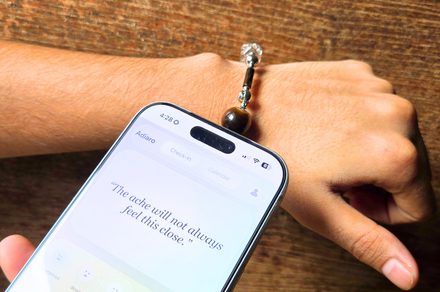
Do you believe in the power of positive journaling, but for some reason, you can’t take out the time or the effort to put pen to paper? If the answer is yes, and the above question describes your predicament, Adiaro may have a neat solution for you. The company makes jewelry in a whole bunch of styles and colors, but the center of it all is the charm gemstone that comes equipped with an NFC tag.
All you need to do is tap your phone against the gem, and it opens a digital journal for you that is also linked to your Google or Apple account. Does it work? Yeah, if you mind the end result, and not the medium. It comes in a variety of gem choices, too. So, if you are someone who believes in the healing power of certain gems, consider this bracelet as the perfect hybrid solution that asks about your mood, lets you vent, use it as a diary, and build an emotional calendar.
It’s a bracelet that wants to blend the spiritual side of gem-based healing with the scientifically proven benefits of journaling. How? Well. at the heart of the gemstone is an NFC tag, and when you tap your phone on it, you get access to a web-based journal app. It works pretty reliably, though, on a few occasions, I’ve found myself inadvertently triggering the notification by simply placing the phone near the Adiaro bracelet in my pocket, or on the table.
I tried the Adiaro Tiger Eye Balanced Chain bracelet, but you can also pick between amethyst, obsidian, white and golden jade, rose quartz, and turquoise options. You can also try an entirely different style with the bead-heavy grounded bracelet, and separately purchase the gem charms in different shapes and colors at $19 apiece.
Attaching them is pretty easy, thanks to a magnetic clasp system that looks like a chrome bead and separates into two halves. As far as the build quality goes, the Balance chain feels pretty high-end. The metal finish is pretty sharp, and there are no loose ends or poor craftsmanship visible on this one.
Well, think of this bracelet as more of a hidden digital diary than a piece of jewelry. As soon as you tap your phone against the gem charm, it triggers a notification that subsequently opens a web-based digital journal app. At the top, you see a thoughtful quote that varies on a day-to-day basis.
Underneath, you can pick between five different moods to reflect your emotional state in that moment. The spectrum starts at “overwhelmed” and slowly progresses to “amazing.” And finally, there’s a dedicated text field where you can describe your mood in 800 characters.
It’s a tad limiting, especially considering the fact that voice-typing on a phone is a lot quicker and far more convenient than writing in a diary using a pen. Once you are done with your digital journaling, it is saved as a log that is synced with your Google Drive or iCloud Drive.
All your mood entries and ruminations are recorded. The Adiaro app creates a progressive map that shows how your mood has changed over the past few days and what kind of thoughts occupied your mind. I like the approach. It’s almost like taking a look into the past few days and assessing how your mental state and energy levels have been at a certain time of the day, or midway through a certain activity.
The broad idea is that, aside from just journaling through a day, you can also check the mood calendar and try to find patterns, depending on the details you have shared in your notes and how your mental state has been. It may not work for everyone. But for some, it can prove to be beneficial.
For example, over a span of three weeks, I noticed that my mood affirmations were usually amazing at noon, and I was high on energy and willing to take on challenging assignments. As the evening passed, I was generally tired, even though my energy levels were consistent, but I felt a certain sense of stress.
Acting on the data at hand, I tried to adjust my work hours and shifted low-priority tasks to the evening slot. It was not a magical cure, but it did help me accomplish a few pending tasks that I kept postponing and felt stressed about. Your mileage might vary depending on how you journal and what kind of actionable insights you can get from the mood calendar.
I have never maintained a diary for journaling, nor have I poured my heart out on an obscure blog. But I know a lot of people who do it, and I see them feel good about it. One of my friends says it’s an escape route from the events that give them anxiety and offers a safe space to vent it all out. Broadly, they see it as a channel of relief.
Adiaro is building on that relief pathway. It might sound like a placebo, or make-believe kind of solution, but there is scientific backing behind the approach. A research paper published in the peer-reviewed JMIR Mental Health journal, positive affect journaling (PAJ) can tone down mental distress and trigger and enhance well-being, serving as an effective intervention.
As part of a randomized trial, patients living with different medical conditions and elevated anxiety symptoms were asked to perform a 15-minute web-based journaling task. The task was performed thrice a week, and the whole experiment lasted 12 weeks. At the end of the trial, the team found that web-based positive affect journaling was linked to lowered mental distress among the participants, lower anxiety, and perceived stress.