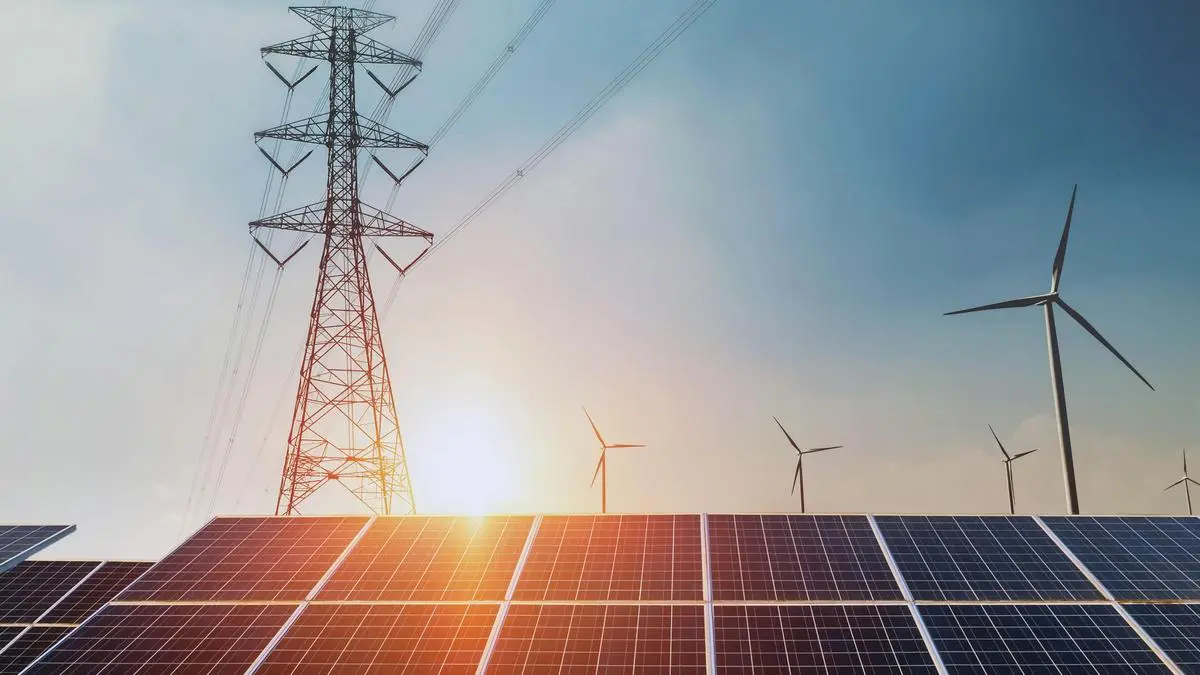
Solar alone now represents around 33 per cent of total installed utility- scale capacity, making it by far the largest clean energy source in the country.
| Photo Credit:
iStockphoto
India's power system
has crossed a threshold that tells a very different story from
the one usually conveyed by electricity generation data.
India has long been portrayed as one of the world's great
coal growth markets, and with good reason. Coal still accounts
for roughly 70 per cent of electricity generation and remains the
backbone of the grid.
Yet a look at the country's installed capacity mix suggests
something profound is underway beneath the surface.
According to the latest capacity data from Ember and Global
Energy Monitor (GEM), clean energy sources now account for 331.7
gigawatts (GW) of installed capacity, compared with 302.0 GW for
fossil fuels.
That capacity split gives clean power a majority share of
India's utility power mix for the first time.
That milestone matters not because India has suddenly become
a clean power system. It has not. Rather, it reveals a growing
tension between what India is building and what India is
burning.
The distinction is important because generation statistics
describe today's electricity system, while capacity figures
provide a window into tomorrow's.
Coal still dominates generation because coal plants can run
around the clock, while solar panels and wind turbines produce
only when weather conditions allow.
But the capacity mix reveals where capital is flowing, what
infrastructure is being added and, ultimately, what type of
power system India is trying to construct.
Viewed through that lens, India's transition appears
considerably more advanced than many observers assume.
In 2010, India had just 0.07 GW of solar capacity. Today it
has 211 GW, according to Ember. Solar alone now represents
around 33 per cent of total installed utility-scale capacity, making it
by far the largest clean energy source in the country.
The extent of that expansion is difficult to overstate.
India's solar fleet today is almost as large as its coal
fleet, which stands at 254.4 GW.
Solar capacity by itself is now larger than the entire
Indian power system was as recently as 2011, when total
installed capacity stood at 211.4 GW.
Source: Read the original article on www.thehindubusinessline.com