Account subscription benefits alongside Premium Stories, Editorials,
Opinions and more. Unlock these with Subscription
The View From India
Looking at World Affairs from the Indian perspective.
First Day First Show
News and reviews from the world of cinema and streaming.
Today's Cache
Your download of the top 5 technology stories of the day.
Science For All
The weekly newsletter from science writers takes the jargon out of science and puts the fun in!
Data Point
Decoding the headlines with facts, figures, and numbers
THEdge
At the cutting edge of education and careers
Health Matters
Ramya Kannan writes to you on getting to good health, and staying there
Gender Agenda
Stories from beyond the binary.
The Hindu On Books
Books of the week, reviews, excerpts, new titles and features.
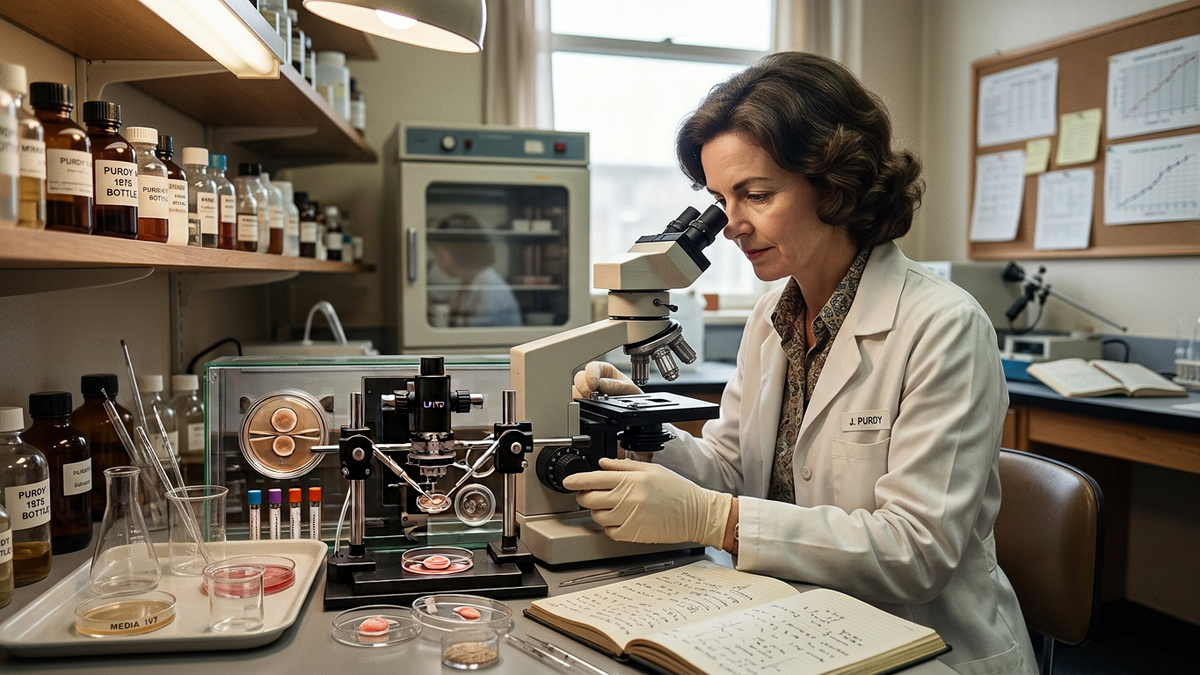
Despite her fundamental contributions to reproductive medicine and co-founding the Bourn Hall Clinic, Purdy's work was historically overlooked for decades before receiving posthumous public recognition
| Photo Credit: Image generated with the help of AI
Taking a safe bet here that most of you who have heard of Louise Joy Brown have not heard at all of Jean Purdy, or her role in the birth of Baby Brown. Louise Brown was the first baby born of an IVF procedure on July 25, 1978. But this might not have been a joyful story, but for Jean Purdy.
Like all the heroines in this column, Jean Marian Purdy, a clinical embryologist and a critical part of the development of in vitro fertilisation, remained uncredited for a long while. Born in Cambridge, U.K., she went to work with physiologist Robert Edwards and gynaecologist Patrick Steptoe at the Physiological Laboratory in Cambridge. They were working on a high-risk experiment and taking medical science where it had never been before – who would have thought babies could be created in test tubes before the trio managed to show that it is possible.
Purdy trained as a nurse in Addenbrooke Hopsital in Cambridge, and joined Edwards in 1968 as a research nurse and quickly became indispensable to the team. Going back to study the records later, scientists established that it was Purdy who managed the laboratory, prepared and tested culture media, and recorded and organised the data of the early IVF work in the lab. Besides this, the records also put her at the centre of patient care, in this case, supporting women who volunteered their eggs and wombs at a time when public sentiment was entirely against it.
Purdy was the first to recognise and describe the formation of the early human blastocyst – the cluster of cells that forms five or six days after a sperm fertilises an egg, in the culture, a key milestone in pre-implantation development. It represents the early stage of embryonic development, where the embryo implants itself into the wall of the uterus to establish a pregnancy. Purdy was the first to see the embryonic cells successfully dividing in the lab, soon these cells would go on to become on 25 July 1978, she was the first to see the embryonic cells that would become Louise Brown. This moment is significant, because it was the first indication that their pioneering technique had worked.