Amid fears for jobs, some film-makers say AI could enable them bypass studio giants and take more creative risks
Near the collonaded entrance to Sony Pictures’ historic Culver City film studio, a tech-powered rival has sprung up this summer. The artists at Promise, a new studio feeding off the potential of AI, can glimpse the lots where Singin’ in the Rain and Men in Black were shot, but no longer do they need to get beyond the studio’s high walls to make their visions come true.
From far more modest premises, they are making movies with rapidly accelerating AI models that create backgrounds, special effects and even “synthetic performers” – using US models but also driven by market-leading Chinese AI.
Backed by Google, Silicon Valley venture capitalists and Disney, Promise is one of a rising number of AI film studios now taking root in Hollywood, with the result that traditional studios’ vast sound stages and financing are becoming less necessary.
It is a controversial trend. Leading directors including Christopher Nolan and Guillermo del Toro have criticised generative technology, actors and writers are fearing for their jobs, and the Democratic congresswoman Laura Friedman, who represents Hollywood’s actors, writers and directors, warned last month: “We can’t wait until we see tens of thousands of American workers displaced.”
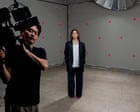
But the excitement and energy about AI’s potential was palpable this week at Promise’s new base when a human actor, Tori Thomas, waited for her call amid rows of computers for early shooting on the studio’s newly announced AI-enabled horror film, Touch Grass, with a budget in the low millions of dollars.
The sound stage was little more than a corner of the office hung with white sheets. A small camera followed Thomas as she scrambled in a chase scene, then the AI did the rest. It superimposed her movement in real time on to a field of swaying grass generated by a Chinese AI model, Seedance 2.5, released this month, which looks set to dramatically slash production times.
Whole scenes – actor and backdrop – were instantly visible on the director’s handheld monitor, as if they were filming in real locations. Even the seedheads in the AI-generated meadow moved as Thomas appeared to brush past. In another take, the field was easily replaced by a nightmarish underground cavern. With a glance at the screen, Thomas could immediately see the backdrop she was acting with.
Promise is not alone in embracing the technology, which Netflix last week said it had used in 300 of its 1,000 titles in 2026. Ron Howard, the veteran director of the Da Vinci Code and A Beautiful Mind, is set to release an AI-enabled animated documentary feature about prisoners of war in Vietnam, working with another new AI studio, Obsidian. Brad Pitt said this week that while there was a lot of pushback, “AI is going to be the very thing that, if used as a tool, is going to help these mid-budget films, $40m- to $90m-budgeted films, get made.”
That chimed with predictions from a new wave of AI native film-makers, such as Kavan “the Kid” Cardoza, 37, who has set up the Phantom X studio. He predicted a creative renaissance circumventing the studio giants not seen since Quentin Tarantino and Spike Lee’s breakthroughs more than 30 years ago.
The Promise shoot involved veteran film-makers including Joel Hynek, an Oscar winner who worked on the manual special effects for Arnold Schwarzenegger’s 1987 action-horror film Predator.
“When we went from optical to digital film, we thought we’d gone to heaven,” he told the Guardian. “It’s like that again. So many things are easy to do. I am an embracer of AI. Some people are wary of it, a little afraid of it, but I see the incredible promise.”
Others, like Nolan, voice concern. “I’ve never seen a technology advancing so rapidly, so completely rejected by the public,” the Odyssey director has said. “Everybody’s suspicion of it is so extreme, particularly young people.”
There has been a backlash against an AI resurrection of the late actor Val Kilmer to star in a new feature and the emergence of the AI “actor” Tilly Norwood, with the actor Emily Blunt calling it “really, really scary” and pleading: “Please stop taking away our human connection.”
But the new AI studios are undeterred. Dave Clark, the director of Promise’s Touch Grass – who is also working on an animation, Hardcore 94, set to an early 1990s LA hip-hop soundtrack – said that with “great dialogue and backstory”, AI-generated characters could become interesting and believable.