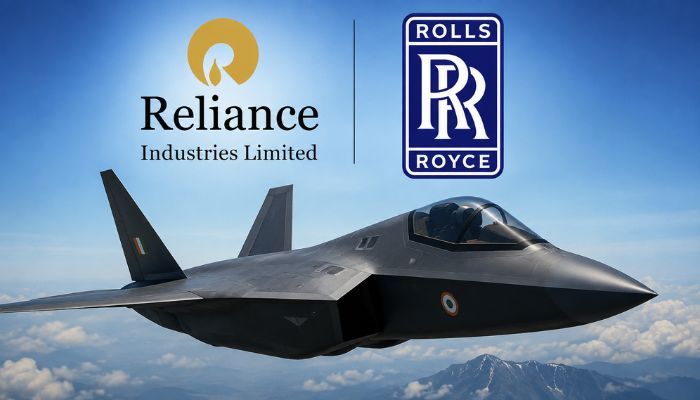
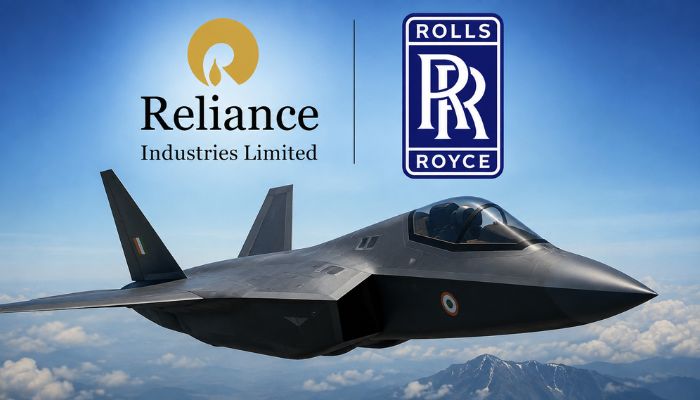
Reliance Industries and British aerospace major Rolls-Royce have announced plans to work together on developing a sovereign combat aircraft engine for India’s Advanced Medium Combat Aircraft (AMCA) programme. The partnership is aimed at giving India greater control over one of the most critical technologies needed for its planned fifth-generation fighter jet. The two companies said on Friday, 14th August, that they intend to explore the design, development, manufacturing and delivery of an indigenous combat engine for the AMCA. As part of the proposed collaboration, Reliance and Rolls-Royce will also explore setting up a dedicated Aerospace Gas Turbine Complex in India.
The proposed facility is expected to become a centre for advanced power and propulsion technology. It would aim to develop capabilities across the complete engine lifecycle, including design, development, manufacturing, testing, production and long-term maintenance and support.
Media Release – Reliance Industries and Rolls-Royce announce strategic intent to partner and develop India's indigenous combat engine for the Advanced Medium Combat Aircraft (AMCA) programme
London / Mumbai, 14thAugust 2026: Reliance Industries Limited (Reliance) and Rolls-Royce…
— Reliance Industries Limited (@RIL_Updates) August 14, 2026
However, the announcement is currently a strategic intent to explore the partnership, and not a final joint venture agreement or commercial engine contract. The companies have not yet disclosed details such as the investment, ownership structure or timeline for establishing the proposed complex.
What will the Reliance-Rolls-Royce partnership do?
The proposed partnership brings together two different strengths. Rolls-Royce will contribute its long-standing expertise in aircraft engines and advanced propulsion technology, while Reliance will bring its manufacturing capabilities, technology, scale and project execution experience.
The central objective is to develop the AMCA’s combat engine in India rather than depending entirely on foreign suppliers for the fighter’s propulsion system.
According to the companies, the proposed Aerospace Gas Turbine Complex would create an end-to-end capability within the country. This means that India could potentially develop expertise not just in assembling an engine but across its entire lifecycle, from design and development to manufacturing, testing, production and maintenance.
The companies also said that the partnership could eventually go beyond the AMCA programme. The proposed facility could support wider cooperation in defence, civil aerospace and new power and propulsion technologies.
This could make the project broader than a single fighter-engine programme, with the potential to create an ecosystem for advanced aerospace engineering and manufacturing in India.
Why is the AMCA engine important?
The AMCA is India’s planned indigenous fifth-generation stealth fighter aircraft. The programme is aimed at developing a more advanced combat aircraft for the Indian Air Force, with a focus on technologies associated with modern fighter jets.
One of the biggest challenges in India’s fighter aircraft programmes has been the development of a powerful indigenous engine. India has historically relied heavily on foreign manufacturers for fighter aircraft engines. Developing a domestic high-thrust powerplant has therefore remained an important part of the country’s push for greater defence self-reliance.
The Reliance-Rolls-Royce proposal is significant in this context because it seeks to combine international engine expertise with manufacturing and industrial capabilities available in India.
If the proposed complex is eventually established and the engine programme moves forward, it could help India build expertise in areas that go beyond simply producing aircraft. A domestic engine capability could give the country greater control over the design, production, testing and long-term support of fighter engines.
The project also fits into the government’s wider Atmanirbhar Bharat push, which seeks to reduce dependence on imports in strategically important areas, particularly defence.
What Anant Ambani said
Reliance Industries Executive Director Anant Ambani said the partnership was aimed at developing capabilities that are important for India’s strategic autonomy. “India’s strategic autonomy requires sovereign capability in critical technologies,” Ambani said.
He said the partnership would combine Rolls-Royce’s expertise in advanced propulsion with Reliance‘s capabilities in technology, manufacturing, scale and execution.
“Our intent with Rolls-Royce is to combine their world-leading expertise in advanced propulsion with Reliance’s technology, manufacturing, scale and execution capabilities to build an indigenous aero-engine ecosystem in India,” he said.
Ambani added that the objective was not just to create a capability for one programme but to develop an enduring national capability in advanced propulsion.
“Together, we aim to build an enduring national capability that can make India self-reliant and, over time, globally competitive in advanced propulsion technologies,” he said. He described the initiative as Reliance’s contribution to Prime Minister Narendra Modi’s vision of an “Atmanirbhar Viksit Bharat”.
Rolls-Royce calls it a major milestone
Rolls-Royce CEO Tufan Erginbilgiç also welcomed the proposed partnership, saying it would combine the British company’s experience in advanced engineering with Reliance’s industrial capabilities in India. “I welcome the opportunity to join forces with Reliance Industries, bringing together our century-long heritage in advanced engineering and proven engine expertise with their homegrown leadership in Indian industry,” Erginbilgiç said.
He said the proposed collaboration could help create a stronger aerospace ecosystem in the country. “Together, with our existing partnerships and capabilities in India, this marks a major milestone towards building a robust, self-reliant aerospace ecosystem in the country,” he said.
The companies said their existing capabilities and partnerships in India could also support the development of the proposed Aerospace Gas Turbine Complex.
What does it mean for India?
For India, the biggest potential benefit of the proposal is the possibility of developing a domestic ecosystem for fighter-engine technology. Aircraft engines are among the most technically demanding components of a modern fighter jet, requiring advanced engineering, manufacturing, testing and maintenance capabilities.
India’s dependence on overseas engine suppliers has been a long-standing challenge for its defence aviation ambitions. An indigenous engine programme could therefore strengthen the country’s strategic autonomy by reducing dependence on foreign sources for a critical component of military aircraft.
The proposed complex could also help build a specialised industrial base around aerospace propulsion. If the project develops as planned, it could bring together design engineers, manufacturers, testing facilities and maintenance capabilities under a broader domestic ecosystem.
Another possible benefit is the development of expertise that could be used for future aircraft and propulsion programmes. The companies have already indicated that their cooperation could eventually extend beyond the AMCA engine to other defence and civil aerospace projects.
The project could also support India’s ambition to become a larger player in the global aerospace manufacturing sector. Reliance brings the ability to operate at large industrial scale, while Rolls-Royce brings decades of experience in aircraft-engine technology. Combining these capabilities could potentially create opportunities for both domestic production and future exports.
However, the partnership is still at an early stage. The two companies have announced their strategic intent and plans to explore the Aerospace Gas Turbine Complex, but important details such as investment, ownership, production timelines and the final structure of the project have not been announced.
The government had also earmarked ₹15 billion (around $157 million) in May for the AMCA programme, as part of efforts to accelerate the development of India’s next-generation fighter aircraft.
Ultimately, the success of the Reliance-Rolls-Royce initiative will depend on whether the proposed plans translate into an actual engine development and manufacturing programme. For now, the announcement represents an important step towards bringing global aero-engine expertise together with India’s growing private-sector defence manufacturing capabilities.
If realised, the Aerospace Gas Turbine Complex could give India something it has long sought in military aviation: a stronger domestic capability to design, build, test and support advanced combat aircraft engines. That would make the AMCA programme not just an effort to build an indigenous fighter, but also an opportunity to develop a wider Indian ecosystem for advanced aerospace propulsion.