Published : Aug 15, 2026 17:55 IST – 9 MINS READ
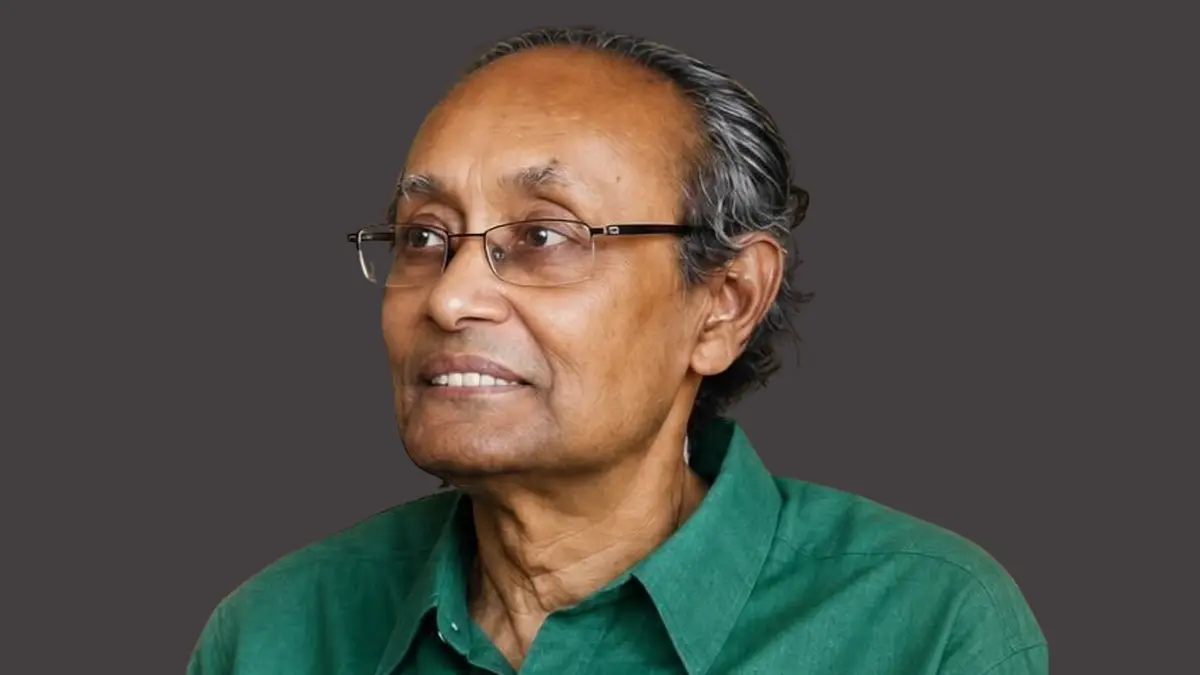
Historian Sumit Sarkar, one of the most influential scholars of modern India, reshaped how generations understood nationalism, society, and history from the bottom up.
| Photo Credit: By Special Arrangement
There are teachers whose lectures one remembers, and there are teachers who become part of the way one thinks. For many of us, Sumit Sarkar was the latter. It is difficult to separate what I learnt from him from what I understand history itself to be. More than 40 years after I first entered his classroom as an MA student at the University of Delhi, I still have the notes I took in his lectures. Their pages have yellowed, but the arguments have not. I return to them even now. His passing feels like not only the loss of one of the greatest historians of modern India, but also the disappearance of a particular intellectual presence: quiet, exacting, sceptical, immensely learned, and utterly without pomposity. He was slight, almost fragile in appearance, diffident in manner, often standing unobtrusively at the edge of a gathering. Yet intellectually, he towered. There was a disjunction between the modesty of the man and the scale of the historical imagination he possessed.
I was his student between 1985 and 1987. His lectures were unlike anything I had encountered before. He would arrive meticulously prepared and begin quietly. An argument would take shape, and just when one felt persuaded, he would introduce contrary evidence, a regional variation, an awkward social fact. Then another. Gradually, the apparently secure proposition with which we had begun would be dismantled, complicated, and reconstructed before us. History, in his classroom, was never the accumulation of information. It was the art of learning to distrust the obvious. There was pin-drop silence, no one wanted to miss a sentence. The range of reading behind those lectures was breathtaking, but it was never displayed for effect. His scholarship entered the classroom lightly. A statistic, a vernacular text, a regional movement or a minor contradiction could suddenly alter the argument. He taught us not to make the past tidy, but to recover its unevenness and suppressed possibilities.
That method had already transformed the study of modern India. The Swadeshi Movement in Bengal, his first landmark monograph, enlarged both the archive and the meaning of nationalist politics. Literature, pamphlets, newspapers, associations, and popular action entered a story too often narrated through organisations and eminent leaders. Questions about nationalism’s social bases, cultural languages, exclusions, and relationship with popular initiative remained central to his work. For generations of students, however, Sumit Sarkar first arrived through Modern India, 1885-1947. My old copy cost Rs.26.50. Nearly everybody in our class possessed one, and nearly every line seemed to demand underlining.
Ostensibly a textbook, Modern India was anything but ordinary. Congress resolutions and constitutional negotiations remained important, but beside them appeared peasants, workers, Adivasis, lower-middle-class activists, caste movements, regional struggles, and anonymous crowds. Nationalism ceased to be simply what national leaders said or intended. One had to ask what happened when their language travelled into a village, a factory, a tribal region, or a local struggle over rent, forests, wages, or dignity. That was the power of his “history from below”. It was never a sentimental celebration of “the people”. Popular politics could be conservative and emancipatory, narrow and eclectic, dependent and autonomous. Nor did he replace leaders with masses. Rather, he explored the unstable relationship between them. Gandhi mattered profoundly, but so did people who invoked Gandhi while doing things Gandhi might never have sanctioned. Leadership could mobilise popular energies, restrain them, redirect them, and sometimes be overtaken by them. History lay in that relationship.
His Marxism was fundamental to him, but never doctrinaire. He constantly stretched its categories against historical evidence. Class mattered, but never by itself. Caste, religious identities, gender, cultural practices, and forms of consciousness could not simply be consigned to a secondary realm of “superstructure”. He was also a staunch feminist, not merely in his scholarship but in his deepest intellectual and political commitments. He had already begun creating spaces in which these questions could be investigated. This intellectual restlessness became even clearer in Writing Social History. Its essays remain models of what richly textured social history can accomplish. Clock time and disciplines of colonial modernity, constricted world of clerical labour, Ramakrishna Paramahamsa and the social milieus that made particular religious forms intelligible, Ishwar Chandra Vidyasagar and the limits as well as possibilities of reform—apparently disparate subjects became ways of asking how large transformations were lived in everyday worlds.
Swadeshi Movement in Bengal, on Bengal’s partition of 1905, and the nationalist movement that it spawned, was full of methodological innovations, using plays, novels, newspapers, and pamphlets.
| Photo Credit:
By Special Arrangement
Equally important was his capacity for self-questioning. Sumit Sarkar had been closely associated with the early Subaltern Studies project, yet he later became one of its sharpest internal critics when he felt that the subaltern, once located in the material histories of peasants and workers, was becoming detached from social relations through an excessive emphasis on discourse and representation. He recognised what the cultural and postcolonial turns had taught historians, but he also insisted that culture could not float free of society. He distrusted intellectual fashions in precisely the way he distrusted political orthodoxies. Perhaps no work demonstrates this openness more movingly than Modern Times: India 1880s-1950s. Instead of simply revising Modern India three decades later, he wrote the book anew. He acknowledged that not only the historiography but his own historical perspective had changed. How many scholars of his stature possess that capacity? To declare that one’s earlier work had become incomplete in the face of new knowledge, new questions and new historical possibilities was itself a measure of his intellectual openness.
For Sumit Sarkar, history remained an unfinished conversation. Modern Times expanded the landscape to environment, economy, city and countryside, caste, languages, and literatures, new middle classes, sociability, theatre, cinema, music, dance, sports, and public culture. Its extraordinary bibliography revealed his inexhaustible curiosity and willingness to read across regions, disciplines and languages. The vernacular archive was never peripheral to him. It was alive with possibilities.
That openness mattered personally to me. When I wanted to work for my MPhil on Premchand and the relationship between literature and history, many considered the subject insufficiently historical. Sumit never did. He encouraged me to enter the vernacular and the literary. Later, when I began a PhD with him and then received a Commonwealth Scholarship to go to SOAS, he was delighted rather than possessive. His comments could be brief, but a few words could shift an argument, reveal a missing layer, or make one see a familiar source differently. His generosity towards students was often exercised without announcement. I remember an incident even before I formally became his student. Despite having done well as an undergraduate at Miranda House, I faced difficulty in securing admission to the MA because I had participated in a protest against a hostel fee increase. Sumit Sarkar, then head of the department, postponed admissions for three days while the matter was resolved and supported my application. He never made anything of it. His principles were firm; their performance was quiet.
Years later, when I joined the same department and was asked to teach the social history paper that I had once learnt from him, I felt deeply inadequate. How could one teach something one associated so completely with Sumit Sarkar? I soon realised that imitation was impossible. The most one could hope for was to preserve something of the intellectual ethic he embodied: prepare seriously, read widely, never underestimate students, question one’s own certainties, and never sacrifice complexity for a convenient argument.
Sumit Sarkar’s widely read history brought peasants, workers, Adivasis, caste movements, and regional struggles into an account of modern India long dominated by national leaders.
| Photo Credit:
By Special Arrangement
His scholarship and his citizenship were continuous with one another. After the demolition of Babri Masjid, his involvement in Khaki Shorts and Saffron Flags exemplified his uncompromising opposition to communalism. He could also be fiercely critical of the organised Left, as his position on Singur and Nandigram showed. At demonstrations, one often saw him standing quietly somewhere in the crowd, almost anxious not to be noticed. Yet he was there, during some of the darkest moments, including protests after the anti-Sikh violence and against communal mobilisation. Moral courage, for him, required neither volume nor self-display. This is perhaps what I shall remember most: the unusual unity between intellectual and personal modesty. In an academic world not innocent of vanity, he possessed astonishingly little of it. The twinkling eyes, gentle sarcasm, and shy smile could coexist with a razor-sharp judgement. He could have occupied a prestigious chair almost anywhere in the world. He chose instead to spend three decades teaching at Delhi University, shaping successive generations of students.
Also Read | History is not to glorify the past, but to understand it: Irfan Habib