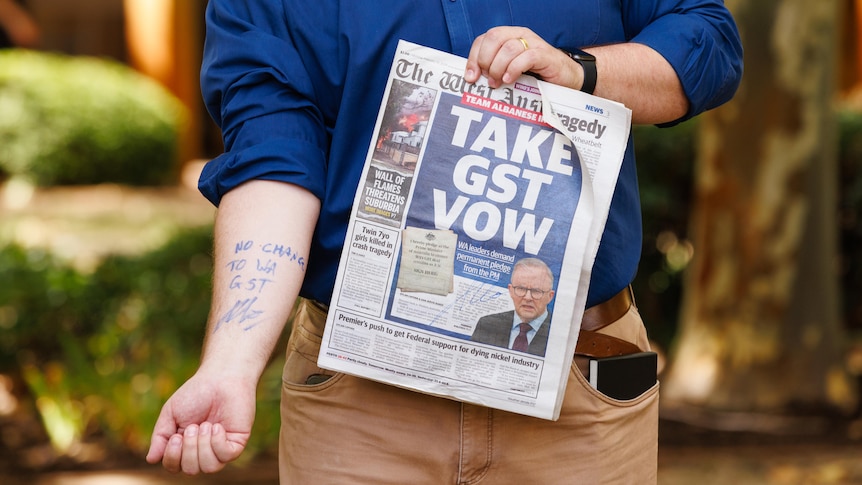
Two years ago, the prime minister cheerfully took a Sharpie proffered by a West Australian journalist to sign a paper pledge to retain the state's GST deal. (AAP: Richard Wainwright)
A permanent marker is, by design, very difficult to erase, but a damning new report suggests Anthony Albanese is going to have to give it a crack.
Two years ago, the prime minister cheerfully took a Sharpie proffered by a West Australian journalist to sign a paper pledge to retain the state's GST deal.
For good measure he then grabbed the reporter's arm and scrawled "no change to WA GST" — even suggesting the signature would make a nice tattoo.
Now, the Productivity Commission has given Albanese plenty of reasons to reconsider reaching for that pen.
Its interim review delivered a brutal assessment of the GST deal struck by the former Coalition government in 2018 and enthusiastically inherited by Labor.
Those changes guaranteed states a minimum GST share, while Canberra agreed to compensate states left worse off than under the previous system.
In practice, the commission has found one state has been left significantly better off: Western Australia.
A permanent marker is, by design, very difficult to erase, but a damning new report suggests Anthony Albanese is going to have to give it a crack. (AAP: Richard Wainwright)
Every other jurisdiction has required "no worse off" payments since the new standard took effect, and that has come at a considerable price.
The reforms were expected to cost the Commonwealth about $5 billion by 2024-25 but have instead soared to almost $23 billion.
And money is only part of the commission's objection.
The GST system exists to smooth out the differences between states so Australians can receive broadly comparable public services regardless of where they live.
But the commission found the 2018 changes had weakened that principle without delivering sufficient improvements elsewhere.
Its preferred prescription is dramatic: unwind the central architecture of the deal, move back towards the pre-2018 system and deal directly with the particular distortion caused by WA's dominance of mining revenues.