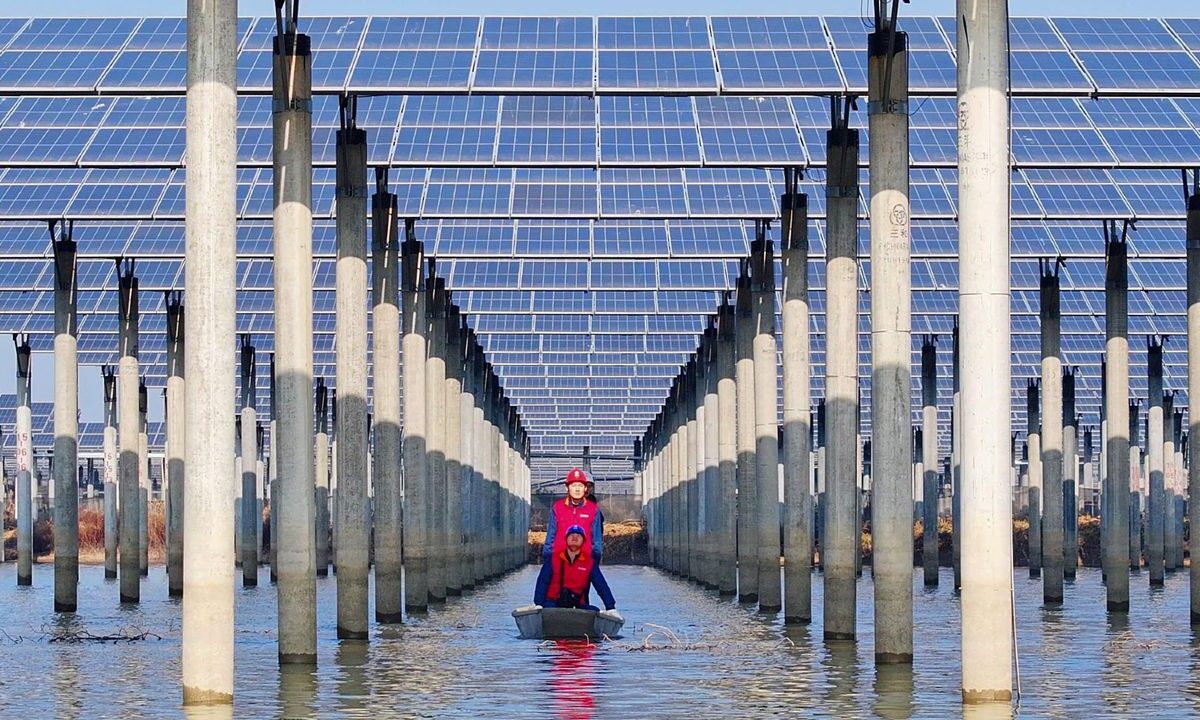
Beijing is embracing clean energy on a massive scale
China has been the world’s biggest polluter since 2006, but in recent years, it has emerged as a clean energy superpower. Huge swathes of China – from the mountain plateaus of Tibet, where the sun shines brighter in the thin air, to the coast off Qingdao – are now covered by solar panels and wind farms.
It is the first country in the world to have installed more than a million megawatts (MW) of solar power – almost double Europe and America’s combined solar capacity, generating enough electricity to power the entire EU.
In May 2025, it installed solar panels at a rate of up to 100 a second. It’s also betting big on wind: a surge in turbine installations means that its wind capacity is now well over three times higher than that of its nearest competitor, the US.
Escape your echo chamber. Get the facts behind the news, plus analysis from multiple perspectives.
From our morning news briefing to a weekly Good News Newsletter, get the best of The Week delivered directly to your inbox.
From our morning news briefing to a weekly Good News Newsletter, get the best of The Week delivered directly to your inbox.
With a population of 1.4 billion and accounting for around a quarter of global manufacturing, China is the world’s largest consumer of energy. Beijing regards its reliance on Middle Eastern oil and gas as a dangerous vulnerability: about 70% of its oil is imported, much of it passing through the Straits of Hormuz and Malacca. China’s rise as a manufacturer was built on coal, but its leaders have also long been concerned about pollution and climate change. Green energy is seen as a solution to all these problems.
In some ways, yes. Analysts believe that China’s emissions may have already peaked. But Beijing isn’t just betting on renewable electricity. It continues to build coal-fired power plants at an eyewatering rate: 85 are due to open this year alone, and it’s building 36 nuclear reactors. China’s National Energy Administration installed over 500 gigawatts (GW) of new power capacity in 2025; the UK grid’s total capacity is around 70 GW.
As a result, China is sometimes described as the world’s first “electrostate”. It is electrifying everything from industry to cars. And the role of green electricity is growing. Coal, which accounted for about 80% of electricity in 2000, provided just 55% in 2025, while wind and solar rose to around 20% from practically nothing over that period. Beijing sees green tech as a source of energy security, future prosperity and influence abroad.
The Made in China 2025 industrial plan, launched in 2015, identified it as a core strategic sector, concentrating on the “new three” industries – solar, batteries and electric vehicles, moving away from lower-value sectors such as textiles and cheap electronics. China also moved to dominate supply chains for the raw materials: cobalt, nickel, graphite, rare-earth metals. Local governments offered cheap land, subsidised electricity, and state-backed credit to manufacturers.
Much of the groundwork had been done before. Chinese researchers studied in Europe and North America, where all these technologies were pioneered; Western companies sold equipment and production lines. Since then, China has left its rivals in the dust.
China now controls 90% of the world’s solar manufacturing, more than 70% of wind turbines, 80% of battery cells, and 70% of electric vehicles. This is leading to plummeting costs across the world: solar panel prices have fallen by some 90% in the past decade (though installation costs have fallen more modestly). The solar boom means that panels are now a ubiquitous sight on rooftops in Pakistan, India and across Africa, providing low-cost energy for millions of people.
In March, driven by the Iran war, exports of Chinese solar panels hit a record 68 GW-worth, double the previous month, with demand especially strong in Southeast Asia and Africa. Chinese wind turbines are now 30%-50% cheaper than those made in the US or Europe.
The UK, like much of the West, has been wiped out as a producer of solar panels and batteries; China has cornered the market. Europe still has a wind turbine industry – there is a major Siemens Gamesa factory in Hull – but they rely heavily on crucial Chinese components, such as high-strength magnets.