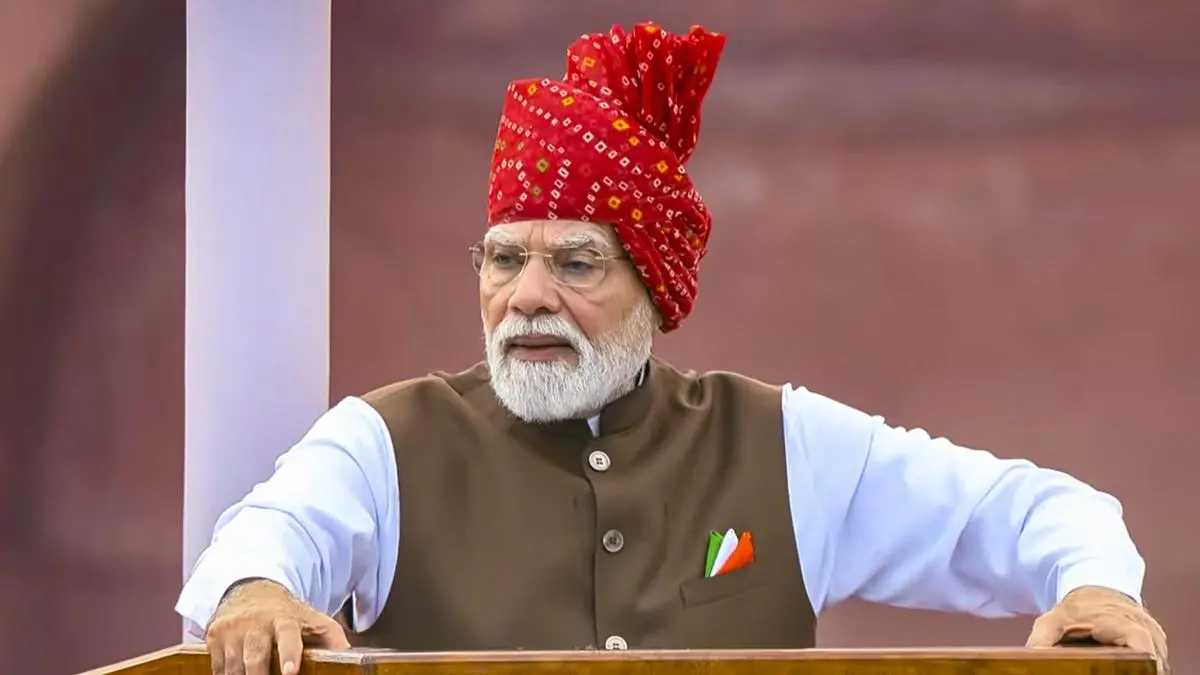
Prime Minister Narendra Modi addresses the nation during the 80th Independence Day celebrations, at Red Fort in New Delhi, on August 15, 2026. (@narendramodi/YT via PTI Photo)
Prime Minister Narendra Modi on Saturday unveiled ‘Saptdharas’ or seven streams to drive India forward and take the nation to new heights. At the same time, he also urged political parties to help in implementing 33 per cent reservation for women in the Parliament and Assemblies.
Addressing the nation from the rampart of the Red Fort on the occasion of the 80th Independence Day, his seven streams included manufacturing power, agriculture & food processing, technology & innovation, Gatishakti, defence power, green economy and soft power. “Our factories must be competitive, our products user-friendly and our packaging must be the best. We need to focus on three things – Cost, quality and scale,” he said.
Further, he emphasised that India has a stable political mandate, a stable government, a vibrant democracy, a strong judicial system and “a constitution that guides us all.”
Every Indian is embracing the spirit of Make in India and Vocal for Local. Sectors that were once seen as ‘No-Go Areas’ are now ‘Go-Ahead Areas.’
“We must believe in ourselves and take pride in building an Aatmanirbhar Bharat,” he said while reminding that India has set a big goal to become a developed nation by 2047.
He declared from the ramparts of the Red Fort that India aims to make five nuclear reactors operational in this decade, since energy security remains crucial in modern times.
“Energy security is the demand of the time. With the SHANTI Act passed in Parliament, we have created the framework to achieve our goal. Our goal is to achieve 100 gigawatts of nuclear power capacity. We aim to start five new nuclear reactors in this decade,” the PM said
He said India has achieved 100 per cent railway electrification, compared to just 30 per cent of the network being electrified since its inception in 1925.
“Railway electrification in India began in 1925. Yet, over nearly 90 years, only 30 per cent of the railway network had been electrified. In just the last decade, India has achieved 100 per cent railway electrification. This has significantly reduced dependence on imported diesel while also contributing to a cleaner environment. India has also taken another major step forward with the launch of its first hydrogen-powered train,” the PM said.
Along with energy security, Modi focused on India’s achievements in the digital technology and innovation sector. He said that the village industries have grown nearly fivefold since 2014 and the number of internet users quadrupled, with digital transactions growing by a hundredfold.
“In the last 12 years, defence production has increased nearly fourfold, while output from Khadi and village industries has grown almost fivefold. Electronics manufacturing has expanded nearly sevenfold. The production of modern railway coaches has risen 21-fold, and mobile phone production has surged 33-fold. Beyond that, we have made our mark in the realms of digital technology and innovation. The number of internet users has nearly quadrupled, patent grants have increased fourfold, and digital transactions have grown a hundredfold,” he said.
The PM said that his government has worked to improve amenities for the common citizen. He asserted that the country has undergone “massive transformation in governance”.
Gas connections have been provided at six times the previous annual speed and construction of housing for the underprivileged at three times the previous rate.
He highlighted that the country has also undergone a massive transformation in governance; thousands of compliance requirements have been eliminated, and hundreds of archaic laws have been repealed. “One cannot march into the 21st century relying on laws from the last century,” he said.
Source: Read the original article on www.thehindubusinessline.com