A new analysis of skulls from a 14th-century battle in Sweden reveals a spiked club inflicted the death blow.
When you purchase through links on our site, we may earn an affiliate commission. Here’s how it works.
BERLIN — Archaeologists have finally determined which weapon caused mysterious square holes in the skulls of soldiers who died in the 1361 Battle of Visby. Close analysis of the bone fractures and cutting-edge motion-capture technology revealed that medieval combatants worked in groups to methodically incapacitate their opponents and then deliver a final, fatal blow with a spiked club.
"We have to understand the complexity of medieval combat; it's not a simple process," Patrick Randolph-Quinney, a biological anthropologist at Uppsala University in Sweden, said in a research presentation Aug. 5 at the 25th European Paleopathology Association meeting in Berlin. The research has not yet been published in a peer-reviewed journal.
Randolph-Quinney and colleagues studied skeletons from a mass grave related to the Battle of Visby, which was fought in July 1361 on the Swedish island of Gotland. The Danish king Valdemar Atterdag (also known as Valdemar IV) aimed to plunder the city of Visby, which was a major hub of the Hanseatic League that had become wealthy through its control of trade routes between Western Europe and the Baltic. Atterdag's soldiers faced off against a similar number of Gotlander defenders, but Atterdag was victorious. The battle resulted in 1,800 Gotlandic casualties to 300 Danish dead.
The men who died at the Battle of Visby were buried in their armor immediately after the fighting concluded. Their final resting place — a mass grave close to the battlefield — was first excavated in the early 20th century. But experts still have questions about what actually happened in the battle and how medieval combat worked.
"The conventional historical narrative suggests that the defenders of Visby were predominantly poorly trained, poorly equipped young boys and elderly men who were no match for the might of the Danish army," Randolph-Quinney told Live Science.
One of the 700-year-old skulls from a combatant in the Battle of Visby that had mysterious square holes.
To better understand the lives and deaths of the men in the mass grave at Visby, Randolph-Quinney launched a project in collaboration with experts in conflict archaeology, ancient DNA, medieval history, and medieval weapons and armor. "It's very difficult to understand what's going on if you actually don't understand what people are capable of doing in those kinds of situations," he said.
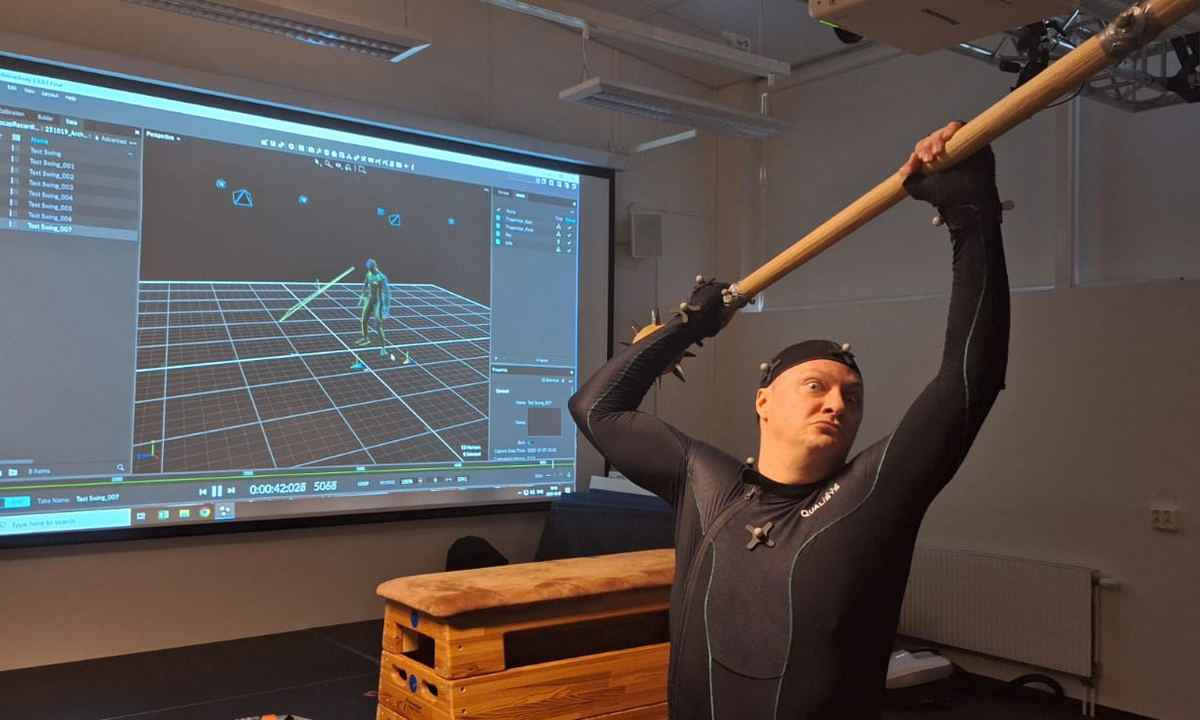
The team set out to solve the mystery of square-shaped holes found in several skulls. The archaeologists who excavated the skeletons in the early 20th century assumed that the injuries were caused by a lance head or an arrow. But Ronja Bågling, an archaeology graduate student at Uppsala University, thought a spiked club may have inflicted the wounds. Randolph-Quinney and team then tested these assumptions using replica medieval weapons and motion-capture techniques.
Get the world’s most fascinating discoveries delivered straight to your inbox.
The team created a model of a human body using cow bones covered in a thick layer of ballistic gelatine, a special type of gelatine engineered to replicate human muscle tissue, and topped with replica medieval armor. Then, they dressed researcher Ray Whitcher, an expert in medieval reenactment, in a 4D motion capture suit, which records movements from multiple angles over a period of time. They gave Whitcher a range of replica weapons, with the direction to go "full-on berserker mode" on the gelatin-covered bones, Randolph-Quinney said.
Researchers built a replica knout (spiked club) to test whether it could make the square holes seen in the skull.
The team found that neither a crossbow nor an ax caused similar damage to the cow bones that the archaeologists saw in the Visby skeletons. "The spiked club, on the other hand, caused immense damage," Randolph-Quinney said, and exactly matches the injuries to the bodies in the grave.
Several of the skeletons had multiple traumatic injuries, in addition to damage from the spiked club. By looking closely at the injuries, the researchers were able to figure out which blow came first and which weapon made it. One skull, for example, had evidence of an ax blow that was then interrupted by the impact from a spiked club, suggesting an attack by more than one person.