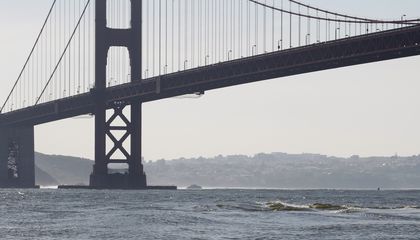
After spending hundreds of hours observing harbor porpoises from the pedestrian walkway of the Golden Gate Bridge, William Keener learned to say “porpoise” in a dozen languages. In German, it’s schweinswal, or “pig whale”; French uses marsouin, “sea pig”; and his favorite, Norwegian, is nise, from the word for “sneeze.” With these terms, he could explain to passing tourists why he was looking down at the water with binoculars.
Keener, a research biologist at the Marine Mammal Center of Sausalito, California, began standing on the bridge to watch the animals’ behavior. He didn’t intend to become an expert in harbor porpoise mating rituals. But “once we realized that these guys are having sex beneath the Golden Gate Bridge, we focused on that,” he says.
Harbor porpoises and humans have been neighbors for thousands of years, living side-by-side along ocean coasts throughout the Northern Hemisphere. Still, despite their long proximity to humans, the dolphin-like marine mammals have been very good at keeping much of their behavior secret. Nobody really knew how they procreated.
Identifying sexual behavior is the first step toward understanding what elements are required for a species to breed. “Mating is key to the success of a population,” Keener says. When it comes to making sure the harbor porpoise stays common where it is common and survives where it is rare, “just understanding what you’re seeing can be crucial.”
Scientists across the world had seen harbor porpoise calves appear from late spring to early fall, depending on the region. They saw signs of a reproductive season—for instance, that a male harbor porpoise’s testes weigh more than his brain during the few months of each year that he is fertile. But experts had gathered no undisputed observations of the act itself.
In 2008, harbor porpoises returned to San Francisco Bay by the hundreds, offering a new opportunity for research on the species. For the previous six decades, they had been rare visitors to the bay, deterred by ocean pollution, a lack of fish to prey on and a World War II anti-submarine net across the Golden Gate, Keener says. He and some biologist friends were eager to learn how the returning porpoises would act in this urban marine environment.
Watching harbor porpoise behavior isn’t easy. The animals typically keep a low profile, exposing their dorsal fins at the surface for only a second or two while breathing. They are sedate, especially compared to the enthusiasm of, say, bottlenose dolphins, which jump into the air on the simple occasion of taking a breath.
At first, the scientists used boats to observe the animals, but the shy harbor porpoises avoided them. Then, the team realized that the Golden Gate Bridge offered the perfect observation point. Its pedestrian walkway extends across the bay about 230 feet above the water, close enough for a clear view of the activity below. The harbor porpoises seemed unaware of the bridge traffic thundering above them, let alone a scientist or two peering over the side.
When Keener first saw the splash from a porpoise body landing on the water, he thought it was a feeding behavior. Perhaps the porpoise had chased a fish to the surface and followed it into the air. The scientists began paying particular attention to these splashes, using a telephoto lens to snap pictures of them. Eventually, in 2010, a photo revealed not prey fish escaping the hunt, but a harbor porpoise penis. The organ is about a third of the length of the male’s five- to six-foot-long body.
That’s when the scientists realized the splashes came from mating behavior.
Each day, the marine mammals swim in and out of San Francisco Bay with the tides. And the Golden Gate itself, the team soon realized, is a prime setting for porpoise sex. It’s the deepest part of the inlet, where males sometimes wait for passing females with whom they can attempt to mate. “We call it the funnel of love,” Keener says.
Over the next eight years, Keener and his team took 144 photos or videos of harbor porpoise mating activity in the bay. What the scientists observed was consistent. The male always approached the female from the left side, even crossing over if he started on her right. “To have an extreme sidedness, ‘lateralization’ as we call it, in mating is unusual,” Keener says. “When mammals copulate, it can be belly to belly, or more often, rear mount, but it’s still symmetrical, not off to a side.”
In almost all cases, the male rocketed up from below when the female surfaced to breathe, making a splash as he landed back in the water. The entire mating process took one second, maybe two.
Yet the scientists saw only two penetrations, each with the male’s body crosswise to the female’s, his belly pressed to her left side. The other 99 percent of attempts were apparently unsuccessful—and almost 20 percent of the time, the male displayed his penis but did not approach closely.
For the scientists who knew that porpoises can only become pregnant during a specific fertile season, it was even stranger that they saw this mating behavior all year round. Keener suggests that the porpoises’ unusual reproductive strategy—which relies on the males approaching with the right angle and speed—could simply require a lot of practice. The team’s description of harbor porpoise mating dynamics, published in 2018, was the first of its kind for any porpoise species.