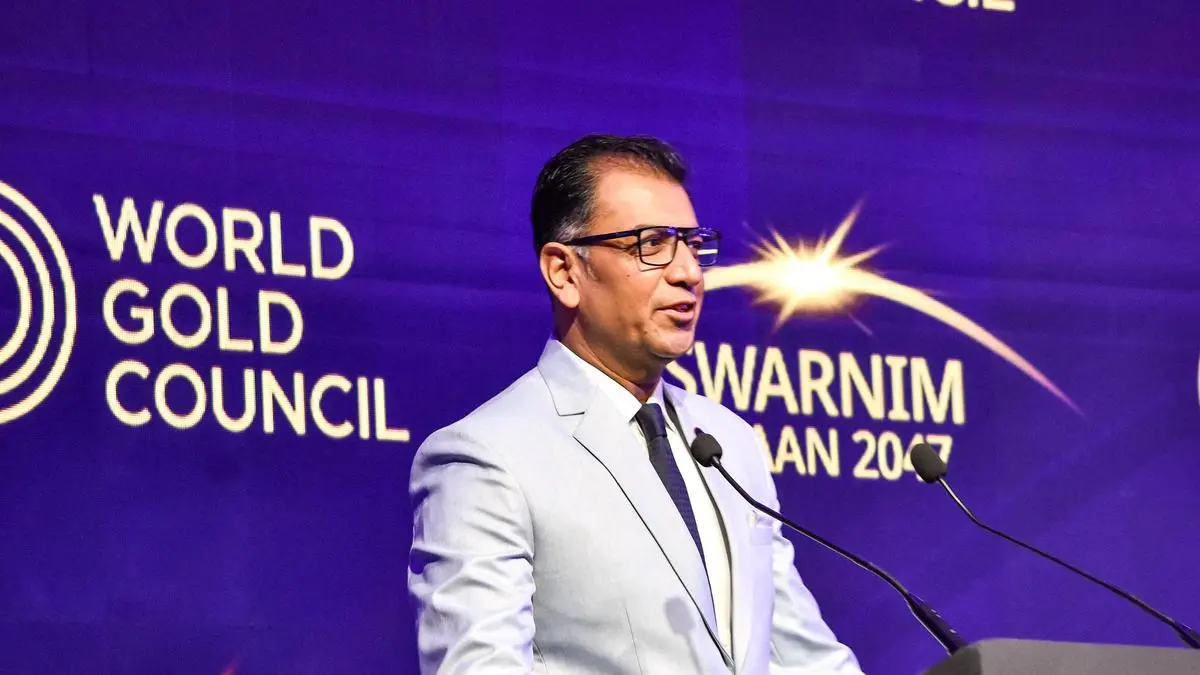
Regional CEO, India, World Gold Council, Sachin Jain
| Photo Credit:
ANI
The demand for gold among Indian consumers has been stable despite the sharp rise in prices in recent months. Though gold demand in the June quarter was down 6 per cent year-on-year, consumer spending on gold zoomed 50 per cent to Rs 1.98 lakh crore due to firm prices. After an exceptional rally for the last two years and early 2026, gold prices moderated in Q2, though they remained elevated by 59 per cent year-on-year. The government had to hike import duty to 15 per cent and appeal to consumers to cut down on gold purchases so that imports can be bought down. The World Gold Council, the body of leading global gold miners, has worked on a report to make gold a growth driver of Indian economy. Sachin Jain, Regional CEO India, World Gold Council spoke to businessline on future of gold in India. Excerpts:
What is the idea behind the ‘Swarna Bharat 2047’ report?
The report presents a roadmap for the gold industry aligned with the vision of Viksit Bharat 2047. If India becomes a $25-trillion economy, what role can gold play? Gold is often viewed only as an imported commodity, but it also supports manufacturing, exports, financial services and millions of jobs. We believe it can become a major contributor to India’s long-term growth. The report was prepared after consultations with industry bodies, leading companies and government departments, including the PMO, the Ministries of Finance, Commerce, Consumer Affairs and Mines, the RBI and Invest India.
The first is domestic gold mining. India could eventually meet 10-20 per cent of its gold demand through local production, generating investment and employment. The second is exports. India imports 700-800 tonnes of gold annually but exports only about 100 tonnes in value-added jewellery. We believe exports can rise to 300-400 tonnes over the next five to ten years through better manufacturing and innovation. The third is financialising household gold. India’s households hold the world’s largest above-ground gold stock. Bringing more of it into the formal financial system can unlock capital for the economy. The fourth focuses on younger consumers. With a median age of 28 and rising incomes, the industry must create new products and digital-first retail experiences. The fifth is expanding gold’s role in technology. Around 8 per cent of global gold demand already comes from applications such as semiconductors, aerospace and diagnostics. India has a significant opportunity here. We also see opportunities in cultural tourism and strengthening India’s position in global gold markets.
Why does the report recommend a Gold Board of India?
Gold-related policy is currently spread across several ministries, resulting in fragmented decision-making. We recommend a single coordinating body, similar to the Tea Board, to streamline policy. Our initial suggestion is that it could function under the Department of Economic Affairs in the Finance Ministry, with government leadership and industry representation in a consultative role. The structure will evolve through consultations, but institutions such as the RBI should certainly have a role. The next step is to develop the governance framework.
There is significant scope. Rural India is increasingly ready for digital gold products. Electronic Gold Receipts, the Gold Monetisation Scheme and bullion banking all need further development. A dedicated task force can continuously identify opportunities and remove bottlenecks. The India International Bullion Exchange is still evolving. Over time, IIBX should become the single gateway for gold imports and exports, improving transparency and strengthening India’s role in global gold markets.
Indian banks have a limited role compared with global peers. Expanding their participation in gold trading, custody and the Gold Monetisation Scheme could deepen the ecosystem. The scheme must become simpler and more accessible. Private jewellers should participate alongside banks because consumers already trust them. Technology and digital records, potentially linked to DigiLocker, can improve transparency and confidence. Discussions with the government are progressing, and we are optimistic about reforms. This version is sharper, avoids repetition, and is well suited for publication in a business newspaper while retaining all the key policy recommendations and data points.
How realistic is the domestic gold mining opportunity?
The opportunity is substantial. Only about 30 per cent of India’s geological area has been surveyed. Modern exploration technology has advanced significantly, and we estimate the potential at around 600 tonnes, with further upside. China offers a useful example. Two decades ago it relied heavily on imports; today it is the world’s largest gold producer. India needs a more investor-friendly mining framework, including provisions for junior mining companies. We also recommend classifying gold as a strategic mineral so approvals are streamlined through the Centre, reducing delays.
India has world-class design talent but needs stronger manufacturing. Like the diamond industry, gold jewellery manufacturing must modernise and target global consumers, not just the Indian diaspora. Gold is also a critical input for semiconductors, electronics and aerospace. As India builds manufacturing capacity in these sectors, demand for gold will increase. The industry must therefore look beyond jewellery and investment. We recommend three task forces covering financialisation, mining, and manufacturing and exports. They will bring together government and industry to drive implementation. The World Gold Council will act as a catalyst.
Copyright© 2026, THG PUBLISHING PVT LTD. or its affiliated companies. All rights reserved.
Comments have to be in English, and in full sentences. They cannot be abusive or personal. Please abide by our community guidelines for posting your comments.
We have migrated to a new commenting platform. If you are already a registered user of TheHindu Businessline and logged in, you may continue to engage with our articles. If you do not have an account please register and login to post comments. Users can access their older comments by logging into their accounts on Vuukle.
Source: Read the original article on www.thehindubusinessline.com