Get the Popular Science daily newsletter💡
Breakthroughs, discoveries, and DIY tips sent six days a week.
The big bang may have started everything we know and love, but there wasn’t much to show for it at first. After that monumental release of initial energy, it took around 150 million years before the first stars began to coalesce. This “cosmic dark age” was comparatively quiet, but far from silent. A delicate signal from this era—known as the 21-centimeter line due to its wavelength in a vacuum—is technically detectable, although very difficult to observe from Earth. The planet’s ionosphere blocks the frequencies from ground-based telescopes, while FM radio, telecommunication arrays, and satellite interference muddles the readings even further.
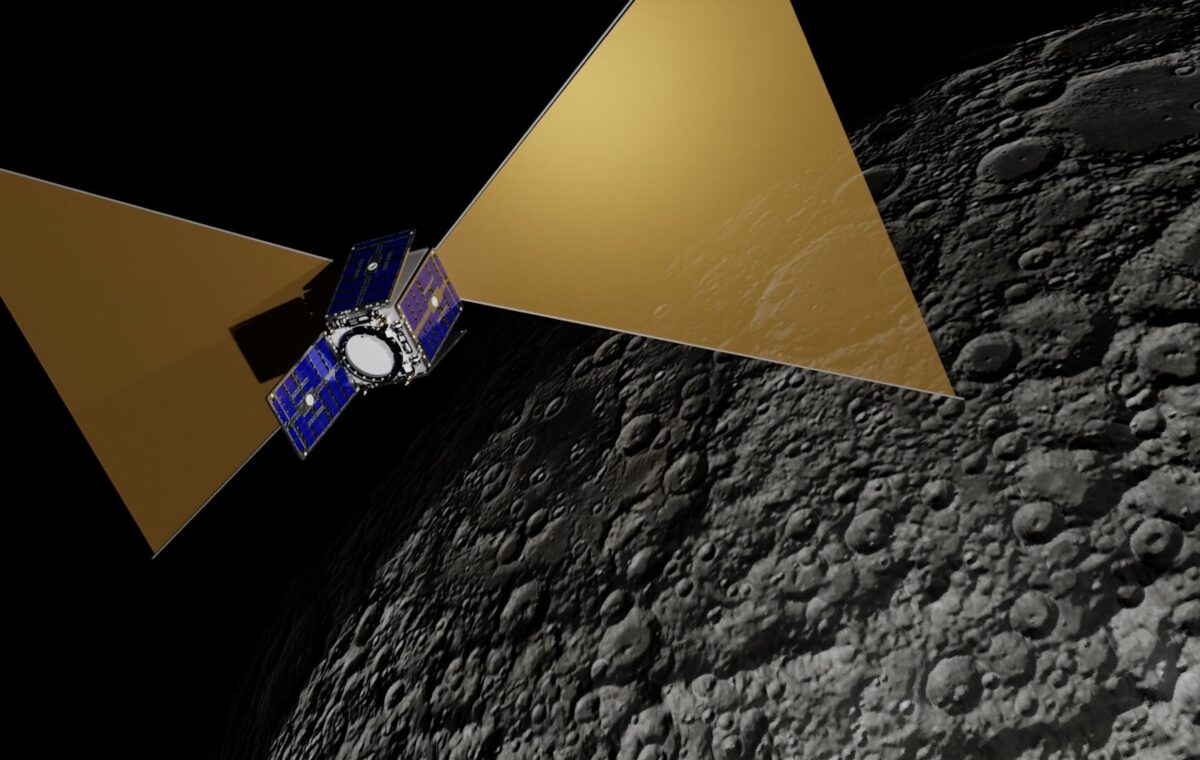
Astrophysicists know that the 21-cm line is made of hydrogen atoms birthed over 13.5 billion years ago, between the big bang’s afterglow and the cosmic dawn, but researchers have never directly observed the ancient period. A recently proposed solution may finally offer scientists a glimpse into the universe’s distant past. All that’s needed is a specially designed satellite about the size of a carry-on suitcase.
Obviously, there is a bit more to the plan than that. As an international team of astronomers explains in Nature Astronomy, their CosmoCube would travel to the moon, then use it as a shield from all of the planet’s noises. CosmoCube would then have about 40 minutes on the dark side of the moon (also called the far side) during every two-hour orbit, allowing it to amass around 1,000 hours of data from extremely low frequencies over an estimated two-year mission. Once compiled, the information could help astronomers begin to fill in the blanks for one of the least understood periods of the universe. One of these missing pieces involves dark matter, and how the mysterious force pulled hydrogen together to form the first stars and galaxies.
“There’s no other place where you can get the sort of shielding you need to detect such a faint signal, while at the same time looking at all of space,” Eloy de Lera Acedo, a study co-author and astronomer at the University of Cambridge, explained in a statement. “The far side of the moon is really the only option: It solves multiple problems at once, opening a clear window to the very early universe.”
While utilizing a lightweight radio antenna to listen for the universe’s earliest echoes, CosmoCube would also constantly reassess its location by alternating between referencing both onboard data and space around it. These consistent double-checks will help isolate any internal noise that could be confused with cosmic signals. Following its potential mission, astronomers would use mathematical models to remove even more excess foreground noise like galactic radio signals, as well as any lingering false flags.
“CosmoCube is aiming to do some ambitious science from a very small satellite in a challenging environment, and to do that requires some clever design techniques,” said Will Grainger, a study co-author and astronomer at the U.K.’s national space laboratory.
Grainger, de Lera Acedo, and their colleagues are already working with partners to build models of CosmoCube that they are now testing for thermal performance. With additional support, they believe they can have the satellite ready to launch within five years.
Still, time is of the essence. Both the United States and India have set their own sights exploring on the moon’s far side, meaning there is a good chance it won’t remain pristinely quiet for long.
2026 Popular Science Home of the Future Awards
39 products that will improve your everyday life.
Andrew Paul is a staff writer for Popular Science.