Doctors and nurses describe rise in fall injuries and other heat-related problems on top of stifling working conditions
“The big thing A&E doctors are seeing during extreme heat now is falls in the elderly,” says Dr Adrian Boyle, an A&E consultant at Addenbrooke’s hospital in Cambridge.
“During this summer’s five heatwaves I’ve seen elderly people get light-headed and dizzy and fall down a whole flight of stairs and break multiple bones, purely because of the heat. The last fall down stairs because of the heat resulted in multiple broken ribs, a wrist and her lower leg.
“These are often elderly people who are taking diuretics – water tablets, to get rid of body fluid – or drugs for high blood pressure. It’s a good thing, most of the time, to be taking them.
“But in this weather, that can make people feel very, very light-headed quickly. We’re seeing lots of people who feel very dizzy, some of whom have fallen over and hurt themselves as a consequence.
“I’m struck by how quickly such accidents happen and how long they take to get over. A wrist fracture can take a couple of months and a broken hip or lower leg more than six months.”
Boyle, who was president of the Royal College of Emergency Medicine from 2022 to 2025, is reflecting on the growing impact of unusually high temperatures on the health of the population and on the NHS, which treats the illness and injuries that extreme heat causes.
He is talking on Thursday as the UK records the hottest day – 38.1C (100.6F) – of a year in which the first two heatwaves alone, in May and June, together caused 2,877 deaths, according to UK Health Security Agency estimates – almost double the 1,504 heat-related deaths it recorded during the whole of 2025.
Figures published by NHS England on Thursday pinpointed July’s two heatwaves as a key reason why a record 2.5 million people attended A&E that month. They included people whose breathing problems and other underlying health conditions were exacerbated by the heat, it said.
“Extreme heat causes other problems too,” says Boyle. “I’ve seen a lot of older people end up in kidney failure because of dehydration. Also, the heat pushes some young people to go swimming in unsuitable and unsupervised rivers where they drown.
“People taking medication for severe mental illness can also be at increased risk as their medication can leave them unable to recognise that they’re getting hot.
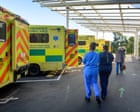
“And hot people stuck in the back of an ambulance outside an emergency department, who are already ill, can get either heat exhaustion or heatstroke as a result. Heatstroke is very dangerous.
“Our hospitals and ambulances are just not set up to look after people in the heat. There is minimal air conditioning in many of our hospital rooms, so ill people are being made hot and this just can’t be good for them.
“Lying on wipeable plastic mattresses in this weather is also very unpleasant, even on top of an ordinary sheet, as they get sweaty quickly.”
Our morning email breaks down the key stories of the day, telling you what’s happening and why it matters